Marseille is no longer just a city; it is a laboratory for the dissolution of the French Republic. As voters head to the polls for the first round of the 2026 municipal elections, the stakes have transcended local trash collection and urban planning. The race between incumbent Socialist Mayor Benoît Payan and National Rally (RN) challenger Franck Allisio is the final stress test for France before the 2027 presidential election. If Marseille falls to the far-right, it will not be because of a sudden ideological shift toward nationalism, but because of a systemic collapse in public safety and the utter failure of traditional governance to manage the city's "narcovault" economy.
The numbers are staggering. While national authorities point to a drop in homicides—from 49 in 2023 to 24 in 2024—the reality on the ground feels far more volatile. This statistical dip masks a horrifying trend: the "juvenilization" of violence. In 2024, a quarter of those imprisoned for murder or attempted murder in France were teenagers. In Marseille, the brutality has reached a fever pitch, evidenced by the 2024 killing of a taxi driver by a 14-year-old hitman and the incineration of another teenager who was stabbed 50 times. This is the environment in which Franck Allisio is thriving. He isn't just selling a platform; he is selling a survival instinct.
The Security Industrial Complex
Allisio’s campaign is built on a promise to triple the municipal police force and double the number of surveillance cameras. It is a classic "law and order" playbook, but in Marseille, it carries a different weight. The city has long been the epicenter of a nationwide cocaine surge, and the municipal police, who traditionally lack the heavy-duty powers of the National Police, have become a focal point of voter frustration.
Payan, leading the "Printemps Marseillais" (Marseille Spring) coalition of Socialists, Greens, and Communists, argues that security is a national prerogative. He is technically correct. However, technical correctness does not win elections in neighborhoods where drug-dealing spots, though halved from 160 to roughly 80, still dictate the flow of daily life. The incumbent is trapped between his progressive ideals and the visceral demand for a "clean-up" that his administration has struggled to deliver.
The Divided Left and the RN Stepping Stone
The National Rally has never controlled a French metropolis. Their largest prize to date is Perpignan, a city of 121,000. Winning Marseille, with its 880,000 residents, would be a seismic shift. Recent Ifop polling shows Allisio and Payan neck-and-neck in the first round, each pulling roughly 30% of the projected vote.
The math for the second round on March 22 is where the tragedy of the left unfolds. Payan’s victory depends entirely on a "Republican Front"—a grand alliance of all non-far-right parties. But the left is cannibalizing itself. Candidates from Jean-Luc Mélenchon’s radical La France Insoumise (LFI) have spent more energy attacking Payan’s "bourgeois" progressivism than Allisio’s hardline rhetoric.
- RN Growth: The party tripled its seats in Marseille during the 2024 snap general election, holding three of the city's seven parliamentary positions.
- The Allisio Strategy: By recruiting former allies of mainstream right-wing figure Martine Vassal into the "Union of the Right for the Republic" (UDR), Allisio has successfully blurred the lines between the traditional right and the far-right.
- The Macron Factor: Proposed electoral reforms to allow direct universal suffrage for mayors in Paris, Lyon, and Marseille have added a layer of procedural chaos to an already heated cycle.
The Economic Shadow of "Planète Mars"
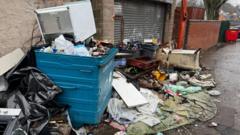
Beyond the sirens and the campaign posters lies an economic reality that neither side wants to fully address. Marseille’s core remains home to a socio-economically disadvantaged population, even as the city pulls in 5 million tourists annually. Urban renewal efforts have focused on making the port area a "competitive economic asset," but these "transformations" rarely trickle down to the housing projects of the northern districts.
Amine Kessaci, an anti-drug activist who lost two brothers to gang violence, has joined Payan’s team to bridge this gap. His focus is on the mundane but vital: fixed trash bins instead of mobile dumpsters and green spaces in concrete jungles. It is a gamble that basic dignity can outcompete the RN’s promised iron fist.
If the "earthquake" Payan fears occurs, it will be because the residents of the northern districts stayed home or because the middle-class voters in the southern districts decided that a far-right mayor is a price worth paying for the perception of order. The outcome in Marseille won't just decide who runs the City Hall on the Quai du Port; it will signal whether the French center-left has any remaining utility in a country increasingly defined by its fringes.
The first-round results tonight will provide the answer. Watch the turnout in the 13th and 14th arrondissements. That is where the "Future of France" will actually be decided.
Would you like me to analyze the specific polling shifts in the northern districts compared to the 2020 election?