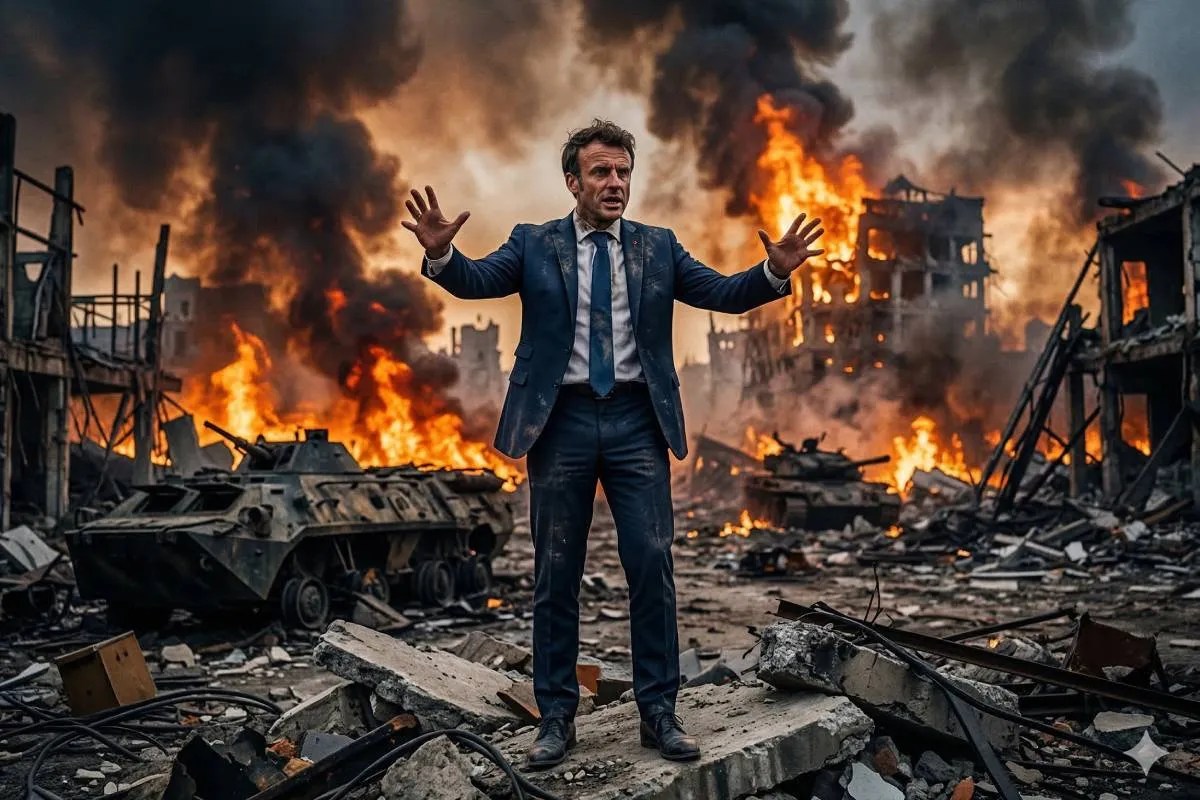
The headlines are screaming about a "breakthrough" because Emmanuel Macron spoke a few sentences about direct negotiations and "stopping the war." The mainstream media is salivating over the prospect of a European savior swooping in to mediate a conflict that has already defied every conventional diplomatic playbook. They see a statesman; I see a desperate attempt at relevance from a leader whose domestic influence is crumbling.
Diplomacy is not a magic wand. You do not stop a high-intensity kinetic conflict by simply inviting people to a table in Paris. To suggest that Macron’s latest "big statement" is the precursor to peace is not just optimistic—it is dangerously naive. It ignores the cold, hard mechanics of geopolitical leverage.
The Myth of the Neutral Mediator
The fundamental flaw in the "Macron as peacemaker" narrative is the assumption that France occupies a neutral, influential middle ground. In reality, France is a committed member of NATO and a primary supplier of Caesar self-propelled howitzers and SCALP missiles.
You cannot be the arms dealer and the priest at the same time.
True mediation requires a level of perceived impartiality that no Western power currently possesses in the eyes of the Kremlin. When Macron talks about "direct talks," he isn't offering a new path; he is repeating a script that has failed consistently since the 2014 Minsk agreements. I have watched diplomatic missions burn through millions of euros in travel and security costs just to produce a "joint statement" that isn't worth the recycled paper it’s printed on.
The "lazy consensus" among pundits is that "talking is always better than fighting." In a vacuum, sure. In a war of attrition where both sides believe they have a path to victory, talking is merely a tactical pause used to rearm. By platforming the idea of "imminent peace" through French intervention, the media provides cover for the status quo rather than challenging the reasons why the war continues.
The Mathematics of Stalemate
Let’s look at the numbers that the "peace" articles conveniently omit. Peace occurs when the cost of continuing the war exceeds the cost of the concessions required to end it.
We use a basic expected utility model to understand this:
$$U_i = p_i(w)V_i - C_i$$
Where:
- $U_i$ is the utility of war for actor $i$.
- $p_i(w)$ is the probability of winning.
- $V_i$ is the value of the territory or political objective.
- $C_i$ is the cost of the conflict.
Currently, $p_i(w)V_i$ remains high for both combatants. No amount of French rhetoric changes the value of $C_i$ enough to shift the needle. Macron’s statements are "cheap talk"—a technical term in game theory for communication that does not directly affect the payoffs of the game. If the talk doesn't come with a massive shift in military aid or a catastrophic sanction package that actually bites, it is noise.
Why Domestic Weakness Drives International Posturing
Why is Macron doing this now? Look at his approval ratings. Look at the fractured state of the French National Assembly.
When a leader cannot pass a budget without a riot, they fly to an international summit. It is the oldest trick in the political playbook: the "Rally 'Round the Flag" effect, but applied to the global stage. By positioning himself as the man who can "stop the war," he attempts to transcend the mundane, grinding failures of French domestic policy.
I have seen this pattern in corporate boardrooms for a decade. A CEO who is failing to hit quarterly targets will suddenly pivot to a "visionary" global expansion plan or a high-profile ESG initiative. It’s a distraction. Macron’s "peace initiative" is the geopolitical equivalent of a failing tech firm announcing it’s now an "AI-first" company to pump its stock price. It’s a vanity project disguised as a humanitarian mission.
The Wrong Question: "Can He Stop the War?"
People are asking, "Will Macron’s statement lead to a ceasefire?" This is the wrong question. It assumes the war is a misunderstanding that can be cleared up over espresso at the Élysée Palace.
The right question is: "What incentive does either side have to listen to France?"
The answer is: Very little.
- For Ukraine: France has been criticized for being "slow and low" on hardware compared to the UK, Poland, or the US.
- For Russia: France is seen as a junior partner in a US-led coalition, incapable of making independent security guarantees that would stick.
If you want to understand when the war ends, stop reading the transcripts of presidential speeches. Instead, watch the production capacity of 155mm artillery shells. Watch the sovereign wealth fund depletion rates. Watch the internal stability of the logistics chains. These are the variables that dictate the end of a war. A "big statement" from Paris is a footnote, not a chapter.
The Dangerous Fallacy of "Direct Talks"
The competitor article treats "direct talks" as a breakthrough. In reality, direct talks without a pre-negotiated framework are a recipe for escalation. When high-level leaders meet and fail, they have nowhere left to go but up the escalation ladder.
Imagine a scenario where a summit is held, Macron smiles for the cameras, and forty-eight hours later, the frontline moves five kilometers. The diplomatic failure becomes a catalyst for more aggressive military action to "prove a point."
We have seen this before. The obsession with "summits" ignores the "shuttle diplomacy" that must happen at the sub-ministerial level for months before a president should even open his mouth. Macron is skipping the work and going straight to the photo op. It is the height of "main character syndrome" in international relations.
Stop Buying the "Savior" Narrative
The hard truth that nobody admits is that Europe is currently a spectator in its own security arrangement. The power to end this conflict resides in Washington and Moscow, with Beijing holding a significant tie-breaking vote. Paris is a secondary actor trying to convince the audience it’s the lead.
If you are waiting for a European president to "order" a ceasefire, you are going to be waiting for a long time. Peace will be ugly, it will be messy, and it will likely be negotiated by people who aren't looking for a legacy-defining headline in Le Monde.
The next time you see a "breaking news" alert about a leader's "big statement" on peace, ask yourself one thing: Does this change the inventory of ammunition on the ground? If the answer is no, then the "news" is just entertainment.
Stop looking for a hero. Start looking at the supply chains. Everything else is theatre.
The war doesn't care about Macron's legacy. It only cares about the math of the meat grinder. If you want to be an informed observer, stop listening to the speeches and start counting the shells. That is the only language this conflict speaks.
Get used to the silence of the diplomats; it’s the only time they are actually being honest.