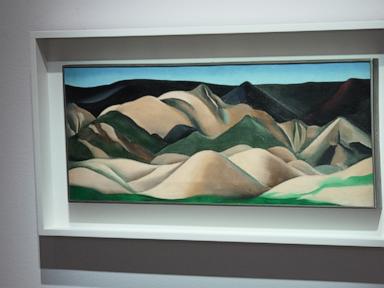
Imagine cleaning out a cramped New York City apartment and pulling a dusty canvas from the back of a closet, only to realize it's an authentic Georgia O'Keeffe painting headed straight for the auction block. That exact scenario captures the dream of every estate liquidator, art appraiser, and casual thrifter across the country.
It sounds like an urban legend. It isn't. In related news, we also covered: What Sergey Lavrov Really Meant With That Orchestra Fable About European Negotiators.
When a Georgia O'Keeffe painting buried in a New York apartment closet goes up for auction, the story immediately grabs headlines because it hits a nerve. People love the idea that priceless American modernism is still hiding behind winter coats and old vacuum cleaners. Yet the actual process of taking an unrecorded or long-forgotten O'Keeffe from a dark Manhattan closet to a major auction house like Sotheby's, Christie's, or Bonhams is grueling, expensive, and full of traps that trip up unprepared heirs.
Why Georgia O'Keeffe Works Still Turn Up in New York Apartments
New York wasn't just a stopover for Georgia O'Keeffe. It was the engine of her early career. Reuters has provided coverage on this important subject in extensive detail.
Between 1918 and the late 1920s, O'Keeffe lived and worked in Manhattan, exhibiting regularly at Alfred Stieglitz's galleries—first 291, then The Intimate Gallery, and later An American Place. Stieglitz was fiercely selective about who bought her work, often selling directly to friends, writers, physicians, and quiet New York intellectuals rather than flashy industrialists.
Those buyers lived in Upper West Side pre-war co-ops, Greenwich Village townhouses, and Midtown apartments. Many of those families held onto their collections for generations.
Over decades, paintings get rotated off walls during renovations. Sometimes an older relative wraps a smaller oil on canvas or charcoal drawing in brown paper, tucks it onto a top closet shelf to protect it from sunlight, and passes away without leaving a detailed inventory. When the next generation clears out the apartment, they find a signature they vaguely recognize from a college art history class.
Honestly, New York real estate turnover is one of the biggest drivers of fresh-to-market art discoveries. When a rent-stabilized apartment or a fifty-year family residence finally gets emptied, the contents hit the light of day all at once.
What Makes a Closet Discovery Valuable at Auction
Not every O'Keeffe carries the same eight-figure price tag. If you find an unsigned pastel sketch from 1916, you aren't looking at the same market tier as a 1920s floral oil or a New Mexico landscape from Ghost Ranch.
Auction specialists evaluate a newly surfaced Georgia O'Keeffe based on four ruthless criteria:
- Freshness to the market: Collectors pay a massive premium for works that haven't been seen publicly in fifty or eighty years. Museum curators and private buyers hate over-shopped paintings that bounce between galleries every few years.
- Subject matter: Her iconic enlarged flowers, New York skyscrapers, and bleached desert skulls command the highest prices. Early abstract watercolors and charcoals still bring strong six- and seven-figure sums, though they appeal to a narrower group of purists.
- Condition issues from poor storage: Closets are terrible environments for fine art. Fluctuating radiator heat, humidity spikes, and accidental knocks from hangers can cause paint flaking, canvas punctures, or acidicmat burn on paper works.
- Provenance and documentation: A clean paper trail linking the current owner back to Stieglitz's gallery or the Georgia O'Keeffe Museum's catalogue raisonné makes bidding fierce. Without that paper trail, estimates drop fast.
For context, the ceiling for O'Keeffe's market was famously set in 2014 when Jimson Weed/White Flower No. 1 sold at Sotheby's New York for $44.4 million, setting the auction record for any female artist at the time. Even smaller, more intimate works discovered in private estates routinely carry pre-sale estimates ranging from $500,000 to several million dollars, depending on their period and medium.
The Authentication Gauntlet Nobody Talks About
Finding the painting is the easy part. Proving it's real is where most people lose their minds.
If you walk into a regional auction house with a suspected O'Keeffe, they won't just take your word for it, even if the signature looks dead-on. Forgers have been copying O'Keeffe's fluid brushwork and minimalist compositions for decades. In fact, fake O'Keeffe watercolors and small oils are among the most common traps in the American secondary art market.
Before any reputable auction house prints a catalog entry, the painting has to survive intense scrutiny.
Checking the Catalogue Raisonné
The first stop is Georgia O'Keeffe: Catalogue Raisonné, compiled by Barbara Buhler Lynes and published by Yale University Press in conjunction with the National Gallery of Art and the Georgia O'Keeffe Museum. This multi-volume reference documents every known work by the artist.
If your closet painting is already listed in the catalogue raisonné with a known history up until, say, 1954, you're in great shape. You simply have to bridge the ownership gap between 1954 and today.
If the painting isn't in the catalogue raisonné at all? You're in for a long, uphill battle.
Forensic Testing and Backing Labels
Appraisers immediately flip a newly found painting around before they even study the front. The back of a canvas—the verso—tells the real story.
Specialists look for specific physical clues:
- Original exhibition labels from An American Place or the Museum of Modern Art
- Stieglitz's handwritten inventory numbers or framing notes
- Period stretcher bars and linen weaves consistent with what O'Keeffe bought in New York or Abiquiú
- Pigments that match her known palette without modern synthetic anachronisms
I've seen families get excited over a signature on the front, only for an appraiser to spot a staple gun pattern on the stretcher bars that didn't exist until the 1960s. That single detail kills a supposed 1920s attribution in ten seconds flat.
How Closet Storage Damages Fine Art (And Hurts the Final Hammer Price)
People assume keeping a painting in a dark closet preserves it. Light fades pigments, right? So darkness must be safe.
Wrong. Darkness protects against UV fading, sure, but New York apartment closets come with pre-war steam radiators right outside the door. Every winter, those pipes hiss and bake the apartment air to desert-dry levels. Every summer, Manhattan humidity swells the wood stretcher bars and relaxes the linen canvas.
That constant expansion and contraction cracks oil paint like dry mud.
When a damaged painting goes to auction, buyers immediately factor restoration costs into their bids. Worse yet, heavy-handed overpainting by an amateur restorer years earlier can permanently depress the value. Major auction houses almost always recommend leaving a closet find completely untouched until their specialists examine it. Cleaning a canvas with household products—or even a damp cloth—can strip delicate glazes that O'Keeffe applied intentionally.
Common Mistakes Heirs Make After Finding a Valuable Painting
When an estate discovery happens, panic and greed usually show up right behind excitement. Families make predictable errors that cost them hundreds of thousands of dollars at the podium.
- Rushing to a local pawn shop or general estate buyer: General liquidators want to clear an apartment in forty-eight hours. They might offer $5,000 cash on the spot for a drawing worth $400,000 because they don't want to spend six months authenticating it.
- Getting competing auction houses into a sloppy bidding war too early: Shop the work quietly to two or three major specialists in American Art. If you blast photos to twenty dealers across Manhattan, you burn the "freshness" of the painting before it ever hits an auction catalog.
- Ignoring tax and estate paperwork: If the painting came from a deceased relative's estate, the IRS cares deeply about fair market value at the date of death. Selling a multi-million-dollar O'Keeffe without a qualified appraisal compliant with Uniform Standards of Professional Appraisal Practice (USPAP) rules creates an immediate audit nightmare.
- Assuming the pre-sale estimate is a guaranteed payout: Auction estimates don't include seller's commissions, insurance fees, photography charges, or conservation expenses unless you negotiate them upfront. On a seven-figure painting, seasoned sellers negotiate zero seller's commission and even ask for a share of the buyer's premium.
Why Auction Houses Love a Good Closet Backstory
Art market insiders are cynical, yet even they know that a great discovery narrative drives bidding.
When an auction house markets a Georgia O'Keeffe painting found tucked away in a New York closet, the press coverage does half the promotional work for free. Wealthy collectors don't just buy pigments on linen. They buy the trophy, the provenance, and the story they get to tell guests over dinner.
A painting with a romantic New York provenance—especially one tied to the city where O'Keeffe painted Radiator Building—Night, New York and her East River views—carries cultural weight that pure financial assets never match.
What to Do If You Suspect You Found an Unrecorded Artwork
If you're clearing out an older family home and pull an unfamiliar painting from a closet, attic, or storage unit, slow down immediately.
Take clear, high-resolution photographs of the front, the back, the signature, and every single label or sticker on the frame in natural daylight. Do not remove the canvas from its frame, do not wipe dust off the painted surface, and do not store it near a heating vent or damp basement while you wait.
Write down everything you know about how your family acquired the piece, including old letters, canceled checks, insurance schedules, or photographs showing the painting hanging on a relative's wall decades ago. Reach out directly to the American Art department at a major auction house or a certified appraiser accredited by the Appraisers Association of America before speaking to local dealers.