You smell the asphalt first. Then the dust. By ten in the morning, the sky over the Third Ring Road loses its blue entirely, flattening into a bruised, milky gray that presses down on the shoulders of every commuter shuffling toward the subway.
For decades, the enemy had a face. It looked like coal smoke billowing from iron chimneys. It smelled like sulfur and the grinding gears of a manufacturing boom that pulled hundreds of millions out of poverty while choking the air they breathed. Governments fought back with iron fists. Factories moved. Coal stoves were banned. Billions of trees went into the ground.
An army of green. Millions of saplings planted by hand along highways, clustered in parks, spilling down mountain slopes in a massive, decades-long campaign to throw a living shield around a parched capital.
Everyone cheered the trees. Why wouldn't they? Trees mean shade. Trees mean oxygen. Trees mean nature fighting back against the gray machinery of urbanization.
Then came the afternoon heat.
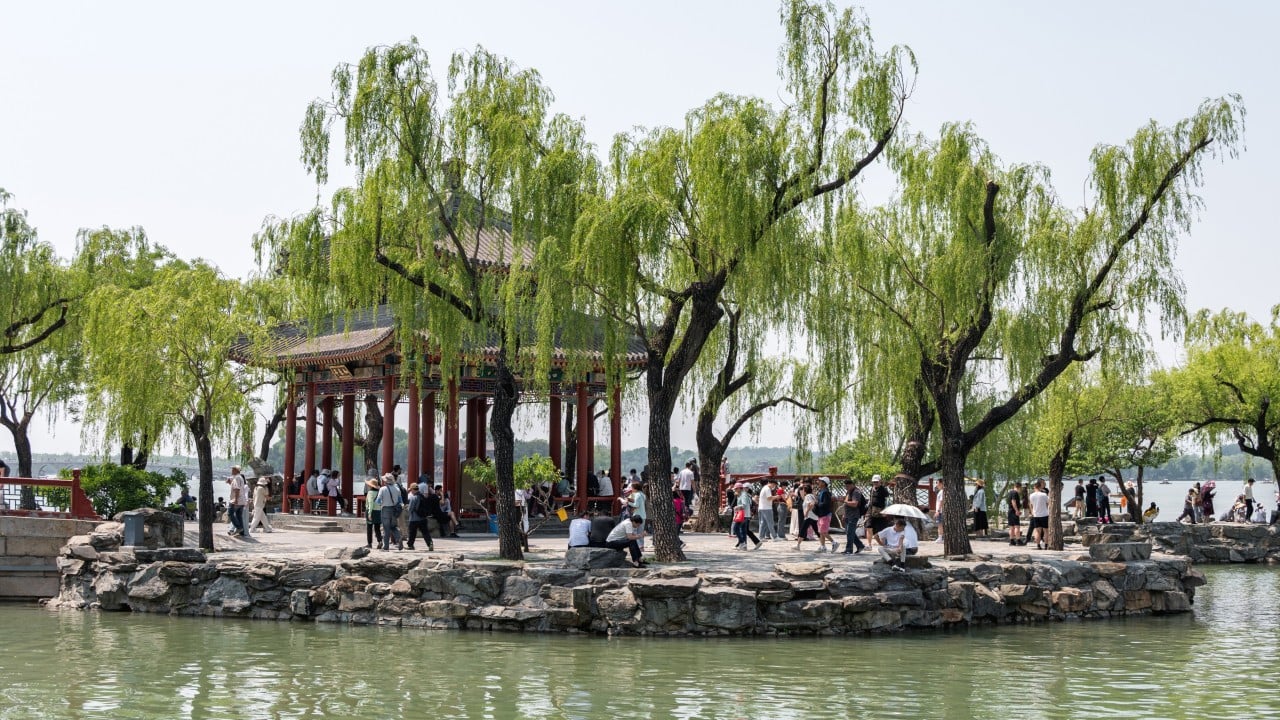
Walk beneath the canopy of a sprawling poplar or a sturdy willow on a scorching July afternoon in Beijing, and you might notice something stinging your eyes. It is not factory soot. It is not exhaust from the bumper-to-bumper traffic idling on the concrete below. It is the very thing you walked into the shade to escape.
The air is burning.
Chinese scientists recently turned their instruments toward an unexpected culprit. They looked up at the leaves. What they found up there in the quiet rustle of green foliage upended a fundamental assumption of modern urban planning.
Trees bleed chemicals. Not poison, but biogenic volatile organic compounds, known simply as BVOCs.
Imagine a massive, sprawling kitchen where millions of invisible bakers are constantly tossing flour into the air. That is a forest on a hot day. Species like poplars, oaks, and willows pump out organic molecules like isoprene and terpenes to communicate, defend themselves against pests, and cope with thermal stress. They are sweating in the stifling heat of a concrete basin.
In a pristine wilderness, these organic compounds float up into the atmosphere, mix with clean air, and vanish into the ecological background hum.
Beijing is not a pristine wilderness.
Beijing is a cauldron. It is a dense bowl of concrete and steel trapped by mountain ranges that lock the air in place, filled to the brim with nitrogen oxides spilled from millions of combustion engines and industrial boilers.
Chemistry does not care about your intentions. It does not pause to appreciate that you planted a park to save the climate. When tree-born volatile organic compounds meet nitrogen oxides under the heavy, merciless glare of a summer sun, a reaction kicks off. Ultraviolet radiation acts as the match.
Ozone forms.
Not the protective shield high up in the stratosphere that saves us from solar radiation. Ground-level ozone. A corrosive, lung-searing gas that burns delicate respiratory tissue, triggers asthma attacks, and tarnishes the bright promise of an ecological revival.
Consider what happens next. The very lungs you planted to clean the city are accidentally helping to brew the smog that forces children indoors.
It is a bitter pill. For years, municipal planners measured success by the square kilometer of canopy cover. More green meant a healthier index. Trees were the heroes of the blueprint. But the atmosphere is a complex, reactive chemical soup, and nature has its own agenda.
Science is rarely tidy. We spent generations simplifying the natural world into a binary code: industry is bad, nature is good. Factories make pollution; trees absorb it.
The reality is messier. Urban trees under extreme heat stress crank up their emissions. A poplar baking in the urban heat island effect releases significantly more reactive compounds than the same tree growing in a cool, breezy mountain valley. The city itself forces the trees to misbehave.
The stakes are invisible, but they are heavy. Ground-level ozone is notoriously difficult to capture with traditional air filters. You cannot simply sweep it off the pavement. It requires controlling the precursor ingredients. Yet while tailpipe emissions and industrial outputs have dropped across eastern China, summer ozone levels have stubbornly refused to follow the downward curve.
Part of the ghost in the machine has been breathing right above our heads.
Does this mean we should tear down the parks? Absolutely not. That would be like smashing your compass because you do not like the direction it points. Urban trees provide irreplaceable cooling effects, reducing surface temperatures by several degrees, intercepting particulate matter, and offering psychological sanctuaries in a hyper-dense metropolis.
Instead, the discovery forces a radical shift in how we engineer the future of our cities.
Urban forestry can no longer be a blunt instrument. You cannot just buy the cheapest, fastest-growing saplings in bulk and scatter them everywhere. Landscape architects now face a sophisticated puzzle. Low-emitter species must take precedence in urban cores. Poplars and certain high-emitting willows, once favored for their rapid growth and resilience, may need to yield ground to species that keep their chemical secrets to themselves.
The air tells a story of unintended consequences. Every policy choice, every sapling planted in the earth, every asphalt road poured under the sun interacts in ways we are only beginning to decode.
Look up the next time you walk down a sun-drenched city avenue. The leaves whisper in the wind, a brilliant, stubborn shade of green, working through the heat, reacting with the world we built around them, quietly shaping the air we share.