The sound did not come from the sky. It came from the marrow of the earth, a low-frequency punch that displaced the air in the lungs of every passerby within three blocks. Kyiv is a city that has learned to translate the language of sudden noises, but this specific roar—sharp, localized, and devastatingly intimate—belonged to a different category of dread. It wasn't the distant thunder of an intercepted cruise missile. It was the sound of a Tuesday afternoon being ripped in half.
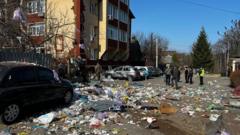
Shota Rustaveli Street is usually a place of caffeine and commerce. It is a vein of the city where the pulse of normalcy beats loudest. Then, at 2:40 PM, the debris began to rain.
Two people were walking. They were not soldiers. They were not symbols. They were simply two humans moving through a Tuesday, perhaps thinking about a deadline or a grocery list or the biting chill of a Ukrainian spring. In an instant, they became the focal point of a forensic investigation and the latest entries in a ledger of national trauma. One moment they were citizens; the next, they were "the injured," victims of what authorities are now calling a calculated act of terror.
The smoke cleared to reveal a jagged geometry of shattered storefronts and twisted metal. But the real damage is never in the masonry. It is in the invisible tether that holds a community together. When a bomb goes off in a capital city, the blast radius isn't measured in meters. It is measured in the sudden, sharp intake of breath from a mother three miles away who realizes her son’s office is around the corner.
The Anatomy of a Shattered Tuesday
Law enforcement moved with the practiced, grim efficiency of a nation that has seen too much. Yellow tape appeared like a sudden, neon spiderweb. SBU investigators crouched over the blackened asphalt, their gloved hands picking through the gray dust for the "telltale" signs—the specific chemical residue, the fragments of a detonator, the signature of the maker.
Security services don't use the word "terrorist" lightly, even in a war zone. To call an explosion a terrorist attack is to acknowledge a specific, malicious intent. It suggests that the target wasn't a building or a bridge, but the very concept of safety. By labeling the Rustaveli blast as such, Ukrainian authorities are pointing to a deliberate attempt to bleed the civilian psyche.
Imagine, for a moment, the perpetrator. This is a hypothetical exercise in understanding the stakes. They did not choose a military barracks. They chose a street lined with cafes. They chose a time when the foot traffic peaks. The goal of such an act isn't tactical victory; it is the erosion of the mundane. They want you to look at your neighbor with suspicion. They want the sound of a car backfiring to feel like a heart attack.
The Invisible Stakes of Normalcy
There is a specific kind of bravery required to live in Kyiv right now, and it isn't the kind found on a battlefield. It is the bravery of the barista who sweeps up the glass and reopens the shop two hours later. It is the courage of the office worker who chooses to walk the same route home on Wednesday.
The statistics will tell you that two people were hospitalized. They will tell you the caliber of the explosives or the estimated weight of the charge. What the data misses is the weight of the silence that followed the blast. For a few minutes, the city held its breath. The traffic stopped. The birds, usually indifferent to human folly, vanished from the eaves.
In those minutes, the "terror" in the "terrorist attack" is at its peak. It is the period where the unknown dominates the known. Was there a second device? Is this the start of a wave? Who was standing next to me?
But then, the sirens fade. The medical teams whisk the wounded away—one in critical condition, fighting a private war against shock and internal trauma—and the city begins to stitch itself back together. This is the part the attackers always miscalculate. They see a blast as a subtraction, a removal of peace. They fail to see it as a catalyst for a different, harder kind of resolve.
Beyond the Yellow Tape
The investigation into the Shota Rustaveli bombing will eventually produce a report. There will be grainy CCTV footage of a shadowed figure or a parked car. There will be a definitive statement on the origin of the components. We will learn if it was a "lone wolf" or a state-sponsored cell.
But for the people of Kyiv, the technical details are secondary to the emotional reality. To live through a terrorist attack in the middle of a larger war is to experience a double-exposure of tragedy. It is an acknowledgment that there is no "front line" when the goal of the enemy is the total destabilization of the human spirit.
Consider the glass. Thousands of tiny, translucent diamonds scattered across the pavement. Each shard represents a window that was once a barrier between the warmth of a shop and the cold of the street. Now, that barrier is gone. The wind whistles through the gaps. It feels like a metaphor for the vulnerability we all try to ignore. We pretend that the walls are thick and the world is predictable because the alternative is paralysis.
The authorities speak of "anti-terrorist measures" and "heightened security," but these are clinical terms for a very visceral problem. You cannot police every inch of a sprawling, ancient city. You cannot x-ray every backpack or vet every shadow. The only real defense against the intent of a bomber is the refusal to be transformed by the bomb.
The two individuals currently lying in hospital beds are the immediate victims, but the intended victim was the city itself. The blast was a question asked in fire and steel: "Are you afraid yet?"
The answer isn't found in the official press releases or the stern faces of the investigators. The answer is found in the sound of the street an hour after the tape was removed. It is the sound of tires on asphalt, the murmur of distant conversation, and the defiant, rhythmic click of heels on the very sidewalk where the glass once lay.
The city does not forget the fire, but it refuses to let the smoke blur its vision. On Shota Rustaveli Street, the sun began to set, casting long, amber shadows over the patch of scorched earth. The yellow tape fluttered in the breeze, a temporary scar on a permanent landscape. By tomorrow, the smell of cordite will be gone, replaced by the scent of roasted beans and the damp earth of a city that has decided, quite simply, to keep walking.