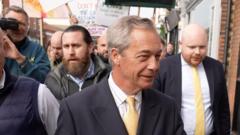
You don't just "walk about" when you're the most polarizing man in British politics. Nigel Farage learned that the hard way—again—during the 2024 general election campaign. In the seaside air of Clacton-on-Sea, what started as a triumphant return to the front lines of Westminster politics ended with a banana milkshake dripping off a dark blue suit. It's a scene we've seen before, but it's not just about the dairy. It’s about the physical wall that's growing between politicians and the public.
When Farage abandoned his walkabout in June 2024, it wasn't a snap decision. It was a reaction to a recurring theme of his career: the milkshake. Victoria Thomas Bowen, a 25-year-old from the area, decided that seeing Farage leave the Moon and Starfish Wetherspoons was her moment. She threw a McDonald’s drink. He looked stunned. The cameras caught everything. This wasn't some spontaneous debate; it was a targeted hit that forced the Reform UK leader back onto his bus.
The cost of a milkshake in Clacton
If you think this is just harmless protest, the courts disagree. Throwing things at people is assault. Period. Thomas Bowen eventually pleaded guilty to assault by beating and criminal damage. She got a 13-week prison sentence, suspended for a year, and had to pay for the cleaning of a security guard's jacket. That’s a heavy price for a five-second viral clip.
But the real cost is to the campaign trail itself. Farage is a "people person" by trade. He wins by shaking hands, holding pints, and leaning over fences to chat with voters. When he has to abandon a walkabout, he loses his best weapon. The 2024 campaign in Clacton saw him retreat more and more to the top deck of a battle bus. It’s harder to throw a drink ten feet up into the air than it is to splash someone on the pavement.
Why the bus became a fortress
A week after the Clacton incident, Farage was in Barnsley. This time, he didn't even get off the bus. He stayed on the open-top deck, waving to supporters while protesters yelled from below. It didn't stop the projectiles. Josh Greally, 28, threw a coffee cup and another object from a nearby construction site. He missed, but the message was clear.
- Security teams are tighter. You won't see Farage without a ring of heavy-set men in suits anymore.
- Walkabouts are shorter. They're often unannounced or kept to "safe" zones where crowds can be managed.
- The "bubble" is back. We complain about politicians being out of touch, but when we throw things at them, they hide in armored cars and bus decks.
Farage himself said these incidents make him "thoughtful." Honestly, it would make anyone thoughtful. If you're wondering why your local MP won't hold an open surgery in a pub, look at the footage from Clacton.
The shift in political engagement
Politics in 2026 hasn't gotten any friendlier. We’ve moved from heckling—which is a grand British tradition—to physical intimidation. Whether you love Farage or loathe him, the result is the same: less access.
When a candidate abandons a walkabout, the local voters are the ones who lose. They don't get to ask about the lack of GPs or the state of the high street because the candidate is busy wiping banana flavoring off their lapel. Farage ended up winning Clacton with 46% of the vote, so the "milkshaking" didn't stop his momentum. If anything, it gave him a victim narrative that his base absolutely loves.
Tactics for a safer campaign
If you're following a campaign or running one, the "Farage method" of staying on the bus is becoming the standard.
- High-vantage points: Stay on the vehicle. It creates a literal and figurative distance.
- Private venues: Move rallies from the street to ticketed halls or private clubs.
- Digital first: Use social media to bypass the need for physical crowds altogether.
Don't expect to see much of "the people's politician" on the actual streets anymore. The bus door is staying shut. If you want to engage with the next big political movement, you're better off finding them on a screen than waiting on a street corner with a cup of coffee.