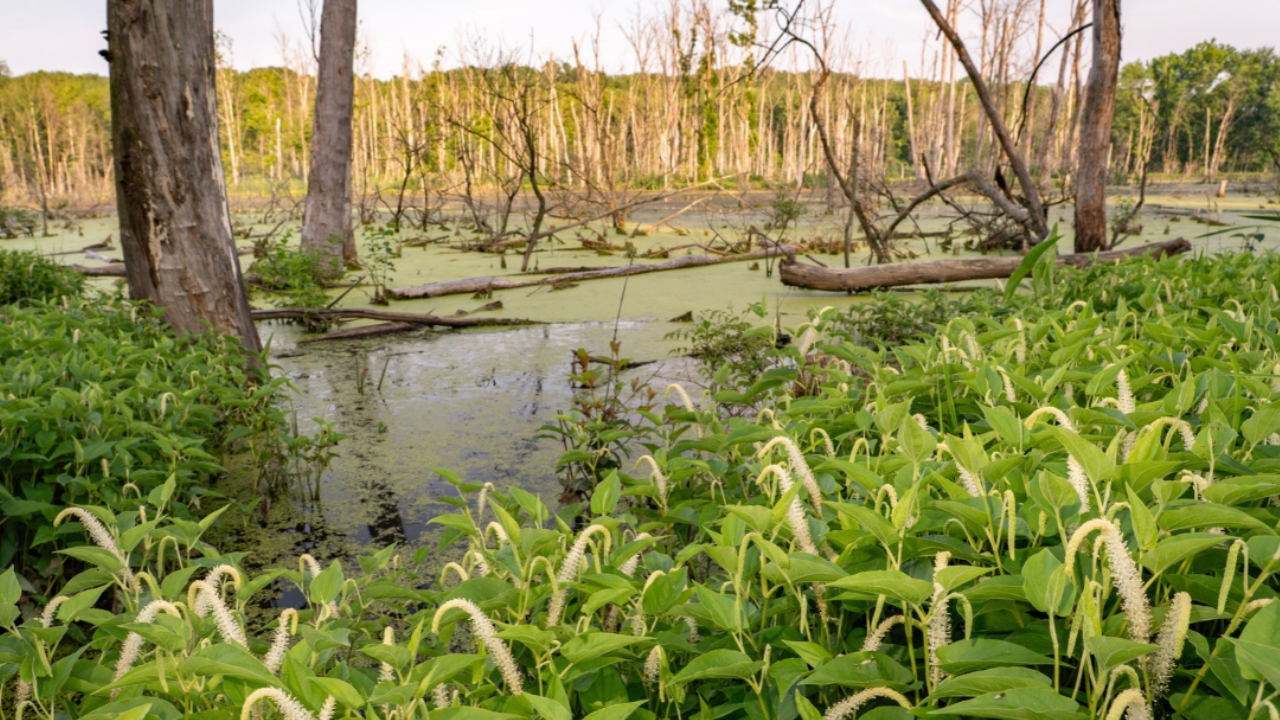
Listen closely at the edge of an Indiana marsh in late April, right as the dusk turns the color of a bruised plum, and you might hear a sound that resembles a heavy stone dropping into deep water.
Plunk.
It is the call of the northern crawfish frog. For eleven months of the year, this amphibian is practically a ghost, living deep underground inside the abandoned mud burrows of crayfish, hidden from the sun, the hawks, and the relentless churn of modern agriculture. When the spring rains finally saturate the clay and gravel of the Midwest, these frogs emerge for a few frantic weeks to breed in fishless, temporary ponds. Then they vanish again.
For decades, nobody really paid attention to the ghost in the mud. Why would they? It isn’t a bald eagle soaring over a canyon, and it isn’t a grizzly bear halting traffic in Yellowstone. It is a chunky, spotted frog no bigger than a closed fist. Yet, when state wildlife officials placed this unassuming creature on Indiana’s endangered species list, that single bureaucratic stroke of a pen triggered a massive chain reaction. Today, 3,950 acres of southern Indiana prairie, wetland, and forest are permanently protected, and a brand-new public wildlife area is open to anyone willing to lace up their boots and walk into the tall grass.
It sounds like a fairy tale. It wasn’t. It was a street fight fought with topographic maps, state funding grants, and the stubborn refusal to let another piece of the American heartland get paved over for a strip mall or drained for row crops.
The Invisible Erasure Of The Midwest
To understand why 3,950 acres matters, you have to understand what Indiana used to look like before the plow. Two hundred years ago, the state wasn't just endless miles of corn and soybeans. It was a sprawling, interconnected mosaic of tallgrass prairies, oak savannas, and black-soil wetlands. Rain didn't rush off the land into polluted drainage ditches; it soaked into the earth like a sponge, filtered through the roots of big bluestem grass that grew taller than a horse and rider.
Then came the tile drains. Then came the highways.
Today, Indiana has lost more than eighty-five percent of its historic wetlands and nearly ninety-nine percent of its original tallgrass prairie. When you drive down Interstate 65, what looks like pastoral tranquility is actually an ecological desert. A monoculture. A place where almost nothing can live except the crop planted there and the insects engineered to eat it.
I remember standing on the edge of a newly drained marsh in southwestern Indiana ten years ago, watching an excavator scoop black peat into a dump truck. The air smelled like dead roots and diesel exhaust. A local farmer stood beside me, leaning against the hood of his pickup, squinting at the trench. He wasn't a villain; he was just trying to squeeze forty more tillable acres out of a wet corner of his property to pay off a combine harvester. When I asked him if he ever saw frogs out there anymore, he shrugged. "Used to hear them so loud in the spring you couldn't hear the television," he said. "Haven't heard a peep since the nineties."
That quietness is the invisible stake. We don't notice extinction when it happens in centimeters and acres. We notice it twenty years later when the silence becomes absolute, when the groundwater drops, and when the heavy spring rains have nowhere to go except into our basements.
How A Small Listing Changes The Rules
In conservation, scale is everything, and law is the lever. When the Indiana Department of Natural Resources officially listed the northern crawfish frog as a state-endangered species, it changed the legal math overnight.
Think of an endangered species listing like a smoke alarm in a crowded theater. Before the alarm goes off, people ignore the faint smell of burning wire. Once it rings, everyone has to stop, look at the exits, and change their behavior. Suddenly, state and federal conservation funds—specifically dollars generated from excise taxes on hunting and fishing gear under the Pittman-Robertson Act, alongside state heritage trust funds—could be legally unlocked and aimed directly at the frog’s remaining strongholds in southwestern Indiana.
Consider a hypothetical scenario to see how this works on the ground. Imagine a family owning 800 acres of reclaimed coal mine land and marginal wetland in Pike or Sullivan County. The soil is too wet for reliable corn yields, and the property taxes keep climbing. A commercial developer offers them a quick buyout to turn the tract into a gravel pit or a solar farm. Without state conservation funding, that family takes the check every single time. You can't eat scenery.
But because the crawfish frog is on the endangered list, the state wildlife agency can step up to the kitchen table with a competitive, fair-market cash offer. They can buy the land outright, not by seizing it through eminent domain, but by outbidding the bulldozers.
That is precisely how the 3,950-acre puzzle came together. Piece by piece, parcel by parcel, conservationists stitched together former surface-mined lands, fragmented bottomland hardwoods, and wet prairies into a single, contiguous sanctuary.
Inside The New Wildlife Area
Step onto the newly opened public property today, and the scale of the victory hits you in the chest. 3,950 acres is more than six square miles of breathing room. To put that in perspective, it is nearly five times the size of New York’s Central Park, dropped right into the rolling hills and flat river bottoms of southern Indiana.
The terrain here is rugged, scarred in places by the coal-mining history of the twentieth century, yet healing in ways that feel almost miraculous. Deep, clear strip-mine pits sit beside shallow, ephemeral wetlands that dry up completely by August. Those seasonal puddles are the secret weapon. Because they dry out every summer, predatory fish like bass and bluegill cannot survive in them. When the spring rains refill those depressions in March, they become safe nurseries for amphibians.
Walk the perimeter of one of these vernal pools in early spring, and the sheer density of life is overwhelming.
- The Amphibians: Alongside the endangered crawfish frogs, the water churns with spring peepers, chorus frogs, and eastern tiger salamanders.
- The Grassland Birds: In the upland prairie sections, Henslow’s sparrows and northern bobwhite quail—birds whose populations have plummeted across North America—nest in the dense thatch of native grasses.
- The Pollinators: Wild bergamot, black-eyed Susans, and milkweed draw monarch butterflies and native bumblebees by the thousands.
For the public, the opening of this wildlife area isn't just a win for biologists with clipboards. It is a win for the kid from Terre Haute or Evansville who has never seen the Milky Way without streetlights washing it out. It is a win for the bowhunter tracking white-tailed deer through frost-covered oaks at dawn, the birdwatcher scanning the cattails for a northern harrier, and the exhausted nurse taking a Sunday afternoon walk just to hear the wind move through something that wasn't planted by a machine.
The Umbrella Effect Explained
Critics of conservation often ask a fair, blunt question: Why spend millions of dollars saving a frog that spends ninety percent of its life in a hole in the ground?
If you are trying to balance a state budget or fix potholes on the highway, spending public money on an obscure amphibian sounds like academic indulgence. I used to wrestle with that exact doubt. Early in my career covering land-use battles, I sat through a county commissioners' meeting where an angry taxpayer held up a photograph of a spotted salamander and demanded to know how much each leg of that creature was costing the county in lost property tax revenue. Nobody in the room had a good answer for him, and the conservationists looked foolish.
They looked foolish because they forgot to explain the umbrella.
In ecology, certain animals are known as umbrella species. Think of an umbrella in a torrential downpour. You hold it up to keep your own head dry, yet the wide arc of fabric also shields your shoulders, your backpack, and the person walking beside you.
The northern crawfish frog is an extraordinarily demanding tenant. It requires massive tracts of unfragmented grassland to hunt beetles and spiders. It needs intact soils so crayfish can dig deep, frost-free burrows. And it requires clean, chemical-free seasonal wetlands to reproduce. You cannot save this frog in a ten-acre city park. You cannot save it in a roadside ditch. To keep this single species alive, you are forced to protect thousands of acres of healthy, functioning ecosystem.
When you open that umbrella for the crawfish frog, hundreds of other species step underneath it for free. The box turtles, the short-eared owls, the bats roosting in the shagbark hickories, and the native wildflowers all survive because the frog demanded enough space to live. Even human communities downstream benefit; those 3,950 acres of wetland and prairie act as a massive natural flood-control system, soaking up millions of gallons of stormwater that would otherwise wash out county roads and flood local farms.
What Comes With Public Access
Opening 3,950 acres to the public is a delicate balancing act. If you lock the gates and keep everyone out, taxpayers rightly resent paying for land they can never set foot on. If you turn it into an amusement park with paved trails and campgrounds, you destroy the very wilderness you set out to protect.
Indiana’s Fish and Wildlife Areas strike a specific, rugged compromise. You won't find gift shops, paved bike paths, or manicured picnic lawns here. You will find gravel parking lots, wooden kiosks with paper maps, and miles of unmowed firebreaks that serve as walking trails.
Visitors have to meet the land on its own terms. You bring your own water, you watch where you step in the tall grass during tick season, and you pack out whatever you pack in. Whether you are there to hunt waterfowl in November, forage for morel mushrooms in April, or simply sit on a fallen log and listen to the quiet, the rules are designed to keep the habitat wild first and convenient second.
That friction is intentional. When you have to work a little bit to enter a wild place, you treat it differently. You pay attention. You notice the mud on your boots and the chill rising off the marsh as the sun drops.
The Weight Of One Small Decision
It is easy to look at the environmental news of the twenty-first century and feel paralyzed. The problems are too big, the acronyms are too dense, and the losses feel permanent. We are constantly told that the clock is ticking, that the ice is melting, and that the forests are burning. After a while, numbness sets in.
Yet, look at what happened in southern Indiana. No international treaty was signed. No miracle technology was invented. A handful of state biologists noticed a quiet, speckled frog disappearing from the mud. They did the unglamorous paperwork to put it on a list. Wildlife managers used decades-old conservation funding mechanisms to buy land from willing sellers. And 3,950 acres of the American Midwest were pulled back from the brink.
History rarely pivots on grand speeches. Mostly, it turns on stubborn people protecting one muddy field at a time.
Next April, when the warm rains sweep up from the Ohio River valley and soak the clay of southern Indiana, the water will pool in the shallow depressions of this new wildlife area. As the light fades behind the oaks, the first male crawfish frog will crawl up out of his dark burrow, inflate his vocal sacs, and let out that deep, resonant plunk into the spring air—and for the first time in a century, nobody is coming with a bulldozer to make him stop.