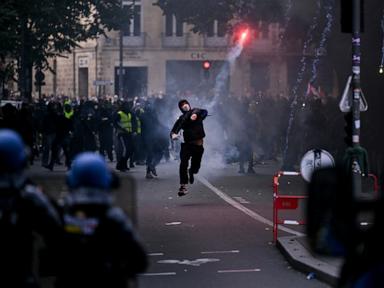
Overnight curfews imposed in Paris and other French cities can reduce visible street disorder in the short term without resolving the economic and institutional pressures driving mobilization. Headline coverage of the unrest often treats a quieter night as proof that the crisis is receding. That reading confuses spatial containment with conflict resolution.
Surface reporting on the curfews and Prime Minister Sébastien Lecornu's assessment relies on a straightforward sequence: demonstrations escalate into rioting and looting, authorities deploy curfews and heavy policing, and overnight calm follows. The underlying logic assumes that order is a direct function of street-level deterrence. What that framing leaves out is how cost-of-living grievances, student discontent over school conditions and admissions, union strike calendars, and partisan positioning ahead of the next presidential election interact across time and space.
Separating Known Facts From Educated Hypotheses
Clear analysis requires separating verified developments from interpretations that remain contested or unproven.
Known facts from the recent French unrest include:
- Demonstrations involving students, teachers, workers, unions, and other groups have targeted high living costs, fuel prices, and school conditions, with major nationwide mobilization occurring in mid-October 2026.
- Episodes of rioting, arson, and looting hit Paris and other cities, prompting authorities to impose targeted overnight curfews, restrict or ban certain gatherings, close metro stations on protest days, and carry out thousands of arrests.
- Prime Minister Sébastien Lecornu stated that targeted curfews helped keep things calm overnight, while officials and opposition figures clashed over blame, policing, and the political fallout.
- Mobilization did not vanish overnight; unions and protest coalitions continued scheduling marches and strikes into November 2026, while the government moved on measures such as furlough support, fuel supply outreach, and proposed revisions to the Parcoursup admissions system.
Educated hypotheses that require ongoing verification include:
- Whether targeted curfews permanently suppress street violence or simply shift timing and tactics toward daytime marches, school blockades, and scheduled strikes.
- Whether blame placed on specific political factions alters voter behavior ahead of the presidential election or mainly hardens existing partisan alignments.
- Whether policy concessions on admissions, energy supply, or temporary relief ease household strain fast enough to lower protest turnout.
The Four Drivers of Mobilization
Standard news summaries often treat protesters and rioters as a single blur. In practice, four distinct drivers feed the unrest, each operating on a different timeline and responding to different incentives.
- Household Cost Pressure. Rising everyday expenses—especially fuel, housing, and basic living costs—create broad, recurring friction across working and middle-income households. Unlike a single legislative bill, price pressure is continuous, giving grievances a durable baseline.
- Educational Bottlenecks. High school and university demonstrators have focused on school conditions, long schedules, and frustration with Parcoursup. Student mobilization tends to spike around specific grievances and calendar moments, and can be partially defused when authorities offer concrete structural adjustments, even if broader discontent persists.
- Organized Labor and Movement Calendars. Trade unions and protest networks turn diffuse anger into predictable mass events through scheduled strike days and marches. This calendar structure converts sporadic frustration into repeatable leverage.
- Opportunistic Violence and Political Polarization. Masked actors, looters, and arsonists exploit large crowds and stretched security perimeters, inflicting heavy damage on shops, vehicles, and public buildings. At the same time, political rivals and officials compete to frame the violence to their advantage ahead of national elections.
Cause-and-Effect Chains Headline Coverage Misses
Curfews operate on immediate street access, not on underlying grievances. Restricting movement during set night hours in specific zones reduces the window for nighttime looting and arson. Yet a curfew does not lower pump prices, fix school timetables, or settle disputes with unions. When underlying pressures remain intact, suppression at night often translates into displacement toward daytime demonstrations, transit disruptions, or blockades.
Heavy policing and broad protest bans also carry a legitimacy trade-off. Restoring order is a core state duty, and officials face intense pressure when shops are ransacked or public buildings are damaged. However, aggressive crowd control, injuries, or sweeping bans can alienate peaceful demonstrators and bystanders, turning an economic dispute into a broader argument over civil liberties and state authority.
Calling every clash a single political plot blurs the line between peaceful marchers, organized unions, and criminal looters—which can make policy responses misaimed and politically costly.
Finally, pre-election timing amplifies every misstep. With the next presidential election on the horizon, every street confrontation and every government concession is read through a competitive lens. A government that appears too soft risks accusations of losing control; a government that relies primarily on curfews and bans risks looking detached from everyday economic pain.
Answers to Common Questions in Plain Analytical Terms
Readers tracking the unrest typically want clear answers to four practical questions:
- Do curfews end the protests? They can quiet specific neighborhoods overnight, which is a real tactical effect, but they do not resolve cost-of-living or labor grievances, so marches and strikes can resume under different rules or hours.
- Why do peaceful marches turn into riots? Large crowds create cover and strain police coverage, allowing smaller groups bent on vandalism or looting to operate alongside or after lawful demonstrations.
- How do demonstrations disrupt daily life beyond the protest zone? Transit authorities frequently close stations along or near demonstration routes, while marches and blockades slow traffic and prompt school or venue closures.
- What could actually cool the broader movement? Measurable relief on household costs, credible follow-through on targeted sector demands such as education reform, and disciplined policing that isolates violent actors without sweeping in peaceful participants.
Operational Playbook for Managing Escalation
Managing a multi-front protest wave requires treating security, policy, and public communication as linked levers rather than separate silos.
- Map grievance tiers before deploying force. Separate non-negotiable economic pain from sector-specific demands (such as student issues) and from pure public-order offenses like looting. Conflating all three guarantees the wrong tool is applied to the wrong group.
- Use narrow, time-bound curfews paired with clear transit notices. When curfews are used, keep their geographic scope and hours tight and publish predictable metro and road advisories so uninvolved residents and commuters are not caught off guard.
- Separate crowd containment from targeted law enforcement. Focus security resources on protecting vulnerable commercial corridors and public buildings and arresting perpetrators of violence and looting, rather than treating every marcher as an adversary.
- Pair order measures with verifiable, near-term relief. Announcements of furlough support, fuel supply efforts, or admissions changes carry credibility only when paired with clear timelines and visible execution.
Limitations and Trade-Offs
No crowd-control or policy mix eliminates risk. Curfews strain local policing capacity and can frustrate businesses and residents in affected districts. Fiscal or energy interventions face budget constraints and global market realities that a single government cannot dictate alone, especially under heavy public debt. Meanwhile, negotiating with one group—such as student representatives—does not automatically satisfy unions or households squeezed by broader prices.
Strategic Recommendation
For decision-makers and analysts assessing the situation, treat overnight calm under curfews as a breathing window, not a resolution. The highest-leverage move for authorities is to use quieted nights to deliver concrete, time-bound relief on household and student pressures while maintaining predictable, targeted policing during scheduled marches and strikes—preventing tactical containment from hardening into a prolonged political standoff.