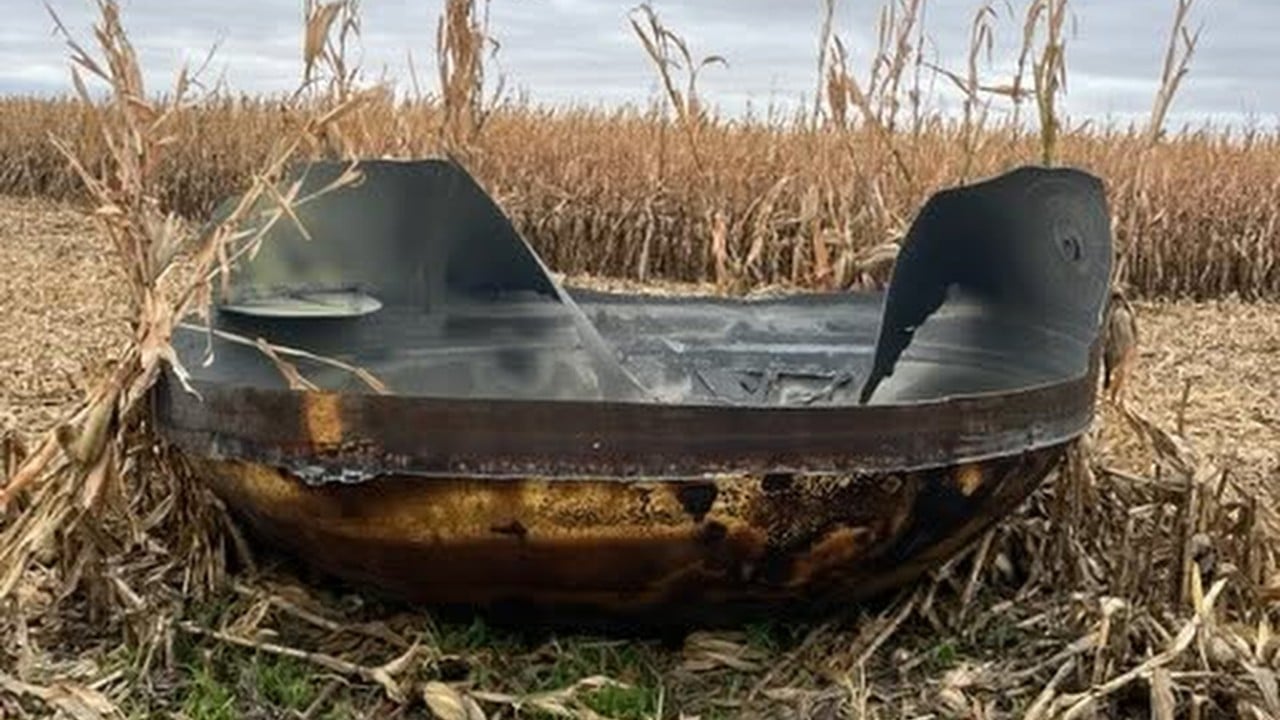
Picture a quiet Tuesday evening in a small Midwestern town. The sprinklers tick against the dry grass, a porch light hums against the gathering dusk, and inside a ranch house someone is turning over a skillet of onions while the local news murmurs in the background. Nothing about that evening feels historic. Nothing feels fragile. Then, high above the atmosphere—higher than any commercial airliner ever flies, where the sky thins into a bruised violet and then into ink—several tons of titanium, aluminum, and scorched composite begin their final, unguided plunge.
(Note: The town and evening above form a hypothetical scenario designed to put human scale around a real physical risk; no specific real-world town is being depicted.)
When astronomers call uncontrolled rocket debris coming down over the United States "embarrassing" for China, the word sounds almost polite. Like a guest knocking over a wineglass at dinner. Embarrassment belongs to press conferences and diplomatic cables. Down on the ground, where gravity has the final word and physics cares nothing for flags or press releases, embarrassment is not what keeps people awake.
Unpredictability does.
I have spent years watching how people react when something meant to stay neatly in its lane suddenly crosses into everyday life. Years ago, working on emergency preparedness and public risk communication around hazardous transport and severe weather, I saw the same pattern repeat itself: folks rarely panic over the slow, visible threats they can see coming on a radar screen. What unnerves them—what makes a quiet kitchen suddenly feel small—is the thing that arrives without a siren, moving at orbital speeds, governed by atmospheric drag and tumbling geometry that even seasoned orbital mechanics experts can only bound within wide corridors.
An astronomer looking up from a dark-sky site or a tracking station sees the problem through a very specific lens. To someone who spends their life mapping the quiet, clockwork precision of orbits and celestial mechanics, letting a massive rocket stage tumble back through the atmosphere without a controlled de-orbit burn looks like sloppy stewardship of a shared commons. It is an engineering choice. Most modern launch providers design upper stages to execute a targeted burn that pushes surviving fragments into remote oceanic drop zones—vast stretches of open water far from shipping lanes and towns. When a heavy core or upper stage is left to decay naturally instead, the reentry footprint stretches across thousands of miles, and the exact moment of breakup shifts with subtle changes in upper-atmospheric density.
That is why astronomers use blunt language. In a spacefaring era where orbital traffic is climbing fast and megaconstellations crowd low Earth orbit, casual habits look archaic. A single large rocket body is not a tiny bolt or a harmless fleck of paint; it is a multi-ton structure hitting the upper air at roughly 17,500 miles per hour. Most of it vaporizes or breaks apart under extreme heating and aerodynamic stress, yet dense components—engine bells, fuel tanks, pressure vessels, high-melting-point alloys—can survive the descent and strike the surface.
Why "Embarrassing" Is Only the Surface
Let us be honest about what a headline like "Rocket debris hitting US homeland is ‘embarrassing’ for China, says astronomer" actually does. It frames an orbital safety issue as a geopolitical scorekeeping match. One side looks clumsy; another looks vindicated. Readers skim it over coffee, nod, and move on because national rivalries feel familiar, almost theatrical.
But the real story is quieter and far more personal.
Imagine an astronomer—let us call her Dr. Elena Vance, a hypothetical composite character drawn from real orbital debris researchers and tracking astronomers—sitting in front of two monitors at 2:00 a.m. The room smells faintly of cold coffee and warm electronics. Outside, crickets chirp in the dark. On her screen, radar and optical tracking points trace a decaying object tumbling end over end. Every pass shifts the predicted reentry window by tens of minutes, which at orbital velocity translates to hundreds or thousands of miles downrange.
She is not cheering for one space agency over another. She is doing math while hoping the laws of probability stay kind.
"People hear 'most of it burns up' and think that means zero risk," an astronomer in her position might explain. "Statistically, the odds of any single person being struck by falling space debris in a given year are very low. Very low is not zero. And airspace closures, disrupted flights, and surprise fragments landing on private property or public roads carry real costs long before anyone is physically hurt."
That distinction matters. When debris enters the atmosphere over populated continents or busy flight corridors, aviation authorities face a thorny dilemma. Closing airspace over a wide swath of country on short notice is expensive, disruptive, and operationally messy when the reentry window itself is moving. Leaving airspace open means accepting a small—yet non-zero—chance that dense metal fragments fall through active flight paths or land near communities.
From an astronomer's vantage point, leaving that gamble to chance when controlled reentry is a known engineering practice feels needlessly reckless. Prestige in space isn't just about launching bigger rockets or planting flags; it is also about cleaning up after yourself and treating the sky above other nations with basic care.
The Physics of a Tumbling Giant
To understand why an uncontrolled reentry is so hard to pin down, it helps to step away from jargon and picture a metaphor. Think of tossing a crumpled sheet of paper off a balcony on a breezy afternoon versus gliding a folded paper airplane toward a specific patch of grass. The crumpled sheet catches gusts unpredictably, flutters, twists, and lands wherever the air currents push it.
A spent rocket stage reentering without active guidance behaves a bit like that crumpled sheet—except at hypersonic speeds where the air itself superheats into glowing plasma.
As the stage dips into thicker layers of the atmosphere, drag slows it down and heats its skin. Because the object is often tumbling or structurally asymmetric as pieces shear off, lift and drag shift from second to second. Meanwhile, solar activity and geomagnetic storms gently puff up or contract the upper atmosphere, subtly altering drag hours or days before reentry.
No wonder predictions wobble. Even sophisticated space surveillance networks tracking an object across multiple passes cannot give a pinpoint street address hours ahead of time. They can narrow down a track and a time window, watch the object break up, and wait to see where radar signatures or ground reports confirm impact.
For ordinary people reading the news, that uncertainty can feel disorienting. One moment you are told debris might pass over a broad region; the next, headlines announce where fragments came down or speculate about what could have happened. Uncertainty breeds two opposite reactions: either unnecessary dread—looking up at every contrail with a knot in your stomach—or total indifference, waving away a real systemic issue because the odds felt tiny yesterday.
Neither reaction helps us think clearly.
A Shared Sky With No Fences
Borders are lines on maps and treaties on paper. At eighty kilometers up, there are no border posts.
Every spacefaring nation—and increasingly private companies—shares the same orbital neighborhood and the same atmosphere below it. Historically, early spaceflight often treated space as an endless frontier where discarded hardware simply vanished into the void. We know better now. Low Earth orbit is crowded, fragments collide and multiply, and every uncontrolled descent adds another variable to an already complex equation.
When debris from a Chinese launch falls on U.S. territory, the friction is immediate because sovereignty is sensitive and public safety is non-negotiable. Yet the underlying standard applies universally: if you send heavy hardware to orbit, you ought to engineer a reliable, responsible way for its remains to come down safely—ideally over empty ocean, far from people, homes, and airplanes.
A sky full of flying hardware only stays safe when every operator treats reentry not as an afterthought, but as part of the mission itself.
Astronomers speak up on this issue precisely because they watch the sky without blinkers. Their job trains them to notice small deviations early—a tiny shift in brightness, a slight drift in trajectory, a habit that looks harmless today but compounds into trouble tomorrow. When they call an uncontrolled descent over the U.S. homeland "embarrassing," they are pointing at a gap between technological capability and basic accountability.
What Happens When the Dust Settles
Suppose a piece of charred metal turns up in a field or a wooded lot after a reentry event. Suddenly the story shrinks from global space policy to a single patch of earth. Local officials have to verify what it is, keep curious onlookers from touching potentially hazardous materials or composite residues, coordinate with federal agencies, and answer anxious phone calls from neighbors who heard a boom or saw a streak of light across the night sky.
Even when no one is hurt, the ripple is real. Trust frays a little more. Public patience wears a little thinner. And the conversation around space safety gets louder—sometimes sharper than necessary—because people feel their quiet lives were brushed by something far away and out of their control.
I will admit freely: I don't have a crystal ball that tells me when every stray piece of orbital hardware will behave neatly, nor can anyone promise zero surprises in a busy sky. Spaceflight is hard. Rockets fail, atmospheres shift, and physics sometimes humbles even the smartest engineers on Earth.
Admitting that uncertainty isn't weakness. It's honesty. The real test isn't pretending risk doesn't exist; it's building habits, norms, and engineering standards that shrink that risk as much as humanly possible before a single bolt leaves the launchpad.
Think back to that quiet Tuesday evening—the porch light humming, the skillet sizzling, the sky darkening overhead. Above the roof shingles, far past the reach of a flashlight beam, a streak of fire crosses the stars in silence, leaving only a memory of light and a quiet question hanging in the cool night air: who is watching where it lands?