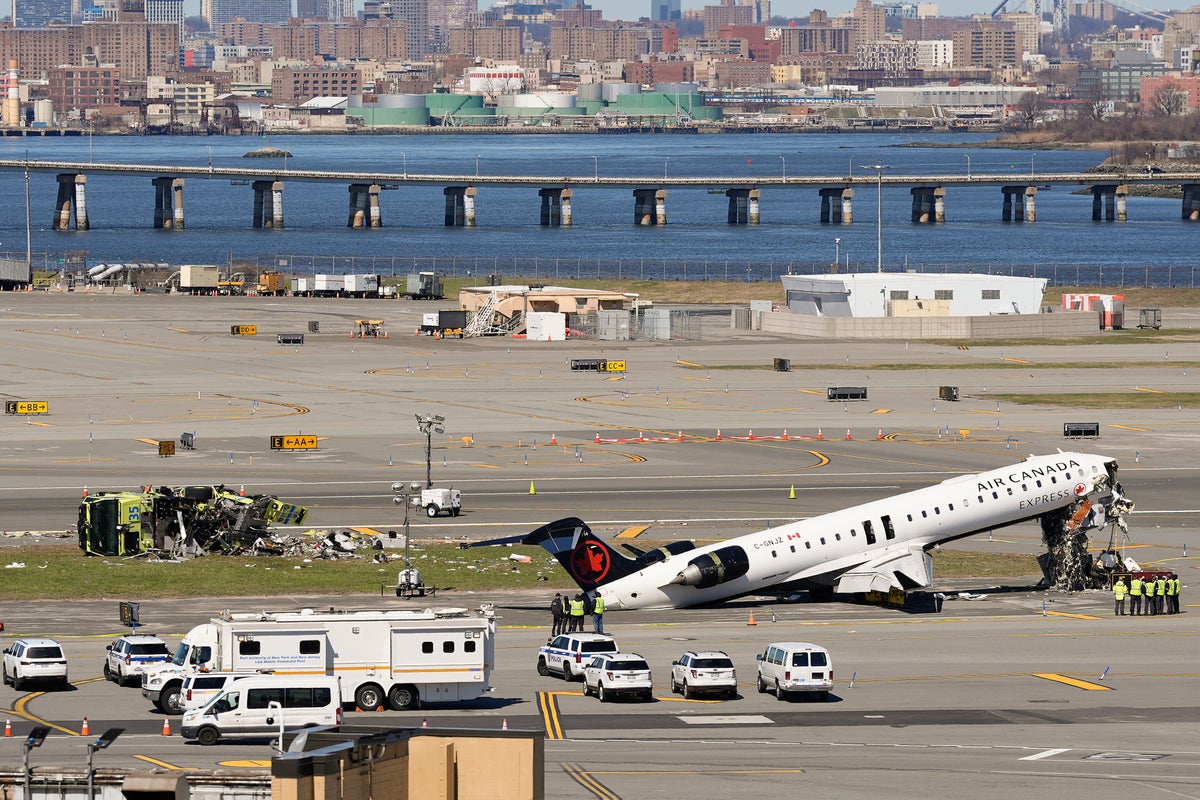
The probability of a runway incursion at a high-utilization airport like LaGuardia is not a matter of random chance but a function of systemic pressure, sensor latency, and the biological limits of human cognitive processing. When two aircraft occupy the same runway space, it represents a total breakdown of the "Swiss Cheese Model" of accident causation, where the holes in individual layers of protection—technology, procedure, and oversight—align perfectly. The recent failure at LaGuardia exposes a critical vulnerability: the gap between automated detection and human intervention time.
The Physics of the Runway Incursion
To quantify the risk, we must define the runway environment as a high-velocity closed system. At LaGuardia, the margins for error are compressed by the physical layout of the airfield, which features intersecting runways and limited taxiway "throat" points.
An incursion occurs through three primary vectors:
- Pilot Deviation: An aircraft enters the runway environment without clearance due to situational awareness loss or communication misinterpretation.
- Controller Error: A clearance is issued that creates a conflict with an existing occupied or protected space.
- Vehicle/Pedestrian Deviation: Non-aircraft entities enter the movement area without authorization.
The kinetic energy involved in a collision between two commercial jets, even at taxi speeds, is catastrophic. Because $KE = \frac{1}{2}mv^2$, the mass ($m$) of a loaded narrow-body aircraft combined with even moderate velocity ($v$) creates a force profile that existing airframe safety standards cannot mitigate. Therefore, safety is entirely dependent on separation, not crashworthiness.
The Architecture of the ASDE-X Failure
The primary defense against ground collisions is the Airport Surface Detection Equipment, Model X (ASDE-X). This system integrates data from surface movement radar, multilateration (MLAT) sensors, and ADS-B broadcasts to create a high-fidelity map of airport traffic.
The failure at LaGuardia was not necessarily a failure of "detection" but a failure of "alerting logic." ASDE-X operates on a set of safety logic parameters known as Safety Logic (ASDE-X SAL). This software evaluates the position, velocity, and heading of all tagged targets. If the system predicts a collision within a specific time horizon—typically 10 to 15 seconds—it triggers a "RWSL" (Runway Status Lights) red signal or an audible alert in the tower.
Structural flaws in this logic often stem from:
- Filter Nuisance Suppression: In high-density environments, "nuisance alerts" (false positives caused by aircraft exiting runways closely behind others) lead controllers to subconsciously de-prioritize the system's urgency.
- The Latency Loop: There is a measurable delay between the moment a sensor detects a deviation and the moment the controller processes the audio/visual alert and relays a "Stop" command to the cockpit. In a high-speed takeoff roll, a 5-second latency loop can equal 400 to 600 feet of travel.
- Target Dropping: Multilateration requires line-of-sight. Physical obstructions or "shadowing" by large hangars or other aircraft can cause a target to momentarily disappear from the logic engine, resetting the collision timer.
The Human-Machine Interface Bottleneck
Standard aviation safety theory relies on the controller as the final arbiter. This creates a "Single Point of Failure" during high-workload periods. At LaGuardia, the frequency congestion is such that the "Time to Intervene" often exceeds the "Time to Impact."
The cognitive load on a ground or local controller involves managing a 4D matrix of aircraft: X, Y, Z (altitude/position), and T (time). When an automated system like ASDE-X identifies a conflict, the controller must perform a three-step cognitive cycle:
- Validation: Is this a real threat or a ghost target/system glitch?
- Communication: Access the correct frequency and identify the specific tail number.
- Execution: The pilot must hear, process, and physically apply brakes or thrust.
If the ASDE-X triggers at $T-10$ seconds, and the Validation/Communication phases consume 7 seconds, the pilot is left with 3 seconds to move 150,000 pounds of metal. This is a mathematically losing proposition.
The Economic Pressure of Throughput
Safety systems do not operate in a vacuum; they operate within the economic constraints of "Throughput Maximization." LaGuardia is one of the most capacity-constrained airports in the world. The pressure to maintain a high "Launch Rate" creates a shrinking "Buffer Zone" between operations.
This "Normalization of Deviance" occurs when operators repeatedly push the boundaries of separation to maintain schedules. When a 2-mile separation becomes the norm instead of a 3-mile separation, the system loses its "Damping Ratio." In engineering, a system with a low damping ratio oscillates wildly when a shock (like a missed radio call) is introduced, leading to a rapid transition from "Normal Operation" to "Catastrophic Failure."
Technical Limitations of Current Mitigation
Beyond ASDE-X, the industry relies on Runway Status Lights (RWSL). These are red lights embedded in the pavement that turn on automatically when the system detects a conflict.
The limitation here is "Visual Acquisition." During heavy precipitation or low-visibility (IFR) conditions, the pilot’s ability to see these lights is severely degraded. Furthermore, RWSL is an "advisory" system. Pilot training dictates that a voice command from ATC supersedes visual cues, creating a moment of hesitation if the lights turn red but the controller remains silent. This "Contradictory Input" phase is where the collision risk peaks.
Quantifying the Reliability Gap
To understand why the system failed, we must look at the Reliability Block Diagram (RBD) of the runway safety chain.
- Sensor Reliability: 99.9%
- Software Logic Accuracy: 98.0% (Accounting for nuisance filters)
- Controller Vigilance: 95.0% (Variable based on fatigue and traffic volume)
- Pilot Reaction: 95.0%
The "System Reliability" ($R_s$) is the product of these probabilities:
$$R_s = 0.999 \times 0.98 \times 0.95 \times 0.95 \approx 0.88$$
An 88% reliability rate in a high-consequence environment is unacceptable. To move toward "Six Sigma" safety, the human element must be moved from the "Critical Path" to an "Oversight Path."
Strategic Shift: From Alerting to Intervention
The current strategy of "Detect and Notify" has reached its ceiling. The LaGuardia incident proves that the notification loop is too slow for modern airfield speeds. The next evolution in aviation safety must involve "Active Intervention" technologies.
- Direct-to-Cockpit Alerting: Bypassing the controller entirely. Systems like Honeywell’s Runway Awareness and Advisory System (RAAS) provide "Aural Enunciation" directly to the pilots. However, this must be integrated with ground radar so the aircraft "knows" where other aircraft are, not just its own position.
- Automated Braking Triggers: Implementing a ground-based version of the "Automatic Ground Collision Avoidance System" (Auto-GCAS) used in fighter jets. If the ASDE-X logic determines a collision is imminent (at a high confidence interval, e.g., >90%), it should have the capability to send a data-link command to the aircraft’s autobrake system.
- Dynamic Geofencing: Replacing static runway hold short lines with virtual geofences. If a transponder-equipped aircraft crosses a "Red Fence" without a digital clearance token, the system should trigger an immediate, high-intensity emergency broadcast on all local frequencies simultaneously.
The aviation industry must acknowledge that human controllers cannot act as the primary safety switch for sub-10-second conflict windows. The strategic move is the implementation of "Low-Latency Autonomous Overrides." This involves shifting the authority of the ASDE-X from a passive monitor to an active digital gatekeeper. Until the "Command and Control" loop is shortened by removing the verbal relay, the risk of a high-speed collision at a congested hub remains an inevitability rather than a statistical outlier.
The immediate tactical requirement for air carriers is the mandatory installation of ADS-B In (Cockpit Display of Traffic Information) for all ground operations, providing pilots with the same situational awareness as the tower. This effectively creates a "Distributed Sensor Network" where every cockpit acts as a redundant check on the controller's instructions.