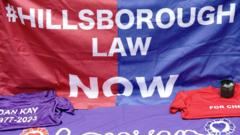
The wooden benches in a courtroom are not designed for comfort. They are hard, upright, and unforgiving, much like the legal system itself. For the families of the ninety-seven people who went to a football match in 1989 and never came home, those benches have been a second home for thirty-five years. They have sat through inquests, private prosecutions, and public inquiries. They have listened to lies being told under oath and watched as the truth was buried beneath layers of bureaucratic self-protection.
Now, they are told to wait again. Recently making headlines recently: Finland Is Not Keeping Calm And The West Is Misreading The Silence.
The Hillsborough Law—officially known as the Public Authority (Accountability) Bill—was supposed to be the finish line. It is a piece of legislation designed to ensure that no other grieving family has to spend three decades fighting a wall of state-sponsored silence. It would introduce a "duty of candour," legally requiring public officials and authorities to tell the truth during investigations. It would level the playing field by providing legal funding for bereaved families, ensuring they aren't outgunned by the unlimited taxpayer-funded legal teams of the police or the government.
But the corridors of Westminster are long, and the pace of change is glacial. Despite repeated promises from successive governments, the full implementation of this law has been pushed back once more. More insights on this are detailed by TIME.
Consider a hypothetical woman named Margaret. In 1989, she lost her son. For the first decade, she was told it was his fault. For the second decade, she was told it was an accident. By the third decade, she finally proved it was gross negligence. Margaret is not a legal expert. She is a retired schoolteacher who had to learn the intricacies of crush dynamics and police radio protocols because the people in charge refused to be honest.
When the state fails, it has a natural instinct to curl into a defensive ball. This isn't necessarily a conspiracy of villains; it is a systemic failure of culture. When a hospital trust makes a mistake that costs a life, or when a police force mishandles a crowd, the immediate reaction of the institution is to protect its reputation. They hire the best lawyers. They "lose" notebooks. They provide statements that are technically true but intentionally misleading.
The Hillsborough Law is the antidote to this instinct. It turns "should" into "must."
The delay in passing this law isn't just a matter of parliamentary scheduling. It is a message. It tells every victim of a state failure—whether they are involved in the Grenfell Tower fire, the infected blood scandal, or the Post Office Horizon disaster—that their need for truth is secondary to the convenience of the legislative calendar.
We often talk about the "wheels of justice" as if they are a grand, inevitable machine. In reality, those wheels are turned by hand. They are turned by the tired hands of campaigners who have to keep pushing even when their hair has turned grey and their voices have grown thin. Every delay allows the grease of apathy to settle on the gears.
The government argues that they need more time to consult, to ensure the wording is precise, and to integrate the duty of candour into existing frameworks. These are the arguments of people who have never had to wait for a death certificate that reflects the truth. Precision is important, but in the world of British law, "precision" is frequently a synonym for "procrastination."
Imagine the power dynamic in a standard inquiry. On one side, you have a family who has just suffered the most traumatic event of their lives. They are grieving, broke, and confused. On the other side, you have a public institution with a multi-million-pound legal budget. The institution's lawyers are there to "mitigate risk." The family is there to find out why their child died.
Without a Hillsborough Law, this isn't a search for the truth. It is a war of attrition.
The duty of candour is a simple concept that terrifies the powerful. It means that if a police officer knows their commander made a fatal error, they cannot stay silent to protect the "thin blue line." It means that if a civil servant sees a report that proves a building is a firetrap, they cannot bury it in a drawer to avoid a scandal. It creates a legal consequence for the cover-up.
Critics of the bill often worry about "vexatious litigation" or the cost to the taxpayer. They argue that if every public official is terrified of being sued, they will become paralyzed by indecision. But this misses the fundamental point of the human experience. We do not expect our public servants to be perfect. We expect them to be honest when they are not.
The cost of a cover-up is always higher than the cost of the truth. We paid for the original Hillsborough inquests. Then we paid for the 2012 independent panel. Then we paid for the longest-running inquests in British legal history. We paid for the lawyers who tried to smear the dead. We paid for the decades of police time spent defending the indefensible. If the Hillsborough Law had been in place in 1989, the truth would have been established in months, not decades. The financial saving would have been immense. The human saving would have been immeasurable.
There is a specific kind of exhaustion that comes from being right but being ignored. It is a weight that settles in the bones. For the families in Liverpool and beyond, the delay of this law is another year of carrying that weight. They are being told that the "lessons learned" from their tragedy are still being processed, thirty-five years later.
At what point does a delay become a denial?
The legal system likes to pretend it is a realm of cold logic and objective facts. It isn't. It is a human system built on trust. When the state refuses to hold itself to the same standards of honesty that it demands from its citizens, that trust evaporates. The Hillsborough Law is not just a tribute to ninety-seven people; it is a foundational repair kit for a broken social contract.
Every day the bill sits on a desk in Whitehall is a day that the culture of concealment is allowed to breathe. It gives another department time to redact a document. It gives another official time to "forget" a conversation. It allows the status quo—where the burden of proof rests entirely on the shoulders of the bereaved—to remain the law of the land.
We are currently witnessing a parade of scandals that all share the same DNA. Whether it is the Post Office leaders who knew their software was flawed while they sent sub-postmasters to prison, or the officials who ignored warnings about flammable cladding on social housing, the pattern is identical. The institutional ego is prioritized over the human life.
The delay of the Hillsborough Law is a victory for the institutional ego.
We often think of justice as a destination, a place we arrive at once the judge bangs the gavel. But for those who have spent their lives in the shadow of Hillsborough, justice is a process. It is the simple, radical act of being seen and being told the truth without having to scream for it.
The families are still waiting in the corridor. The lights are dimming, and the doors are still locked. They have been told the key is being forged, that the locksmith is busy, that the paperwork is being filed. They have heard it all before.
Justice delayed is not just justice denied; it is a slow, quiet form of cruelty. It is the act of watching a clock tick while knowing that with every second, the people who hold the answers are hoping you will simply get tired and go home.
The families of the ninety-seven are not going home. They have nowhere else to go. They are staying on those hard, wooden benches until the law catches up to the truth.
The rest of us should be asking why the law is running so slow.