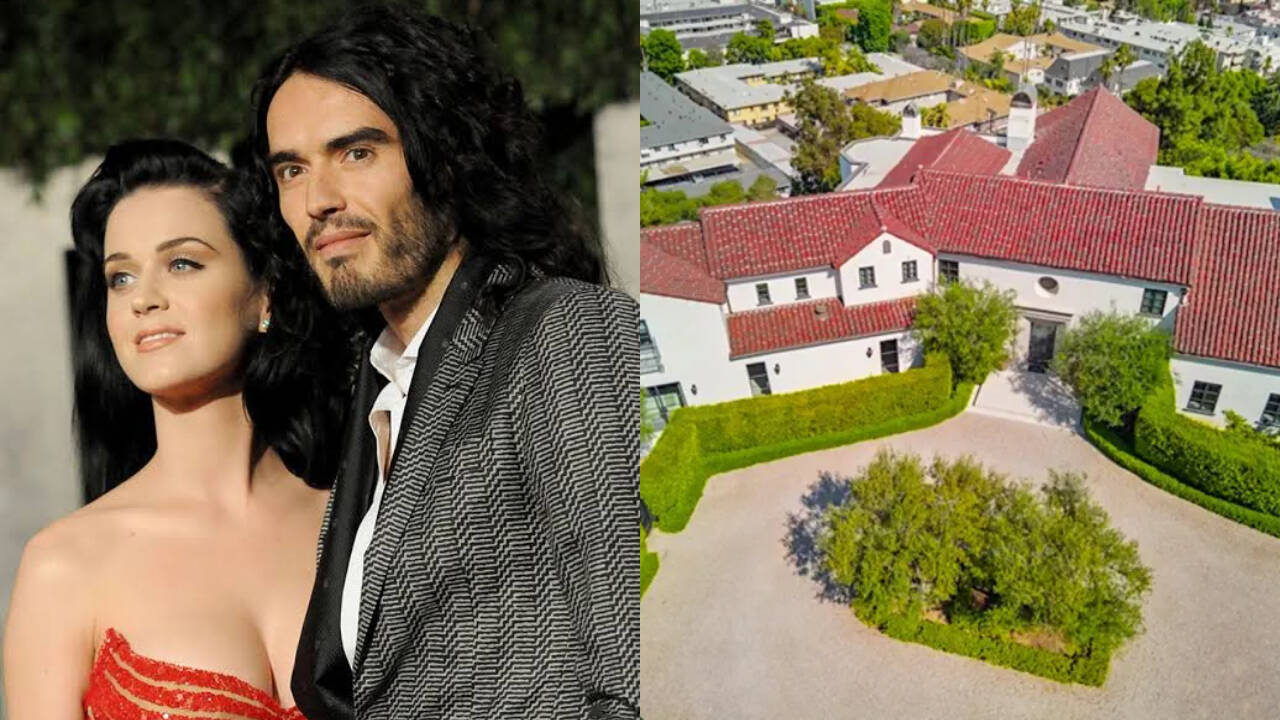
Listing a historic Los Angeles estate once owned by Katy Perry and Russell Brand at $275,000 per month exposes a fundamental structural shift in how ultra-high-net-worth individuals allocate capital toward residential assets. Rather than functioning as a standard shelter expense or a traditional real estate investment, a $3.3 million annual lease operates as a synthetic financial instrument that trades capital efficiency for extreme liquidity and privacy. Standard real estate coverage treats these figures as mere celebrity trivia, missing the underlying mechanics of cap rate compression, tax arbitrage, and the valuation decay of celebrity provenance.
The Mechanics of Ultra-Luxury Lease Pricing
To understand how an institutional or private landlord arrives at a $275,000 monthly asking price, one must strip away the celebrity narrative and examine the underlying asset valuation. The property in question—a 1920s Spanish-style compound in the Hollywood Hills acquired by Perry and Brand in 2011 for roughly $6.5 million and later sold following their divorce—sits in a submarket where architectural pedigree and acreage dictate baseline land value. When a property of this caliber enters the rental market at $3.3 million per year, the pricing model relies on three distinct financial variables: For a different view, read: this related article.
- Implied Asset Valuation and Gross Yield: In prime Los Angeles residential markets (such as the Sunset Strip, Beverly Hills, and Bel Air), gross rental yields for trophy properties typically compress to between 3% and 5% of the property's current market valuation. Working backward from an annualized rent of $3.3 million, the landlord is implicitly valuing the estate between $66 million and $110 million, or pricing in an aggressive liquidity premium for short-term availability.
- The Carrying Cost Pass-Through: Ownership of a historic hillside compound carries severe operational drag. Between California property taxes (assessed at roughly 1.1% to 1.25% of the most recent purchase price, plus local bonds), specialized wildfire insurance policies in high-risk canyon zones, full-time groundskeeping, and preventative maintenance on century-old masonry and plumbing, baseline carrying costs easily exceed $50,000 to $80,000 per month before debt service.
- The Liquidity and Optionality Premium: Ultra-luxury leases rarely run on standard 12-month terms without substantial markups. Landlords pricing at the $275,000 tier are factoring in vacancy risk—the reality that the pool of qualified tenants capable of passing a $3.3 million annual income-to-rent underwriting threshold is microscopic. A single six-month vacancy destroys annual yield, forcing the owner to front-load the risk into the monthly rate.
The Rent-Versus-Buy Calculus at the $3 Million Annual Tier
Conventional personal finance dictates that paying $3.3 million per year in rent without building equity is fiscally reckless. Within the ultra-high-net-worth bracket, that logic reverses entirely. For a tenant—typically a studio executive in transition, a touring musician, a tech founder post-exit, or an international sovereign wealth principal—leasing at $275,000 per month solves four acute capital allocation problems.
First, opportunity cost of equity. Purchasing an equivalent $40 million to $60 million estate in Los Angeles requires either tying up tens of millions in illiquid cash or securing a jumbo mortgage. Even when deploying leverage, the down payment alone (typically 30% to 40% in the super-prime tier) removes $15 million to $24 million from productive deployment. If that capital generates a conservative 8% to 12% annualized return in private equity, venture, or public markets, the foregone investment income alone approaches $2 million to $2.8 million annually—nearly covering the entire lease cost while preserving total balance sheet liquidity. Further coverage regarding this has been provided by Forbes.
Second, transaction friction and tax drag. Los Angeles real estate carries punitive entry and exit costs. Specifically, the City of Los Angeles Measure ULA transfer tax imposes a 4% tax on property sales above $5 million and a 5.5% tax on sales above $10 million, levied on the gross sale price regardless of whether the seller realizes a profit. Buying a $40 million home and selling it two years later incurs $2.2 million in transfer taxes alone, alongside another $2 million to $2.4 million in standard brokerage commissions and closing costs. A tenant leasing for 24 months spends $6.6 million with zero exposure to principal loss, illiquidity, or regulatory transfer penalties.
Third, balance sheet anonymity. Direct property acquisition in California requires navigating strict beneficial ownership disclosure rules, particularly under Corporate Transparency Act mandates and FinCEN geographic targeting orders that pierce standard LLC veils for all-cash luxury purchases. A lease structure allows a high-profile occupant to secure physical perimeter privacy through a corporate tenancy agreement without placing their personal or holding-company balance sheet on permanent public tax rolls.
Fourth, operational insulation. Historic Hollywood Hills estates are notoriously complex to maintain. Hillside stabilization, aging Mediterranean tile roofs, legacy electrical systems, and bespoke mechanical plants create asymmetric downside risk. In a triple-net or modified gross luxury lease, structural capital expenditures remain the landlord's liability, capping the tenant's maximum financial exposure at the monthly rent figure.
The Decay Curve of Celebrity Provenance
Media coverage inevitably anchors the property's identity to Katy Perry and Russell Brand, who purchased the three-acre compound at the height of their respective commercial peaks before divorcing in 2012. In institutional real estate valuation, however, celebrity provenance does not operate as a permanent value multiplier; it follows a predictable, decaying asset curve.
- Phase 1: Immediate Halo Effect (Years 0–2 Post-Ownership). Immediately following a high-profile sale, media saturation generates organic global awareness. Brokers use this visibility to attract international buyers who value trophy recognition over strict price-per-square-foot metrics. Even here, the halo rarely translates into a direct price premium unless the celebrity executed a significant, documented architectural restoration.
- Phase 2: Structural Neutralization (Years 3–7). As the property changes hands—as this estate did when Perry offloaded it and subsequent owners redeveloped or modernized the interiors—the original celebrity association decouples from the physical asset. High-end buyers in Los Angeles are hyper-focused on architectural provenance (such as Wallace Neff, Paul Williams, or Richard Neutra) rather than pop-culture history. Pop-culture fame attracts looky-loos and paparazzi, which actively degrades the privacy premium that luxury buyers pay for.
- Phase 3: Marketing Hook Only (Years 8+). More than a decade after Perry and Brand's brief tenure, their names serve purely as an algorithmic hook for syndication algorithms and lifestyle press. For the actual tenant signing a $275,000 monthly lease, the 2011 ownership history holds zero economic utility. In fact, excessive press coverage around a rental listing can reduce its marketability by alerting security teams that the address is publicly compromised.
Structural Constraints of the Hollywood Hills Submarket
Evaluating this listing requires isolating the micro-market dynamics of the Hollywood Hills compared to flatland trophy enclaves like Beverly Hills Flats or Holmby Hills. The physical geography imposes hard operational constraints that directly influence both valuation and tenant demand:
- Ingress and Egress Bottlenecks: Canyon roads limit motorcade access, complicate private security logistics, and create friction for daily commuting to studio lots in Burbank or corporate hubs in Century City. Tenants paying $275,000 per month often require staff quarters, multi-car staging areas, and rapid-response security perimeters—features that steep topography naturally restricts.
- The Acreage Anomaly: The primary differentiator of this specific compound is its multi-acre footprint within the Hills, an extreme rarity where most parcels sit under half an acre. Acreage in the Hollywood Hills commands an exponential premium because it solves the submarket's biggest liability: sightline intrusion from neighboring hillside properties.
- Insurance Market Contraction: California's residential property insurance crisis has disproportionately hit hillside estates bordering wildland-urban interfaces. Many traditional carriers have exited the market entirely, forcing property owners into the California FAIR Plan paired with expensive excess-and-surplus lines. For a landlord, insuring a multi-million-dollar compound against brush fire risk can easily exceed $150,000 to $250,000 annually, a cost embedded directly into the $275,000 monthly asking price.
Underwriting the Super-Prime Lease: A Practitioner Framework
When advising a family office, business manager, or corporate relocation team evaluating a super-prime lease at the $250,000+ monthly threshold, standard residential lease agreements are wholly inadequate. The transaction must be structured like a commercial real estate acquisition to protect against asymmetric operational failures.
1. Audit the CapEx and Maintenance Carve-Outs
Luxury landlords routinely attempt to shift routine maintenance onto tenants. At $275,000 per month, the tenant's representative must negotiate a strict bright-line rule: all mechanical, HVAC, pool filtration, hillside drainage, and structural systems remain under the landlord's financial and operational control, with guaranteed 24-hour service-level agreements (SLAs) for critical failures. A broken chiller in August or a hillside mudslide during winter rains renders the asset unusable; the lease must include automatic rent abatement triggers if habitability or compound security is compromised for more than 48 hours.
2. Neutralize the Public Footprint
Because listings of this profile generate immediate media coverage, the address and interior floor plans become public record before the lease is even signed. Security protocols require inserting non-disclosure agreements (NDAs) binding the listing brokerage, property management staff, and prior vendors from confirming occupancy. Furthermore, the lease should grant the tenant unilateral authority to upgrade perimeter camera arrays, biometric access points, and ballistic glazing at their own expense without restoration penalties upon exit.
3. Structure Option-to-Purchase Mechanics
A tenant committing $3.3 million in annual rent provides the landlord with substantial cash flow stability and de-risks the asset during volatile interest rate cycles. Never execute a lease at this tier without negotiating a Right of First Refusal (ROFR) or a fixed-price purchase option exercisable within the first 12 to 18 months, ideally with a negotiated percentage (typically 25% to 50%) of paid rent credited toward the purchase price. This converts a pure expense into a funded due-diligence period, allowing the tenant to test neighborhood noise, canyon traffic, and microclimate realities before absorbing Measure ULA transfer taxes.
Limitations of the Ultra-Luxury Rental Model
Treating a $275,000 monthly lease as a superior financial strategy carries clear boundaries. The model fails entirely if the occupancy horizon extends beyond 36 to 48 months. Over a four-year period, cumulative rent outlays reach $13.2 million—a figure that surpasses transaction friction, property taxes, and opportunity cost losses even in a high-tax jurisdiction like Los Angeles.
Furthermore, the super-prime rental market suffers from extreme illiquidity on the exit side. Unlike commercial leases, ultra-luxury residential landlords rarely permit subletting or lease assignments. If a tenant's corporate mandate changes or personal circumstances shift six months into a two-year commitment, the remaining $4.95 million obligation becomes an unrecoverable sunk cost unless a negotiated early-termination buyout clause—typically capped at three to six months' rent—was secured prior to execution.
Strategic Execution for Market Participants
For landlords holding historic trophy assets in Los Angeles, pricing at $275,000 per month is a defensive yield play designed to wait out compressed buyer demand and punitive transfer taxes without liquidating the underlying land. However, relying on decade-old celebrity provenance to justify top-decile pricing is a flawed strategy; institutional-grade tenants underwrite security infrastructure, turnkey interior modernization, and operational reliability, not pop-culture nostalgia. Landlords must strip celebrity branding from marketing collateral, pre-fund comprehensive preventative maintenance, and offer flexible corporate lease structures to capture the narrow pool of qualified tenants.
For prospective tenants and family offices operating in this tier, the optimal play is to exploit the landlord's vacancy risk. High-end properties priced above $250,000 per month routinely sit on the market for six to twelve months, eroding the owner's annual yield targets. Rather than accepting the headline rate, structure an offer at a 15% to 25% discount ($205,000 to $230,000 per month) backed by a single upfront lump-sum payment for a 12-month term, paired with a strict non-disclosure covenant and an embedded purchase option. In a thin market, immediate cash certainty outweighs theoretical asking price every time.