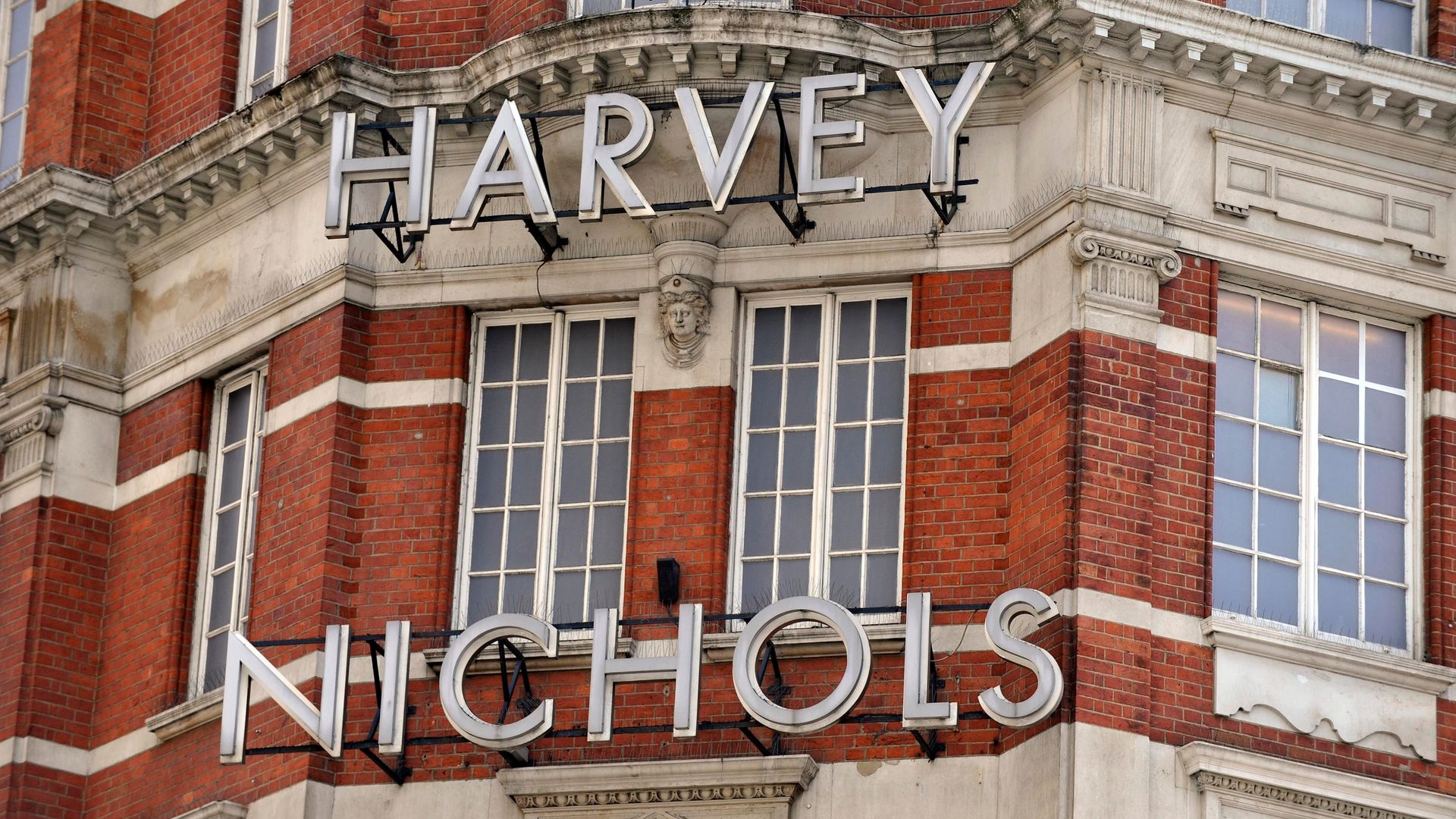
The British high street is a graveyard of institutional ambition, yet suitors still swarm the carcass of high-end department stores. Next and Frasers Group are preparing to lodge their formal takeover bids for Harvey Nichols, stepping into an auction that exposes the brutal mathematical reality facing modern luxury retail. After five consecutive years in the red—culminating in a thirty-four million pound pre-tax loss—the iconic Knightsbridge institution is up for sale. Sir Dickson Poon’s thirty-five-year stewardship is drawing to a close under the heavy weight of mounting debts, changing tourist demographics, and structural margin decay.
Understanding why two of Britain's most aggressive retail operators want a loss-making luxury chain requires looking past the glossy brand equity and examining the plumbing of modern corporate consolidation. This is not a traditional rescue mission. It is a calculated high-stakes gamble on intellectual property, supply chain dominance, and prime real estate leverage.
The Anatomy of a Decline
Harvey Nichols was once the undisputed playground of London’s style vanguard. Today, it represents a cautionary tale of operational inertia. To grasp how an emblem of British opulence bled millions, one must examine the shifting sands of high-net-worth spending.
For decades, the business relied heavily on international tourists who flew into London specifically to spend foreign currency on designer apparel, cosmetics, and fine wine. The abolition of VAT-free shopping for international visitors dealt a severe structural blow to that model. Tourists diverted their luxury shopping trips to Paris, Milan, and Madrid, where tax-free shopping remained intact.
At the same time, the regional store footprint—spanning locations from Edinburgh to Birmingham—became an expensive millstone around the company's neck. Unlike the high-margin Knightsbridge flagship, provincial high-end department stores struggle to maintain the footfall required to cover soaring business rates, commercial rents, and specialized staffing costs. Revenue dropped by five percent to roughly two hundred and four million pounds, proving that shrinking revenues cannot support a legacy cost structure designed for an entirely different era of retail economics.
The Contrasting Playbooks of the Bidders
The impending bids from Next and Frasers Group present two wildly different operational philosophies for rescuing a distressed luxury asset. Neither path is without steep risks.
Next has built a formidable reputation as the quiet accumulator of wounded British heritage brands. Under the leadership of Lord Wolfson, Next does not buy companies to run them as standalone museums. Instead, it systematically absorbs their infrastructure, migrates their back-end e-commerce onto its proprietary Total Platform, and ruthlessly slashes redundant corporate overhead. When Next acquired brands like FatFace, Joules, and Russell & Bromley, the strategy centered on operational efficiency and digital scalability.
If Next captures Harvey Nichols, the playbook will likely involve stripping away the administrative bloat, shrinking or shuttering underperforming regional storefronts, and turning the famous nameplate into a high-margin digital storefront backed by Next’s massive logistics machine.
Frasers Group, helmed by Michael Murray, operates with an entirely different temperament. Frasers wants physical dominance and absolute market share in the premium sector. Through its Flannels chain and its troubled stewardship of House of Fraser, Mike Ashley’s retail empire has consistently doubled down on physical retail experiences, arguing that experiential brick-and-mortar stores remain vital for high-end brands.
Yet, Frasers' entry into the sales process has sparked open anxiety among luxury brand partners. High-end fashion houses are fiercely protective of their brand equity, often guarding their distribution channels against aggressive discounting or multi-brand environments that they perceive as downmarket. Several key suppliers raised formal concerns when Frasers forced its way into the bidding room, questioning whether a group deeply associated with Sports Direct and mass-market clearance can successfully nurture top-tier luxury houses like Balmain or Max Mara.
The Hidden Cost of the Turnaround
Behind the boardroom maneuvering lies a cold financial requirement that few casual observers appreciate. Industry insiders suggest that any successful buyer must immediately inject upwards of sixty million pounds into a comprehensive turnaround strategy just to stabilize the ship.
A hypothetical example illustrates the challenge. If an investor buys the brand for a nominal sum, they inherit millions in deferred maintenance, obsolete inventory management systems, and leases on cavernous regional stores that consume capital like a furnace. Revitalizing the Knightsbridge flagship while renegotiating supplier terms requires immense liquid capital. Brand partners are watching closely, knowing that a mismanaged transition could trigger a domino effect of supplier pullouts, instantly vaporizing the core asset value of the enterprise.
Wealthy private buyers from Asia and the Middle East are also lurking in the wings, offering alternative pools of capital that are entirely decoupled from traditional British high street logic. These sovereign or private family office investors often view legacy British luxury assets through a different lens—treating them as prestige global trophies rather than immediate operational turnaround projects.
The Ultimate Prize
The battle for Harvey Nichols is ultimately about scarcity. Truly global luxury department store brands with historical resonance in London are finite assets. They cannot be easily replicated from scratch.
Whether the keys are handed to Next to be digitized and streamlined, absorbed into Frasers' physical luxury portfolio, or snapped up by international capital looking for a European anchor, the era of gentle, family-backed stewardship is officially dead. The corporate vultures are circling not because the store is healthy, but because the bones underneath the luxury veneer are still strong enough to anchor a multi-million-pound retail empire—provided someone is ruthless enough to fix what is broken.