Nonstick cookware operates within a finite performance window dictated by thermal fatigue, mechanical abrasion, and polymer degradation. Most consumers discard pans based on subjective visual cues like superficial scratches rather than objective functional failure, leading to either premature replacement or prolonged exposure to degraded polytetrafluoroethylene matrices. Maximizing the utility of coated cookware requires a precise understanding of the degradation lifecycle, temperature thresholds, and chemical failure points that render a pan unsafe or operationally inefficient.
The Material Science of Polymer Breakdown
Polytetrafluoroethylene, commonly known as PTFE, provides the slick, low-energy surface characteristic of modern nonstick cookware. The integrity of this fluoropolymer layer depends on covalent carbon-fluorine bonds, which are among the strongest in organic chemistry. However, these bonds have defined thermal stability thresholds.
When a PTFE-coated surface is heated beyond $260^\circ\text{C}$ ($500^\circ\text{F}$), the polymer matrix begins to destabilize. At temperatures exceeding $350^\circ\text{C}$ ($662^\circ\text{F}$), rapid thermal decomposition occurs, releasing various fluorinated fragments and gases. While normal stovetop cooking with oil or water rarely reaches these pyrolysis points under standard operational loads, empty preheating on high burners can cross these thermal boundaries in under two minutes.
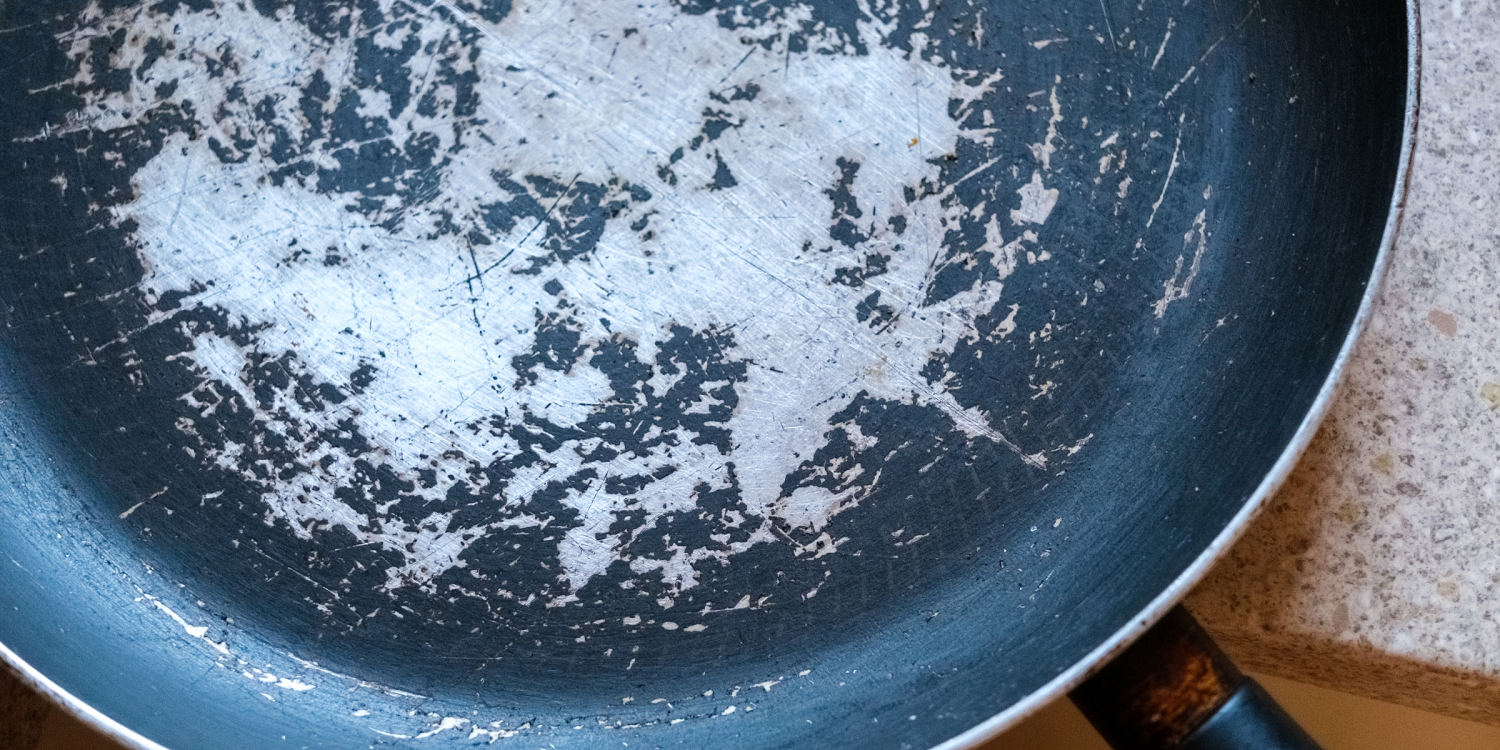
The degradation process is accelerated by mechanical stress. The interface between the aluminum or stainless steel substrate and the PTFE coating relies on an intermediate primer layer or a mechanically roughened metal surface (often achieved via grit-blasting or acid-etching). When metal utensils, abrasive scouring pads, or high-friction cleaning tools interact with the topcoat, microscopic fissures form. These fissures propagate downward through the coating layers, eventually exposing the base metal. Once the substrate is exposed, two failure modes occur simultaneously:
- Substrate Oxidation: Aluminum oxidizes at the base of the scratch, undermining the adhesion of the surrounding polymer film and causing flaking.
- Thermal Hotspots: Exposed base metals alter heat distribution, creating localized high-temperature zones that accelerate thermal degradation of adjacent PTFE.
The Thermodynamics of Thermal Shock and Delamination
Thermal shock represents a primary driver of structural failure in multi-clad and stamped aluminum nonstick pans. Aluminum exhibits a high coefficient of thermal expansion compared to the fluoropolymer coating and any applied stainless steel base plates. When a severely hot pan is plunged into cold water, the dimensional contraction rates of the underlying metal and the surface coating diverge sharply.
This differential movement creates severe interfacial shear stress. Over time, repeated thermal shock cycles overcome the bond strength of the primer layer, resulting in micro-delamination. While the surface may initially appear intact, internal pockets of separation form. These pockets disrupt thermal conductivity, producing uneven heating across the cooking surface, and eventually rupture through the top layer as blisters or peeling edges.
Quantifying Operational Wear Indicators
Replacing a nonstick pan should be governed by measurable performance criteria rather than cosmetic wear. Superficial surface scratching that does not expose the underlying metal does not compromise food safety or nonstick functionality; it merely alters the aesthetics. Conversely, functional failure manifests through specific, quantifiable operational changes.
Surface Energy and Release Failure
The defining characteristic of PTFE is its extremely low surface energy, which prevents food molecules from forming hydrogen bonds or van der Waals interactions with the pan. As the coating wears through microscopic abrasion, the effective surface energy increases. Food begins to stick not because the pan is dirty, but because the exposed substrate or thinned polymer layer no longer repels proteins and carbohydrates. When traditional release agents like oil or butter become mandatory for tasks that previously required no fat, the functional lifespan of the coating has expired.
Substrate Exposure Thresholds
The appearance of base metal—whether silvery aluminum or dark cast material—indicates a breached containment barrier. While ingested PTFE fragments pass through the human digestive tract inertly without systemic absorption, exposed reactive metals can leach into acidic or alkaline foods, altering flavor profiles and introducing unwanted metallic ions into the diet. Any visible breach extending to the substrate warrants immediate retirement of the cookware.
Warping and Geometric Deformation
Warping alters the mechanical interaction between the pan and the heat source. Induction cooktops require flat, continuous contact to complete the magnetic circuit; even a minor deflection reduces heating efficiency and triggers thermal protection shutdowns in modern induction ranges. On gas and radiant electric stoves, a warped bottom creates uneven oil pools, compromising culinary execution and accelerating localized thermal degradation where the metal makes direct contact with the hottest flame vectors or burner coils.
Economic Optimization and Replacement Cycles
The cost-per-use metric governs the financial logic of cookware management. Consumer-grade nonstick pans stamped from thin aluminum sheets typically exhibit an operational window of 12 to 24 months under regular home-cooking frequencies. Heavy-gauge forged aluminum or anodized aluminum pans paired with multi-layer reinforced coatings extend this window to 36 or 60 months.
Extending the life of a nonstick pan beyond its structural window yields diminishing returns. As thermal conductivity degrades and surface friction increases, energy consumption rises, cooking times lengthen, and the probability of ruined food increases. The total cost of ownership must account for the wasted ingredients and energy inefficiency associated with operating degraded equipment.
Operational Protocols for Maximizing Lifespan
Mitigating thermal and mechanical fatigue requires adherence to strict operating parameters. Temperature management is paramount; nonstick cookware should never be subjected to high-heat settings, as low-to-medium thermal profiles are entirely sufficient for the thermal conductivity properties of aluminum substrates.
Cleaning protocols must eliminate abrasive friction. Sponges utilizing nylon webs or cellulose compositions should replace metallic scouring pads. Furthermore, chemical degradation can occur when harsh dishwasher detergents containing strong alkalis and abrasive mineral additives etch the polymer surface over dozens of wash cycles. Hand washing with mild dish soap preserves the integrity of the topcoat significantly longer than automated mechanical washing.
Implement a strict equipment audit every six months. Inspect the cooking surface under direct, angled light to identify micro-abrasions, measure flatness against a straightedge to detect warping, and evaluate release performance using a dry-heat test. Retire units that fail any two of these three operational criteria.