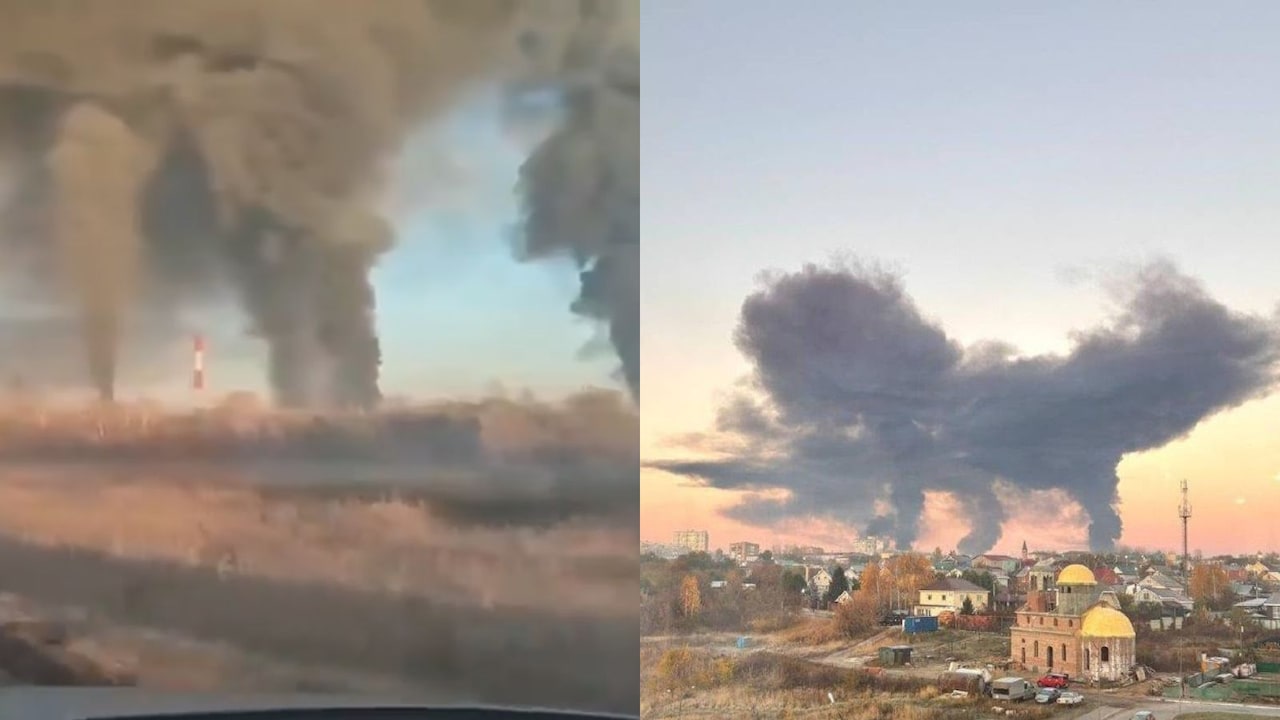
Thick black smoke rising over a Russian oil refinery isn't just another viral clip on your social feed. It's a visible sign of an asymmetric energy war that is actively rewriting global fuel markets, military logistics, and refinery engineering.
When footage of burning distillation towers circulates online, most coverage stops at the spectacle. You see the flames. You read a two-paragraph summary about air defenses and emergency crews. Then everyone moves on until the next video drops. That surface-level reporting completely misses why these strikes happen, how refineries actually break, and what a damaged processing plant in Eastern Europe means for fuel prices everywhere else.
What Actually Happens When a Drone Hits an Oil Refinery
People hear "oil refinery strike" and picture a giant underground pool of crude oil catching fire. That's rarely what happens. Crude storage tanks are massive, spread out, and relatively easy to bypass or replace.
The real targets are atmospheric and vacuum distillation units—the tall, complex cracking towers that separate raw crude into diesel, gasoline, and aviation fuel.
These towers are custom-engineered nightmares to fix. Unlike a punctured pipeline that a welding crew can patch in forty-eight hours, a distillation column relies on specialized precision components. Western energy sanctions since 2022 have cut Russian operators off from original equipment manufacturers in the United States and Europe. When a long-range drone carrying a few dozen kilograms of high explosive slams into a primary processing unit, the facility doesn't just lose a tank of fuel. It loses its ability to refine anything at all for months.
I've spent years tracking downstream energy infrastructure, and the pattern here is unmistakable. Attackers aren't trying to burn down an entire multi-square-kilometer industrial complex. They don't need to. Taking out a single catalytic cracker or hydrotreating unit bottlenecks the entire plant.
Why Dark Smoke Means Something Specific
If you watch those videos closely, the color and density of the smoke tell you almost everything about what is burning.
- Dense, oily black plumes usually indicate burning heavy hydrocarbons, crude oil, or diesel storage pools. The combustion is incomplete because the fire isn't getting enough oxygen, creating heavy carbon soot.
- Bright orange flames with lighter, thinner smoke often point toward pressurized gas leaks, flare stacks overloading, or lighter refined fractions like naphtha and gasoline igniting.
- Secondary explosions minutes after impact happen when heat weakens adjacent pressurized vessels, causing what engineers call a BLEVE—a boiling liquid expanding vapor explosion.
Firefighters at these sites face a brutal equation. You can't just spray water on burning hydrocarbons; water sinks beneath the oil, flashes to steam, and violently throws burning fuel outward. Crews have to rely on specialized firefighting foam and focus primarily on cooling neighboring intact units so the fire doesn't cascade across the entire facility.
The Economics Behind Asymmetric Drone Warfare
Look at the math. A long-range, one-way attack drone built from commercial-grade composites, a small combustion engine, and basic satellite or inertial navigation costs tens of thousands of dollars. Meanwhile, a mid-sized oil refinery represents billions of dollars in capital investment and generates millions in daily export revenue.
You don't need an economics degree to see how lopsided that exchange is.
Even when air defense systems intercept ninety percent of incoming drones, the ten percent that slip through inflict damage orders of magnitude more expensive than the entire attack wave. Defending a massive country's energy grid is practically impossible because refineries are fixed, sprawling, unarmored targets sitting hundreds of kilometers from the front lines. You can't wrap a 150-foot distillation tower in concrete.
How Refinery Outages Ripple Through Global Markets
Here is where people usually get confused about global oil prices. You might expect a burning Russian refinery to send crude oil prices skyrocketing overnight. Sometimes it actually does the exact opposite.
Think about the supply chain. Russia produces millions of barrels of crude oil every day. When its domestic refineries get knocked offline, the country suddenly has less capacity to turn that crude into diesel and gasoline at home.
So what happens to the unrefined crude? It gets pushed onto tankers and sold on the global export market instead.
That creates a weird split in energy markets:
- Crude oil supply stays steady or even ticks up, keeping raw benchmark prices relatively calm unless export terminals themselves are hit.
- Refined product markets tighten, especially for diesel and gasoil, because global refining capacity just shrunk.
- Domestic fuel shortages hit locally, forcing governments to impose temporary export bans on gasoline and diesel to keep domestic trucks, tractors, and military vehicles running.
When Moscow has previously enacted temporary fuel export bans following refinery maintenance and drone disruptions, global diesel margins immediately reacted. Europe, South America, and parts of Asia all compete for the same seaborne barrels of refined diesel. A fire in Ryazan, Nizhny Novgorod, or Samara changes the price of shipping freight in Rotterdam and Singapore.
Why Air Defenses Struggle Against Low-Altitude Drones
Every time a new refinery video surfaces, commentators ask the exact same question. How did a slow, noisy propeller drone fly hundreds of kilometers through defended airspace?
Physics and geography explain most of it.
Traditional radar networks are built to spot fast, high-altitude fighter jets and ballistic missiles. Because the Earth curves, ground-based radar has a blind spot close to the surface. A small drone flying fifty meters off the ground—hugging river valleys, forests, and power lines—stays hidden beneath the radar horizon until it's practically on top of its target.
Acoustic sensors and mobile machine-gun teams help, sure. Electronic warfare jammers can spoof GPS signals and knock commercial drones off course. But modern long-range attack drones increasingly use inertial navigation paired with optical terrain-matching cameras. They compare the ground below them to pre-loaded satellite maps. You can't jam a camera looking at a river bend.
And there is another problem nobody likes admitting. Moving air defense batteries away from front-line troops to guard dozens of individual oil refineries leaves military units exposed. Moving batteries away from refineries leaves the fuel supply exposed. There is no clean way out of that dilemma.
What Most Coverage Misses About Refinery Resilience
It's tempting to assume that a few viral videos mean a country's entire energy sector is collapsing. That's wishful thinking, and it ignores how resilient heavy industry actually is.
Soviet-era and modern Russian refineries were built with significant redundancy. Large facilities often run multiple parallel primary distillation units. If a drone destroys CDU-6, operators can sometimes reroute feedstock through CDU-4 or push other regional plants past their normal nameplate capacity to pick up the slack.
Repair crews have also gotten faster at improvising. While western sanctions block official replacement parts from companies like Honeywell or UOP, Chinese industrial suppliers and grey-market intermediaries have stepped into the gap for valves, pumps, and control electronics. Repairs take longer and cost way more than they used to, and patched-up equipment breaks down more frequently, yet offline capacity does eventually come back online.
The real impact isn't a sudden, cinematic collapse. It's a slow, grinding attrition. Every strike forces unscheduled downtime, drains specialized engineering labor, eats up foreign currency reserves for replacement parts, and lowers overall refining margins.
How to Read the Next Refinery Strike Headline Like an Analyst
The next time a video of burning oil infrastructure trends online, skip the sensationalist commentary and look for four specific details to understand whether the strike actually matters:
- Identify the specific facility and its daily capacity. A strike on a small regional depot processing 20,000 barrels per day is a tactical nuisance. A direct hit on a major hub like Omsk, Kirishi, or Ryazan—plants processing over 300,000 barrels per day—is a genuine market event.
- Check which unit burned. Look at satellite imagery and industry reports over the following forty-eight hours. If only a storage tank burned, production might resume within days. If a primary crude distillation unit or catalytic reformer took damage, expect a multi-week or multi-month outage.
- Watch diesel crack spreads, not just Brent crude. If you want to see how traders are pricing the damage, look at the price difference between raw crude oil and refined diesel. That spread tells you immediately whether the market expects a genuine product squeeze.
- Track official export policy shifts. Watch for sudden government announcements restricting gasoline or diesel exports. Policy changes confirm that domestic supply buffers are tightening far more reliably than social media footage ever will.
Understanding energy infrastructure turns passive news consumption into real situational awareness. Follow the processing capacity, watch the refined product spreads, and pay attention to the engineering bottlenecks rather than the smoke clouds.