Silence does not arrive all at once. It creeps in like fog over a harbor, blurring the edges of words until a crowded restaurant sounds like rushing water and a grandchild’s laugh turns into a muffled guess.
I know that fog intimately. Three years ago, after a sudden viral infection and a round of aggressive antibiotics, the high frequencies in my left ear simply vanished. Overnight, the crisp consonants of human speech—the s, the t, the f—dissolved into static. You sit at dinner tables nodding along, smiling at jokes you only half-heard, exhausting your brain just to stitch together syllables from context clues. You realize, with a cold, sinking dread, how fragile the architecture of human connection really is.
When you lose your hearing, the first thing an audiologist tells you is brutal in its finality.
Gone.
Inside the spiral shell of your inner ear—the cochlea—sit roughly fifteen thousand microscopic sensory hair cells. They are not actual hair, of course, though under an electron microscope they look like tiny, neatly arranged bundles of bristles swaying in an invisible current. When sound waves enter your ear, fluid ripples across these bristles, bending them like reeds in a river. That mechanical bend triggers an electrical signal that shoots straight to your brain, translating air pressure into a symphony, a siren, or a whisper.
Here is the catch that has haunted medicine for generations. In humans and all other mammals, once those hair cells break, wither, or die—whether from a rock concert, an aging body, or a toxic medication—they never grow back. Never. Unlike your skin, which knits itself shut after a paper cut, or your liver, which can regenerate entire lobes, your inner ear is a one-shot biological gamble. When the bristles break, the music stops permanently.
For decades, scientists have hunted for a blueprint to override that genetic dead end. They looked at birds, which can regrow damaged inner ear cells. They studied zebrafish, which carry similar sensory cells along the outside of their bodies to feel vibrations in the water. Yet the molecular code for rebuilding mammalian hearing remained stubbornly locked.
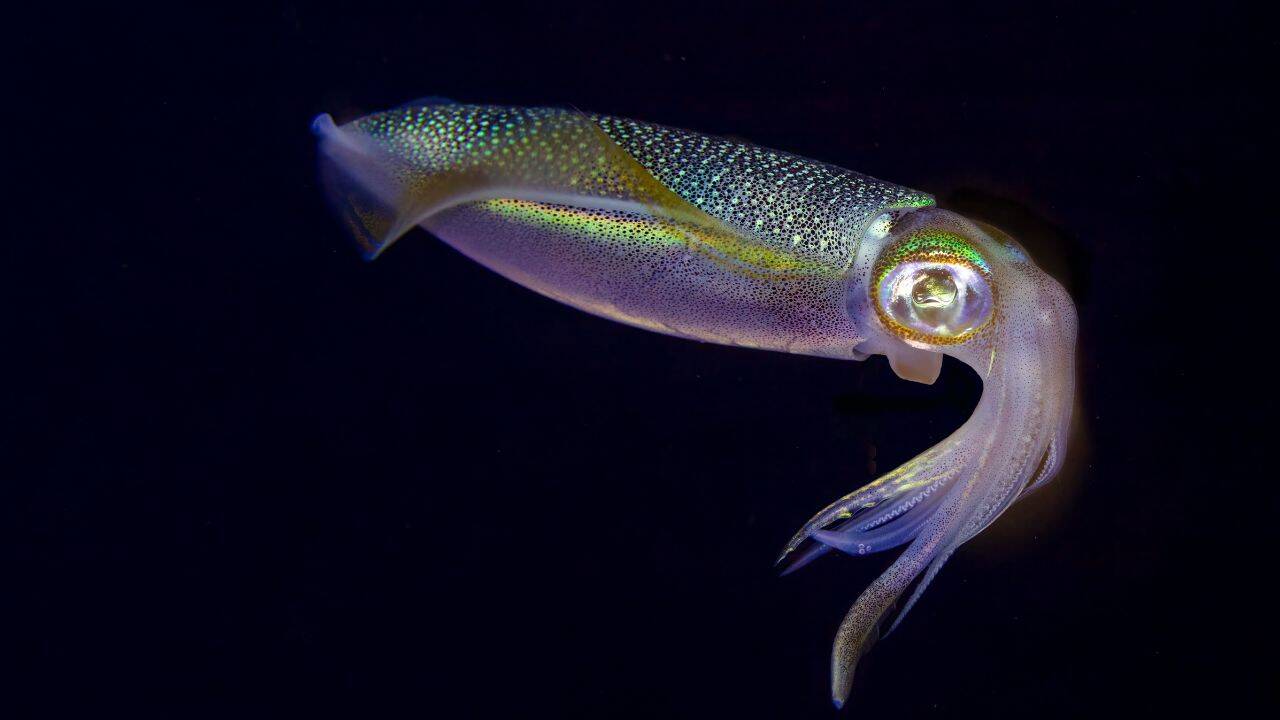
Then, marine biologists took a closer look at an animal we usually associate with ink clouds, calamari rings, and deep-ocean myths. They looked at the squid. And what they found across its translucent skin is rewriting our understanding of how sensory organs are built—and how they might one day be rebuilt in us.
A Suit of Armor Made of Touch
To understand why a squid holds the key to your ears, picture a hypothetical night dive forty feet below the surface of the Pacific. Let us call our diver Maya. In the pitch dark, Maya’s flashlight beam cuts through the black water and lands on a longfin inshore squid hovering motionless in the current.
To the naked eye, the squid looks smooth, slick, and entirely exposed. It has no external ears. It has no hard shell. In an ocean packed with sharks, dolphins, and larger fish hunting by movement and sound, the squid appears defenseless.
Yet the moment Maya twitches her fin three feet away, the squid fires a jet of water and vanishes into the dark before her eyes even register the motion.
How did it know she was there?
Recent breakthroughs in marine neurobiology—specifically research examining the epidermal lines running down the head, mantle, and arms of developing squid—revealed an astonishing sensory network. Scientists discovered hundreds of specialized sensory hair cells scattered directly across the squid's outer body.
Think of the squid as wearing a living, breathing acoustic suit. While humans tuck our fifteen thousand hair cells deep inside the hardest bone in the skull for protection, the squid wears its equivalent of the inner ear on the outside of its skin.
These cells, arranged in distinct lines along the squid's body, function as a hydrodynamic radar. Every time a predator flicks its tail, every time a current shifts, water pressure pushes against these microscopic hair bundles on the squid’s skin. Just like the cells inside Maya’s own cochlea, those bent bristles fire immediate electrical signals to the squid's nervous system, mapping the direction, speed, and size of nearby movement in total darkness.
This is not merely a neat evolutionary party trick. When researchers examined the genetics and cellular structure of these external squid hair cells, they stumbled onto a startling revelation. Despite evolving on completely separate branches of the evolutionary tree—separated by over five hundred million years from our last common ancestor—these cephalopod cells share deep developmental and structural parallels with the mechanosensory hair cells of vertebrates.
Nature, it turns out, solved the problem of detecting vibration twice, using remarkably similar biological tools.
The Evolutionary Echo Inside Your Skull
Pause and let the weight of that sink in. Five hundred million years ago, before dinosaurs walked the earth, before trees took root on dry land, a tiny, worm-like ancestor swam in ancient seas. Over eons, life split into radically different paths. One branch led to vertebrates—fish, amphibians, birds, and eventually humans sitting in quiet rooms reading articles on glowing screens. Another branch led to invertebrates—mollusks, octopuses, and squid.
Yet both branches relied on the exact same mechanical principle to perceive the physical world: tiny, hair-like projections called stereocilia and kinocilia bending in response to fluid motion.
In biology, when two vastly distant species develop nearly identical structures, scientists look closely at the underlying genetic switches that turn those cells on. Think of DNA not as a rigid blueprint, but as a massive library of recipes. Mammals still have the recipes for growing sensory hair cells inside our genetic library; we use them in the womb to build our ears in the first place. The tragedy of human hearing loss is not that we lack the recipe. It is that shortly after birth, our bodies slam the book shut, lock it in a vault, and throw away the key.
Squid, however, keep the book open on the kitchen counter.
As a squid grows from a tiny hatchling into an adult, it continuously adds new sensory hair cells across its expanding skin to maintain its radar coverage. Even more crucially, because those cells sit exposed to the abrasive ocean—scraping against rocks, battling currents, escaping predators—cephalopods possess active cellular machinery to generate, maintain, and repair these delicate structures throughout their lives.
You might wonder: Why haven’t we already cured deafness using fish or birds if they regrow hair cells too?
It is a fair question, and the honest answer reveals how messy and frustrating medical science actually is. For years, researchers focused heavily on chickens and mice. They learned how to force supporting cells in a mouse's inner ear to divide and turn into new hair cells in a petri dish. The catch? Those newly minted mammalian hair cells often grew up disorganized, failed to wire themselves properly to the auditory nerve, or died off quickly. We could spark the fire, so to speak, but we could not get the house to stay standing.
Studying squid gives researchers an entirely fresh comparative model—an evolutionary Rosetta Stone. By comparing the genetic pathways that build and sustain hundreds of accessible hair cells on the outside of a squid with the pathways that shut down inside a human cochlea, scientists can isolate the exact molecular brakes that keep human cells frozen in time.
Why Studying a Squid Beats Dissecting a Bone
There is also a practical, logistical breakthrough hiding in plain sight here, one that anyone who has ever waited years for a medical trial to move forward will appreciate.
Studying the human inner ear is a nightmare for researchers. The cochlea is tiny—roughly the size of a garden pea—and it is entombed inside the temporal bone, the densest bone in the human body. You cannot take a biopsy of a living person's inner ear without destroying their hearing. Even in laboratory mice, extracting and imaging intact hair cells requires painstaking micro-dissection that often damages the very tissue scientists want to observe.
Now contrast that with a squid embryo or hatchling.
A young squid is largely transparent. Its sensory hair cells are not buried inside solid bone; they sit right on the surface of its skin, bathed in seawater, completely visible under a microscope while the animal is alive and functioning.
Imagine you are a neurobiologist trying to watch a bridge being built. Studying a mammal is like trying to figure out how the bridge was constructed by drilling through a mountain after the builders have already gone home. Studying a squid is like standing on the riverbank in broad daylight, watching the engineers lay every rivet in real time.
Researchers can observe how a squid’s nervous system guides new axons—the wiring of the nervous system—to connect cleanly to newly formed hair cells. They can see how the supporting cells around the hair bundles organize themselves so the bristles point in the exact right direction to detect directional flow. In human hearing, directionality is everything; if regenerated hair cells grow back pointing at random angles, the brain receives garbled noise instead of clear speech. Watching squid assemble these arrays with geometric precision on their skin offers a living masterclass in cellular engineering.
The Invisible Weight of the Quiet World
Whenever a story like this makes headlines, a familiar wave of skepticism rolls in. Great, people think, another miracle discovery in a sea creature that won't help anyone for thirty years.
I understand that cynicism. When you are the one asking people to repeat themselves three times at the pharmacy counter, or avoiding phone calls because you cannot read lips through a receiver, distant scientific breakthroughs can feel like cold comfort. Hearing aids help—mine sits tucked behind my left ear right now, a tiny marvel of silicon and algorithms—but any hearing aid user will tell you the truth: amplifying sound is not the same as restoring hearing. A hearing aid turns up the volume on the whole room, magnifying the clatter of forks and the hum of the air conditioner right alongside your partner's voice.
More than four hundred and thirty million people worldwide live with disabling hearing loss, a number projected to climb past seven hundred million over the next few decades. And the cost is not just social isolation. Groundbreaking epidemiological studies over the past decade have uncovered a terrifying link between untreated hearing loss and cognitive decline. When the brain has to work overtime every waking second just to decode muffled sounds, it steals cognitive bandwidth from memory and thinking. Mild hearing loss doubles the risk of dementia; severe hearing loss increases it fivefold.
Hearing is not a luxury sense. It is the tether that keeps our brains anchored to the world around us.
That is why discovering hundreds of sensory hair cells across the body of a squid matters so profoundly. It is not about turning humans into sea creatures or harvesting squid DNA for sci-fi injections. It is about cracking the fundamental rules of how biology builds a vibration sensor from scratch—and how it keeps that sensor alive against wear and tear.
Decoding the Switch
Let us pull back the curtain on what happens next in the laboratory, using a simple analogy to make sense of the genetics.
Think of a damaged human inner ear like an abandoned factory. The assembly lines—the supporting cells that sit right next to the dead hair cells—are still sitting on the factory floor. The power is still connected to the building. Yet the main breaker switch has been flipped to OFF, and heavy padlocks have been welded over the box.
When scientists analyze the genetic activity inside the skin of a squid as it grows new hair cells, they are essentially looking at the wiring diagram of an identical factory where the lights are blazing and the assembly lines are running 24 hours a day.
By sequencing the RNA of these squid cells—reading the active chemical messages the DNA is sending out—researchers can identify the specific transcription factors, the molecular foremen, that walk onto the factory floor and order new hair cells to be built. Then, they can cross-reference those molecular foremen with the human genome.
In many cases, the exact same proteins exist inside our own cells, lying dormant.
If researchers can pinpoint the precise combination of molecular signals that tells a squid's skin cell, "Become a sensory hair cell, orient yourself north, and plug into this nerve fiber," pharmaceutical companies can design targeted gene therapies or small-molecule drugs to deliver that exact same wake-up call inside the human cochlea. No scalpels. No robotic implants. Just a localized drop of medicine into the middle ear that persuades your own dormant cells to finish a job they abandoned before you were born.
We are not there yet. Science moves in deliberate, sometimes agonizingly slow steps, verifying every pathway, testing safety, ensuring that waking up dormant cells does not trigger uncontrolled growth. Anyone promising a cure tomorrow is selling snake oil.
Yet something fundamental has shifted. For generations, the dogma of audiology was absolute: what is lost in the inner ear is lost forever. Every time biologists uncover another ancient organism quietly regenerating the very cells we thought were irreplaceable, that dogma cracks a little wider.
Listening in the Dark
Late at night, when I take my hearing aid out and set it on the nightstand, the left side of my world drops into a thick, cottony hush. The hum of the refrigerator disappears. The rustle of the sheets against my left ear goes mute. I am reminded, every single night, of what it feels like to lose a piece of the sensory bridge connecting me to the room.
Five hundred million years ago, in the crushing, lightless depths of an ancient ocean, evolution forged a microscopic instrument so sensitive it could feel the faintest ripple of water displaced by a passing shadow. It stitched hundreds of those instruments across the sleek skin of the squid, giving a soft-bodied creature the power to "hear" the entire ocean with its skin. And half a billion years later, nature tucked that very same instrument inside the delicate spiral of your skull so you could hear a violin string vibrate, a raindrop hit a windowpane, or someone whispering your name across a dark room.
We have spent decades staring into the silence of the human ear, convinced the door was locked from the inside. It turns out the key was swimming in the dark all along.