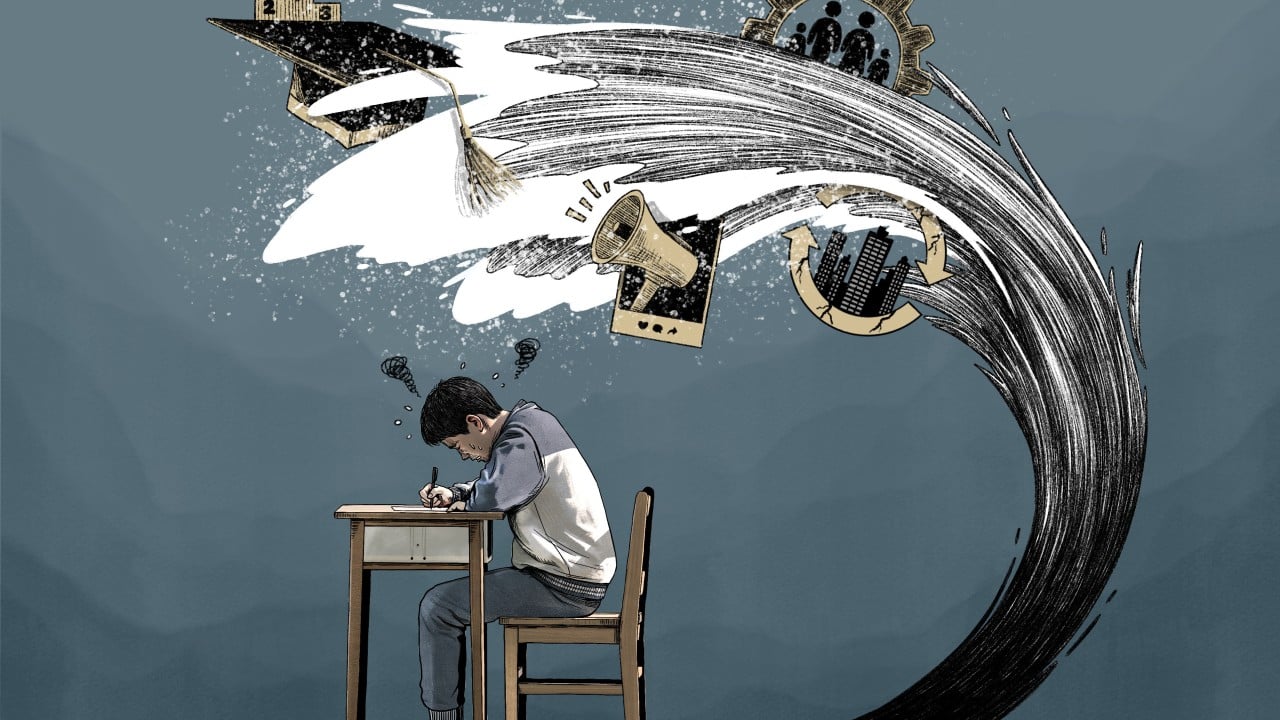
The onset of clinical anxiety and depressive symptoms among Chinese youth has migrated downward from university cohorts into primary school classrooms because the country’s talent-filtering architecture operates as a winner-take-all tournament with front-loaded elimination rounds. When a macroeconomic system restricts upward mobility to a narrow academic funnel, rational households respond by accelerating human capital investment earlier in the child’s developmental timeline, trading long-term psychological resilience for short-term testing variance.
Most journalistic accounts frame this crisis as a cultural quirk—an artifact of Confucian respect for scholarship or overbearing parenting. That diagnosis is analytically lazy. Parental behavior in urban and semi-urban China is an entirely predictable optimization response to structural incentives. When the return on investment for entering a top-tier university (Project 985 or Double First-Class institutions) diverges radically from the return on vocational or lower-tier tertiary tracks, risk-averse families treat childhood not as a period of cognitive exploration, but as an arms race in standardized test preparation.
The Architecture of Front-Loaded Filtering
To understand why eight-year-olds exhibit stress biomarkers previously associated with corporate executives, one must map the institutional bottlenecks governing Chinese social mobility. The system relies on two binary sorting mechanisms: the Zhongkao (high school entrance examination) and the Gaokao (national college entrance examination).
- The Mid-Teen Bottleneck: Under the Ministry of Education’s diversion policy, roughly 50 percent of students are channeled away from academic high schools into vocational tracks at age 15 based on Zhongkao scores. Because vocational credentials carry severe wage penalties and social stigma in the domestic labor market, the Zhongkao functions as an existential cliff.
- The Geographic Quota Distortion: Admission to elite universities is rationed by provincial quotas rather than a unified national cutoff. A student in Henan or Guangdong faces dramatically lower acceptance probabilities for Peking or Tsinghua University than a peer in Beijing or Shanghai, artificially inflating the required study hours per marginal point gained.
- The Signaling Monopoly: In a slowing macroeconomic environment marked by elevated youth unemployment, employers rely heavily on institutional pedigree as a cheap screening heuristic. When the job market contracts, the penalty for missing the top tier increases, pushing families to hedge against failure earlier.
This structure creates a classic Red Queen Effect: every household increases its investment in extracurricular tutoring, cognitive drilling, and sleep deprivation simply to maintain its relative rank. Because standardized exams grade on a curve, aggregate effort rises while individual probability of success remains static. The physiological cost of this zero-sum escalation is absorbed entirely by the developing nervous system of the child.
The Neurobiological Cost Function of Chronic Hyper-Vigilance
Treating academic pressure purely as a sociological phenomenon ignores the biological mechanisms translating external expectations into early-onset pathology. The human prefrontal cortex—responsible for executive function, emotional regulation, and impulse control—does not reach full maturation until the mid-twenties. Subjecting a nine-year-old brain to chronic, high-stakes evaluation alters neuroendocrine development through three distinct pathways.
First, continuous academic threat activates the hypothalamic-pituitary-adrenal (HPA) axis without adequate recovery intervals. In healthy stress cycles, acute cortisol spikes resolve once the stressor passes. In an environment governed by weekly rankings, public score postings, and parental anxiety, cortisol remains chronically elevated. Prolonged exposure to glucocorticoids impairs neurogenesis in the hippocampus, degrading memory consolidation—the very cognitive faculty the student is trying to optimize.
Second, systemic sleep restriction disrupts synaptic pruning and emotional processing. Primary and middle school students routinely average fewer than seven hours of sleep due to homework volume and late-night supplemental instruction. Rapid Eye Movement (REM) sleep is essential for stripping emotional charge from daily memories. When REM cycles are truncated, the amygdala remains hyper-reactive, lowering the threshold for anxiety responses and somatic symptoms such as chronic headaches, gastrointestinal distress, and insomnia.
Third, the externalization of self-worth produces fragile identity structures. Psychologists distinguish between internal locus of control (believing outcomes stem from personal agency) and contingent self-worth (tying personal value strictly to external metrics). When every waking hour is audited against a numerical rubric, children fail to develop intrinsic motivation or tolerance for ambiguity. When an inevitable academic setback occurs—a dropped rank in fifth grade or a failed mock exam in eighth—the child lacks the psychological scaffolding to separate a poor performance from total personal failure.
Why Policy Interventions Trigger Shadow Markets
In July 2021, Beijing introduced the Double Reduction policy, banning for-profit tutoring in core school subjects and restricting homework loads. Viewed through a purely regulatory lens, the policy aimed to decompress childhood schedules and lower household educational expenditure. Operational reality proved far messier, illustrating Goodhart’s Law: when a measure becomes a target, it ceases to be a good measure.
By suppressing the visible supply of commercial tutoring without altering the underlying scarcity of elite university seats, the state inadvertently drove test preparation underground while increasing its cost.
- Asymmetric Access: Wealthy households pivoted to private, one-on-one tutors disguised as "housekeepers" or "educational consultants," paying steep risk premiums. Middle- and lower-income families lost access to affordable group classes, widening the achievement gap and heightening parental panic.
- Metric Displacement: With written exams restricted in early primary grades, anxiety migrated toward alternative screening criteria—competitive coding, English proficiency tests, and specialized arts certifications—fragmenting children’s schedules across multiple high-pressure domains rather than concentrating on one.
- Institutional Risk Aversion: Public school teachers, still evaluated by local education bureaus on their cohorts' Zhongkao pass rates, face conflicting mandates. They are instructed to reduce homework while maintaining test performance, resulting in covert assignment distribution via parent messaging apps rather than official classroom boards.
The failure of Double Reduction to curb youth mental health deterioration demonstrates a fundamental rule of systems design: you cannot regulate away behavioral symptoms while leaving the incentive architecture intact. As long as one exam at age 15 and another at age 18 dictate lifetime earnings trajectories, parents will circumvent any administrative barrier placed between their child and a competitive edge.
The Clinical Supply-Demand Deficit
As the incidence of pediatric depression, self-harm, and school refusal rises, China’s healthcare infrastructure faces a severe structural mismatch. Historically, domestic psychiatric resources concentrated on severe psychotic disorders in adults rather than internalizing disorders—such as generalized anxiety and major depressive disorder—in minors.
The supply bottleneck operates across three layers:
- Specialist Scarcity: China has fewer than 500 full-time, specialized child and adolescent psychiatrists nationwide serving a population of over 250 million minors. General psychiatrists often lack training in developmental psychopathology, leading to frequent misdiagnosis or over-reliance on adult pharmacological protocols.
- School-Level Triage Failures: While policies mandate psychological counselors in primary and secondary schools, these roles are frequently filled by administrative staff or moral education teachers holding rudimentary weekend certificates. Furthermore, students rarely utilize campus counseling because confidentiality is porous; disclosures of suicidal ideation or severe distress are routinely reported directly to homeroom teachers and parents, converting the counselor into an extension of the disciplinary apparatus.
- Diagnostic Stigma: Within many households, psychiatric conditions are interpreted as moral weakness, malingering, or reputational damage to the family lineage. Parents frequently delay clinical intervention until the child exhibits acute somatic collapse or absolute school refusal, at which point acute inpatient stabilization is required rather than outpatient behavioral therapy.
Distinguishing Known Mechanics from Analytical Forecasts
Any rigorous assessment of this crisis must separate empirically established trends from structural projections.
Established Facts:
- Epidemiological surveys conducted by institutions such as the Chinese Academy of Sciences consistently show rising rates of depressive symptoms and sleep deprivation correlating directly with grade progression, with measurable spikes occurring as early as fourth grade.
- The structural ratio of academic high school seats to vocational seats remains fixed near 1:1 in most provinces, maintaining intense competitive pressure at age 15.
- Pediatric psychiatric outpatient visits in Tier-1 cities (Beijing, Shanghai, Guangzhou) have grown faster than general pediatric care over the past five years.
Analytical Hypotheses:
- Human Capital Depletion: If chronic stress impairs executive function and intrinsic curiosity during peak neuroplasticity, the cohort entering the workforce in the 2030s may exhibit high procedural compliance (test-taking proficiency) alongside depressed capacity for non-linear innovation—a severe liability for an economy attempting to transition from manufacturing to high-tech research and development.
- Demographic Feedback Loops: The financial and psychological toll of raising a child through this gauntlet acts as a primary suppressor of fertility rates. Young adults who experienced early academic burnout firsthand are increasingly refusing to reproduce the cycle, accelerating demographic contraction.
Limitations of Institutional Reform
Expecting rapid cultural or legislative resolution is unrealistic. Several structural constraints limit the speed and efficacy of potential interventions:
- Meritocratic Legitimacy: Despite its brutality, the Gaokao system is widely perceived by the Chinese public as the last remaining bulwark against nepotism and corruption. Replacing standardized exams with holistic admissions criteria—such as recommendation letters, extracurricular portfolios, or interviews—would immediately favor affluent, connected urban elites, triggering severe social backlash.
- Fiscal Constraints: Expanding the supply of elite universities to dilute scarcity requires massive capital expenditure at a time when local governments are heavily indebted and central budgets are strained by defense, industrial subsidies, and pension obligations.
- The Collective Action Trap: Individual parents cannot unilaterally disarm. A family that pulls its child out of the testing race to protect their mental health accepts a high probability of downward social mobility unless millions of other families do so simultaneously.
Structural Decoupling as the Only Viable Hedge
Addressing early-onset mental health deterioration requires dismantling the single-track dependency that links childhood compliance to adult survival. For policymakers, educational administrators, and institutional leaders operating within this system, incremental wellness campaigns—such as mindfulness assemblies or stress-management posters—are cosmetic distractions.
The required intervention is structural decoupling across three operational levers:
- Eliminate Irreversible Tracking at Age 15: Abolish the rigid Zhongkao diversion wall by integrating academic and vocational curricula into comprehensive secondary schools. Allowing students to transfer between technical and university-preparatory tracks up to age 18 removes the existential panic currently compressed into middle school.
- Equalize Post-Secondary Signaling: Redirect state funding away from hyper-concentrated elite university clusters toward regional applied-science institutions, while prohibiting state-owned enterprises and civil service recruiters from using Project 985 or 211 pedigree as an automated resume filter. Reducing the wage premium of the top 2 percent of universities lowers the rational incentive for parents to over-invest in primary school test prep.
- Mandate Independent Clinical Triage: Separate school psychological services from academic administration entirely. Fund third-party, community-based adolescent mental health clinics operating under strict medical confidentiality laws, staffed by licensed clinical psychologists rather than repurposed teaching faculty.
Until the economic cost of finishing in the middle of the academic distribution is reduced, households will continue to treat childhood as a high-risk capital allocation problem, and the clinical fallout will continue to surface in younger cohorts.