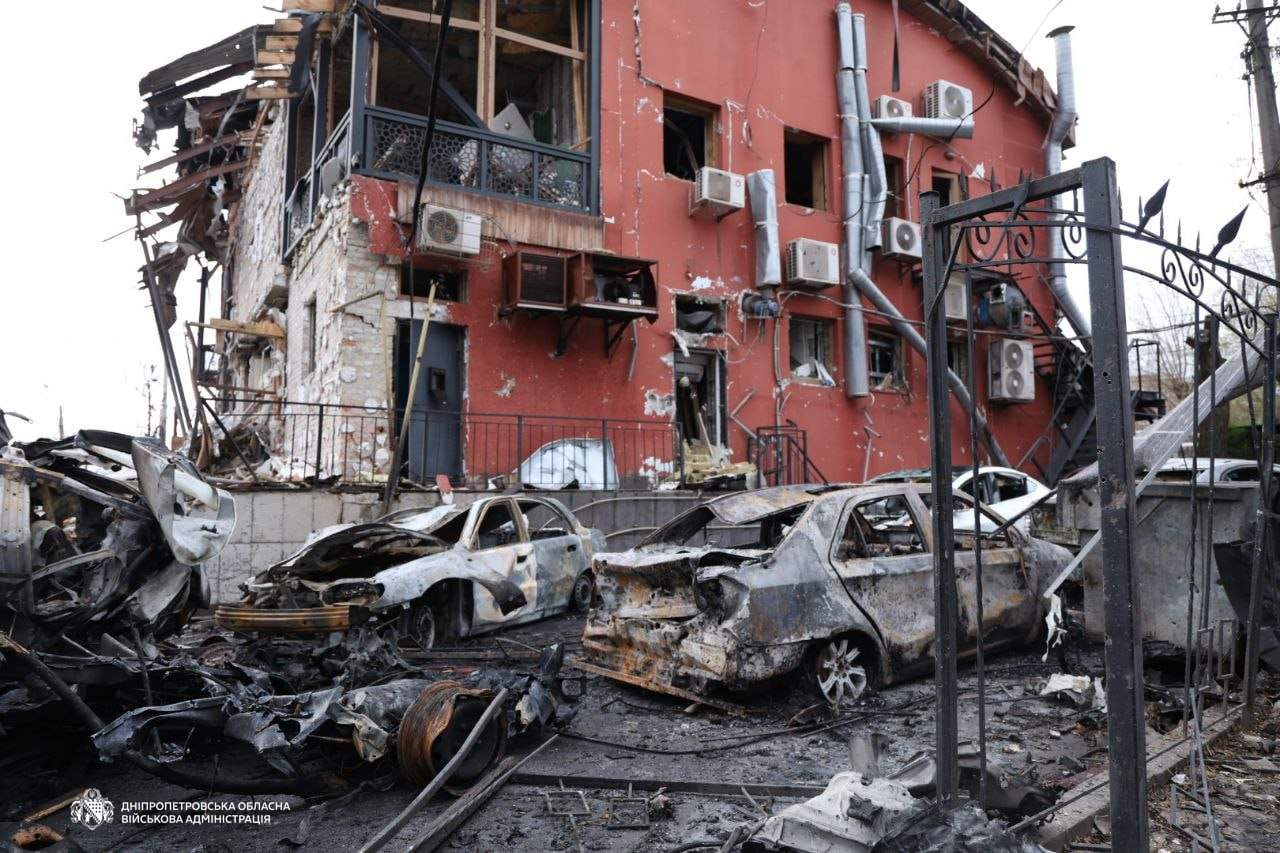
Two dead. Sixty wounded. Another headline about a ballistic missile tearing through central Ukraine, digested over morning coffee and forgotten by lunch.
Every major news desk runs the exact same playbook. They publish the casualty figures, quote a regional governor condemning the strike, mention the air raid sirens, and move on to the next news cycle. It is clean, predictable, and completely blind to what is actually happening on the ground.
When you reduce a ballistic missile strike in central Ukraine to a tragic box score, you are falling for the oldest trap in modern war reporting. You are measuring the kinetic splash while ignoring the strategic flood.
Ballistic missiles are not just oversized artillery shells designed to rack up a body count. In the geometry of modern warfare, a single Iskander-M or Kinzhal slamming into a central Ukrainian city like Kryvyi Rih, Poltava, or Dnipro is an economic, logistical, and psychological scalpel. Focusing exclusively on the immediate casualties obscures the real mechanics of attrition warfare—and guarantees that Western observers keep asking the wrong questions about how this war is being won or lost.
The Casualty Fallacy and the Economics of Air Defense
I have spent years analyzing defense procurement and air defense saturation models, and the single biggest blind spot among armchair commentators is treating every missile strike as an isolated moral tragedy rather than a line item on an industrial balance sheet.
Look at the math. A short-range ballistic missile like the Russian 9K720 Iskander travels at hypersonic speeds during its terminal phase—roughly Mach 6 to Mach 7—and follows a quasi-ballistic trajectory, meaning it can execute evasive maneuvers and deploy decoys before impact. Intercepting one requires top-tier Western systems like the MIM-104 Patriot PAC-3 or the Franco-Italian SAMP/T.
Here is the brutal asymmetry that standard news reports ignore:
- The Attacker's Cost: Russia produces ballistic missiles domestically under wartime mobilization, absorbing high costs in rubles while burning through subsidized state-run industrial capacity.
- The Defender's Cost: A single Patriot PAC-3 MSE interceptor costs roughly $4 million. Standard doctrine often requires firing two interceptors at a single incoming ballistic target to ensure a high probability of kill.
- The Geographic Trap: Central Ukraine is the logistical heartland connecting Western supply lines to the eastern and southern fronts. It is vast. You cannot put a Patriot battery over every rail junction, transformer station, and industrial depot in Poltava or Cherkasy.
When a missile gets through and kills two people and wounds sixty, the headlines scream about civilian suffering. Meanwhile, military planners in Kyiv and Washington are staring at a much darker reality. Every time Russia fires a ballistic missile into central Ukraine, it forces a Hobson's choice. Either Ukraine depletes an irreplaceable, multi-million-dollar interceptor meant to protect critical front-line staging areas, or it leaves the heartland exposed to terror and infrastructure degradation.
If you only count the dead and wounded, you miss the silent victory the attacker achieves even when a missile is intercepted—and the compounding strategic tax paid when it is not.
Why Central Ukraine Is the Real Center of Gravity
Standard coverage treats strikes in central Ukraine as random acts of cruelty because they happen hundreds of kilometers away from the trench lines in Donetsk or Zaporizhzhia. That is a fundamental misunderstanding of operational art.
Carl von Clausewitz defined the "center of gravity" as the hub of all power and movement on which everything depends. For Ukraine, the front line is merely the tip of the spear. The shaft—the heavy repair depots, the rail hubs, the power substations, the reserve training grounds, and the defense-industrial workshops—sits squarely in the central oblasts.
Think about what happens when a ballistic missile strikes an urban-industrial center in central Ukraine.
First, you have the immediate physical disruption. Even if the warhead misses its primary military or industrial target by fifty meters—which explains why adjacent apartment blocks take the blast wave and produce sixty wounded civilians—the shockwave halts operations. Power grids trip. Rail traffic freezes for hours while engineers inspect tracks for unexploded ordnance and structural damage.
Second, you trigger massive logistical dispersion. To survive ballistic missile threats, Ukrainian forces and manufacturers cannot concentrate assets. Instead of one efficient, centralized maintenance hub repairing damaged armored vehicles, they must scatter operations across dozens of smaller, concealed, and far less efficient facilities.
I have seen defense contractors burn millions of dollars and lose months of production speed simply trying to decentralize supply chains under persistent overhead threats. Dispersion saves lives, yes, but it destroys efficiency. It slows down the flow of ammunition, repaired howitzers, and medical supplies heading east. That friction—what military theorists call the cumulative drag of war—is the real objective of the strike.
Dismantling the "Terror Bombing" Myth
Whenever a ballistic missile hits a residential area or a commercial district in central Ukraine, the immediate consensus is that the strike was purely an act of state terror designed to break civilian morale.
Let's be brutally honest about the history of air power: strategic bombing almost never breaks civilian morale. From the London Blitz to the firebombing of Dresden, from Hanoi to Kyiv, attacking cities historically hardens public resolve rather than forcing surrender. Military planners on both sides of this conflict know this. They have read the exact same RAND Corporation studies and post-World War II Strategic Bombing Surveys.
So why do they keep firing ballistic missiles into populated central Ukrainian cities?
- Intelligence, Surveillance, and Reconnaissance (ISR) Compression: Unlike cruise missiles, which fly subsonically and give air defenders twenty to forty minutes of warning, a ballistic missile launched from Crimea or Belgorod hits central Ukraine in under five minutes. That compressed timeline leaves zero margin for moving high-value mobile targets—like air defense launchers, command posts, or troop concentrations—once the launch is detected.
- Double-Tap Attrition: A recurring, cold-blooded tactic in this war is striking a target, waiting twenty minutes for first responders, emergency crews, and military investigators to arrive, and then dropping a second ballistic missile on the exact same coordinates. That is not random terror; it is systematic targeting of specialized emergency infrastructure that cannot be easily replaced.
- Psychological Exhaustion Over Morale Collapse: There is a massive difference between breaking a population's will to fight and degrading their cognitive bandwidth. You do not need civilians to beg for surrender to win an operational advantage. You just need factory workers sleeping two hours a night because air raid sirens went off three times between midnight and 4:00 AM. Sleep-deprived engineers make mistakes. Exhausted logistics coordinators miss bottlenecks.
Calling these strikes "senseless terror" makes for emotionally satisfying journalism, but it is analytically lazy. It turns a cold, calculated campaign of systemic exhaustion into a caricature of irrational malice. If you underestimate the cold logic behind the strike, you will never build the right defense against it.
The Questions Nobody Is Asking About Air Defense
If you look at what people actually search for after these attacks, the queries reveal just how distorted public understanding has become. People ask why Ukraine didn't shoot the missile down, or whether NATO air defenses are failing. Both questions are built on flawed premises.
Why didn't air defense intercept a ballistic missile in central Ukraine?
Because interception is a game of physics and coverage radius, not a magic dome. A Patriot battery's anti-ballistic missile footprint is vastly smaller than its footprint against aircraft or cruise missiles. While a system might detect aircraft 150 kilometers away, its ability to intercept a terminal-phase ballistic missile is restricted to a tight bubble—often just 20 to 40 kilometers around the launcher itself. If a city in central Ukraine isn't sitting directly under one of the few available batteries, the missile falls unopposed. There is no "failure" of the system; the system simply wasn't there because there aren't enough of them on the planet to cover a country the size of Texas.
Are ballistic missile attacks increasing because Russia is winning?
No. In fact, heavy reliance on ballistic missile strikes against deep rear areas often signals frustration at the tactical front. When ground offensives bog down into costly, meter-by-meter meat grinders, commanders inevitably reach for long-range strike assets to demonstrate reach, appease domestic hawks, and try to interdict the enemy's rear before reinforcements reach the front. It is a symptom of stalemate, not a sign of an imminent breakthrough.
Can Ukraine stop these attacks by building more bunkers?
Concrete is necessary, not sufficient. You can harden command posts and build underground schools, which Ukraine is actively doing in cities like Kharkiv and Zaporizhzhia. But you cannot bury an entire electrical grid, a cross-country railway network, or every multi-story apartment building built during the Soviet era. Passive defense buys time, but it does not solve the shooter problem.
The Uncomfortable Truth About the Cure
Here is where the contrarian reality gets uncomfortable, and where my own argument runs straight into geopolitical friction.
You cannot win an air defense war on the defensive. Basic military doctrine—from Giulio Douhet to modern Pentagon joint operations manuals—is unequivocal on this point: trying to catch arrows in mid-air is a losing proposition. The only mathematically sustainable way to stop ballistic missile strikes in central Ukraine is to destroy the launchers, the storage depots, and the production facilities before the missiles ever leave the rail.
"Shoot the archer, not the arrow" sounds great in a Pentagon briefing room. In practice, it carries massive risks that standard commentators gloss over.
Strike deep inside Russian territory with Western-supplied long-range missiles, and you immediately collide with escalation thresholds, intelligence-sharing bottlenecks, and the hard reality of finite Western stockpiles. Even if every restriction were lifted tomorrow, Russia's sheer strategic depth means mobile Iskander launchers can hide in forests thousands of kilometers away, emerging for ten minutes to fire and vanishing before counter-battery assets can react.
Furthermore, shifting resources toward deep-strike capabilities cannibalizes funding and industrial capacity needed for basic front-line survival—155mm artillery shells, armored personnel carriers, and tactical drones. If you spend billions chasing mobile missile launchers in the Russian rear while your infantry runs out of mortar rounds in Donetsk, you lose the war on the ground while winning headlines in the air.
That is the real dilemma sitting on the desks of military planners right now. Every option carries a brutal price tag.
Stop Reading the Box Score
The next time a ballistic missile hits central Ukraine and the wire services push out another sterile bulletin—two dead, sixty wounded, rescue workers clearing rubble—do not just scroll past after registering a moment of sympathy.
Look at the map. Check the coordinates. Ask what rail line runs two kilometers west of the impact zone. Ask what power substation feeds the industrial district next door. Ask how many millions of dollars in air defense interceptors were burned in the surrounding oblasts that night, and how many hours of sleep an entire city just lost before their morning shift at the logistics depot.
Wars of attrition are not decided by the dramatic casualty counts that dominate the evening news. They are decided in the margins—in delayed freight trains, depleted interceptor magazines, fragmented supply chains, and exhausted populations pushed to the edge of cognitive collapse.
The headline tells you two people died. The strategy tells you an entire region was just forced to pay a tax it can barely afford. Start reading the war for what it actually is, not for how neatly it fits into a news alert.