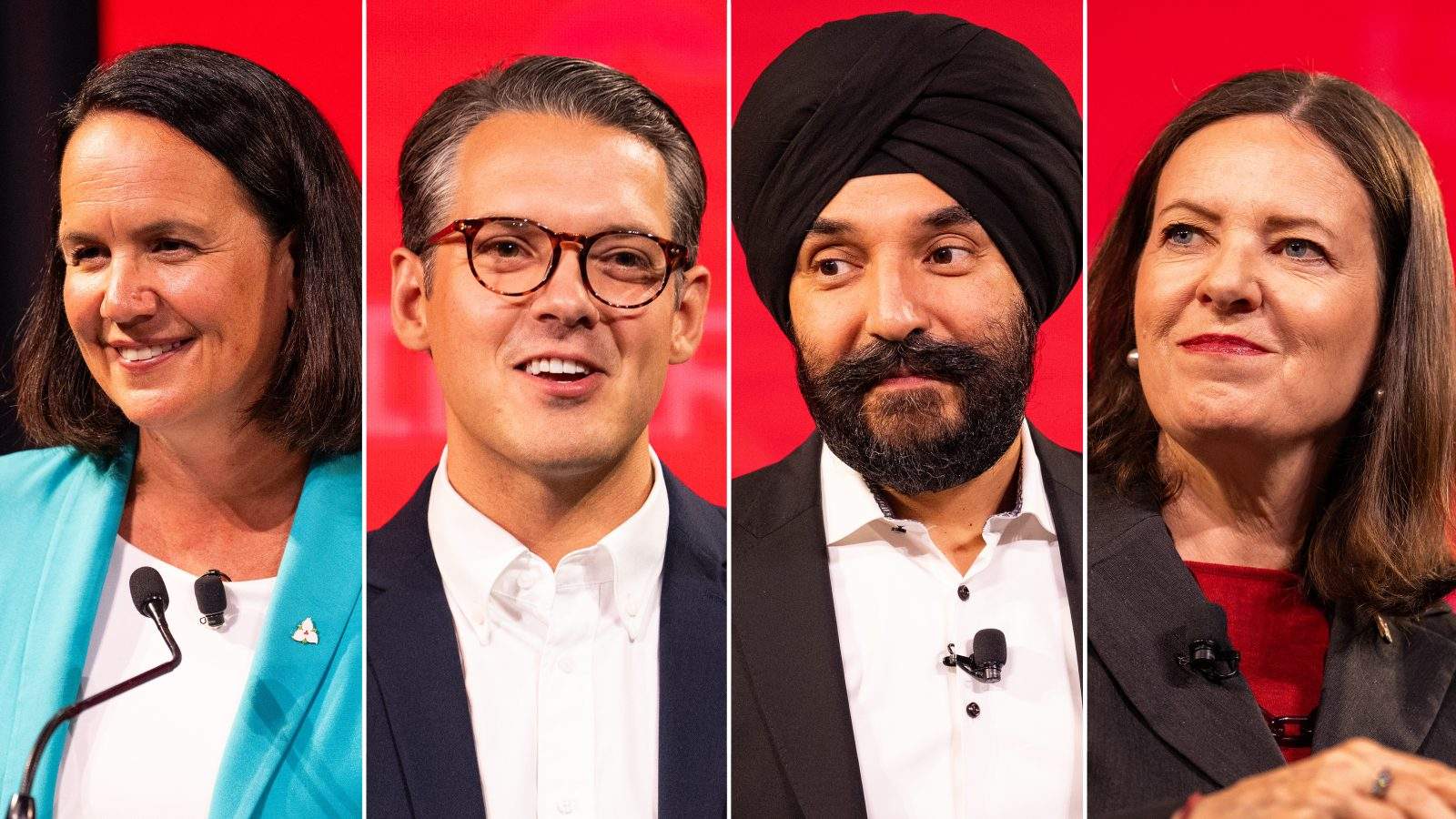
Political commentators treat party leadership conventions like championship games, operating under the assumption that swapping out the person at the podium automatically fixes a broken electoral machine. Standard coverage of the Ontario Liberal Party naming a new leader after weeks of ranked-ballot voting frames the announcement as a definitive turning point. According to traditional political reporting, a fresh face, a unified caucus, and a renewed policy platform are the primary ingredients required to rebuild a party that lost official party status in back-to-back provincial elections.
That perspective mistakes a symptom for the disease. While party insiders and political observers debate the merits of individual candidates, membership sign-up numbers, and down-ballot transfer strategies, structural political science suggests that leadership changes rarely alter a party's baseline trajectory on their own. In Canadian provincial politics, the mechanics of voter realignment, regional polarization, and grassroots infrastructure carry far more weight than the personality occupying the leader's office.
The Myth of the Political Savior
In modern parliamentary democracies, media coverage heavily personalizes politics. Journalists focus on leadership races because conflict, personality clashes, and horse-race metrics are easy to narrate. However, political scientists who study electoral behavior—such as those contributing to the Canadian Election Study—consistently find that leadership effects are largely conditional. A leader can amplify an existing wave of public sentiment, or accelerate a collapse, but a leader rarely manufactures a coalition out of thin air.
When a party suffers catastrophic losses, as the Ontario Liberals did in 2018 and 2022, the instinct is to search for a charismatic communicator who can win back suburban swing voters. Yet this approach ignores why those voters left in the first place. Electoral shifts in Ontario are deeply tied to structural economic pressures, housing affordability, healthcare capacity, and shifting demographics across the Greater Toronto Area (GTA) and southwestern Ontario.
Consider the mechanics of Ontario's electoral map. Winning a majority at Queen's Park requires dominating the suburban belt surrounding Toronto—areas like Peel, York, Halton, and Durham—while holding urban cores and remaining competitive in eastern and northern ridings. Between 2018 and 2022, the Ontario Liberals did not simply lose because their leaders failed to deliver sharp debate lines. They lost because the Progressive Conservatives successfully built a working-class, private-sector union coalition in the suburbs, while the New Democratic Party (NDP) consolidated progressive urban and northern seats. Naming a new leader after a weeks-long voting process does not automatically dismantle the opposing party's ground game in Mississauga or Brampton.
The Structural Flaws of Ranked-Ballot Membership Drives
To understand why leadership races often create a false sense of momentum, look closely at how Canadian political parties select their leaders. Most provincial and federal parties use a weighted one-member, one-vote system, often utilizing a ranked ballot where every riding is assigned an equal number of points regardless of how many party members actually live there.
Proponents of this system argue that it forces candidates to build broad geographic support across the province rather than relying solely on dense urban centers. Critics and electoral reform analysts, however, point out several structural distortions inherent to this process:
- Artificial Membership Inflation: Leadership campaigns rely on "instant members"—individuals signed up by campaign teams solely to cast a ballot in the leadership contest. Political organizers routinely acknowledge that a massive percentage of these new members do not donate money, volunteer during general elections, or even remain engaged with the party six months after the convention.
- The Compromise Candidate Effect: Ranked ballots reward second- and third-choice appeal. While this prevents a fringe candidate from winning with a narrow plurality, it frequently produces a consensus choice who offends the fewest party factions rather than someone who inspires general election voters.
- Financial Depletion: Prolonged leadership races drain millions of dollars from the exact same donor pool that the party needs to fund its general election campaign. Instead of paying down party debt or hiring full-time field organizers in marginal ridings, donor money goes toward internal campaign consultants, digital ads targeting existing partisans, and convention logistics.
Imagine a scenario where a leadership campaign signs up 15,000 new members across 124 ridings. On paper, the party boasts a revitalized grassroots base. In reality, if 12,000 of those members were signed up via a free membership drive orchestrated by a single candidate's team, the local riding associations still lack the boots on the ground required to knock on 40,000 doors during a cold February provincial election.
What Voters Actually Ask Versus What Insiders Debate
When political pundits analyze a leadership convention, they ask questions about internal party unity, caucus endorsements, and ideological positioning along the left-center spectrum. When everyday Ontario voters think about provincial politics, their concerns are entirely different.
Does a new leader automatically restore official party status?
No. Official party status in the Ontario Legislative Assembly requires winning at least 12 seats—a threshold set by the Legislative Assembly Act (which the Progressive Conservative government raised from eight seats in 2018). Achieving this requires winning specific geographic contests under the First-Past-the-Post (FPTP) electoral system. In 2022, the Ontario Liberals actually won a slightly higher share of the popular vote (23.85%) than the Ontario NDP (23.74%), yet the NDP won 31 seats to the Liberals' eight. Why? Because the Liberal vote was inefficiently distributed—finishing second in dozens of ridings without winning enough pluralities. A new leader cannot overcome vote inefficiency without targeted, riding-by-riding organizational strength.
Can the party simply pivot to the center to win back Progressive Conservative voters?
Many political strategists argue that the path back to power lies in occupying the traditional "radical center"—promising fiscal restraint alongside targeted social spending. However, political science research on spatial voting models shows that when an incumbent government successfully occupies the center-right on economic issues while neutralizing traditional wedge issues through infrastructure spending and targeted tax cuts, a simple rhetorical pivot by the opposition fails to move voters. Voters rarely abandon a governing party they view as competent on bread-and-butter issues simply because an opposition party adopts similar talking points.
Why does voter turnout matter more than leadership approval ratings?
In the 2022 Ontario general election, voter turnout plummeted to 43.5%—the lowest in provincial history. Over half of eligible voters stayed home. Analysts from organizations like Elections Ontario and academic observers noted that the collapse in turnout disproportionately hurt opposition parties. When voters feel disengaged or convinced that the outcome is predetermined, they do not switch parties; they abstain. Reversing historic apathy requires sustained, year-round community organizing and clear, material policy distinctions—not a weekend media bump from a leadership convention.
The Real Work Starts After the Convention
If selecting a new leader is merely the starting gun rather than the finish line, how do opposition parties in parliamentary systems actually rebuild from near-collapse? History and political science point to three unglamorous, infrastructure-heavy priorities that matter far more than the leader's personal brand.
1. Rebuilding Riding Associations in Non-Target Seats
In many Ontario ridings, local Liberal riding associations became dormant shells following consecutive defeats. Without active local executives, parties cannot recruit high-caliber local candidates early, raise localized funds, or maintain voter databases. Successful political rebuilds require investing central party resources into ridings the party expects to lose in the next cycle, simply to build the organizational muscle memory needed to compete two cycles down the road.
2. Mastering Modern Data and Voter Identification
Modern election campaigns are won through precise voter identification and turnout modeling, not broad television appeals. Parties in power enjoy immense data advantages through legislative resources and continuous fundraising. An opposition party rebuilding from single-digit seat counts must focus relentlessly on upgrading its voter relationship management software, tracking demographic shifts in high-growth municipalities, and identifying soft supporters years before the writ drops.
3. Defining a Coherent Policy Identity
Voters punish parties that appear opportunistic. When an opposition party attempts to critique the government from the left on healthcare spending while simultaneously critiquing it from the right on fiscal deficits, voters perceive a lack of core conviction. Political theorists emphasize that durable electoral coalitions are built around a clear, predictable value proposition. Whether an opposition party chooses to champion aggressive public sector investment, radical housing supply deregulation, or structural tax reform, it must commit to a consistent narrative long enough for low-information voters to actually hear it.
The Limits of the Institutional Rebuild
Admitting that leadership races are overhyped does not mean the person at the top is irrelevant. Even the most well-funded, data-driven grassroots organization will stall if the party leader is prone to unforced errors, struggles to command media attention, or fails to hold a fragile caucus together under pressure. In a media environment dominated by short-form video and algorithmic news feeds, a leader's inability to communicate clearly can undermine years of local organizing in a single news cycle.
Furthermore, rebuilding party infrastructure takes time—often two full electoral cycles—while donors, media outlets, and party activists demand immediate results. A leader who focuses exclusively on long-term organizational health risks facing an internal revolt if polling numbers do not improve within 12 to 18 months.
Ultimately, the conclusion of a weeks-long voting process gives the Ontario Liberals a spokesperson, a fundraising draw, and a temporary burst of earned media. What it does not give them is a guaranteed seat count, a revitalized donor base, or a solution to the geographic vote inefficiency that has kept them sidelined at Queen's Park. Until the party solves the structural mechanics of how it organizes, funds, and differentiates itself across Ontario's shifting electoral map, the name on the leader's office door remains a secondary detail.