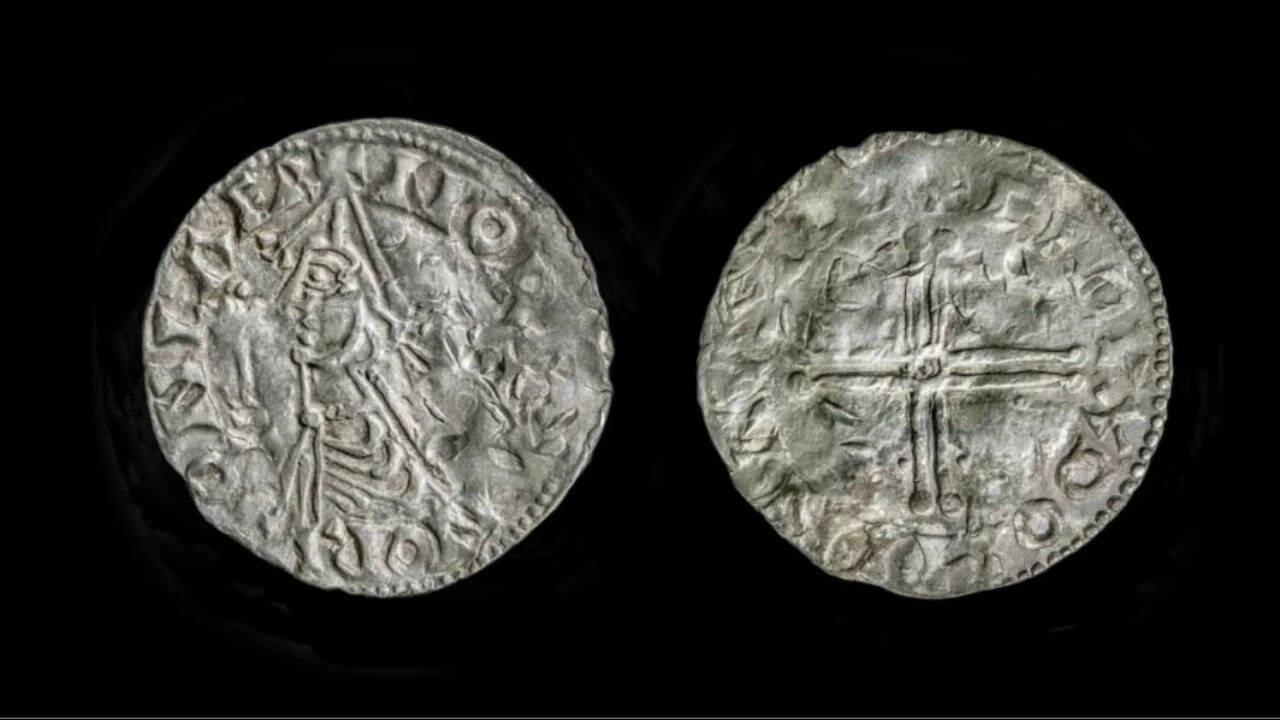
In a plowed field in Trøndelag, central Norway, a metal detectorist uncovered a silver coin struck during the reign of King Olaf Haraldsson—later canonized as Saint Olaf—marking the first time such a penny has been found in the country since 1924. Pulled from the largest Viking Age silver hoard ever documented on Norwegian soil, the discovery does far more than satisfy antiquarian curiosity. It forces historians to redraw the economic map of eleventh-century Scandinavia and proves that Norway's earliest domestic currency circulated much closer to the political heartland of Trøndelag than surviving records previously indicated.
For over a hundred years, numismatists have operated with a glaring blind spot. While thousands of foreign coins from England, Germany, and the Islamic world regularly turn up in Scandinavian soil, coins minted by Norway's own Viking kings remain vanishingly rare. Until this excavation, the total global inventory of known Olaf Haraldsson pennies hovered around a dozen specimens, almost all of them found outside Norway in regions like Gotland or modern-day Poland. The absence of domestic finds led many scholars to assume Olaf's minting operation was purely symbolic—a vanity project designed to mimic Anglo-Saxon kings rather than a functioning medium of exchange.
The 1924 Ghost and Why Domestic Minting Vanished
To understand why this single silver disc matters, you have to look at the mechanics of Viking Age commerce. In the early eleventh century, Scandinavia ran on a bullion economy. Merchants did not care whose face was stamped onto a piece of metal; they cared about weight and silver purity. They carried portable balance scales and routinely hacked silver armbands, brooches, and foreign coins into fragments known as hacksilver to settle debts.
Coinage, by contrast, is an instrument of state control. When a king strikes his own coins, he is attempting to replace raw bullion with a fiat-adjacent currency whose value is guaranteed by royal authority—and taxed accordingly. Olaf Haraldsson, who ruled Norway from 1015 to 1028, understood this well. Having spent years fighting as a mercenary in England alongside Æthelred the Unready, Olaf saw firsthand how a centralized minting system funded armies and consolidated royal power.
When he returned to Norway to claim the throne, he brought English moneyers with him. The surviving coins from his reign bear unmistakable Anglo-Saxon design hallmarks, including the king's profile and Christian iconography. Yet, for reasons that have baffled researchers since the last domestic discovery in 1924, those coins simply disappeared from the Norwegian archaeological record.
Two competing theories emerged over the twentieth century to explain this absence:
- The Political Collapse Theory: Olaf's aggressive push to Christianize Norway and centralize tax collection alienated powerful regional chieftains, particularly the Earls of Lade in Trøndelag. When Olaf was driven into exile in 1028 and killed at the Battle of Stiklestad in 1030, his currency may have been actively recalled, melted down, or rejected by a populace hostile to his rule.
- The Export Drain Theory: Because domestic Norwegian merchants preferred weighing raw silver over counting stamped pennies, Olaf's coins may have flowed immediately outward through Baltic trade networks, ending up in hoards in Sweden, Denmark, and Slavic territories where foreign silver was readily absorbed.
The Trøndelag hoard complicates both narratives. Finding an Olaf penny in the very region that orchestrated his downfall suggests his coinage penetrated local trade networks deeper and faster than the Political Collapse Theory allows.
Anatomy of Norway's Largest Viking Hoard
Numbers tell the story here. Most Viking Age hoards discovered in Norway consist of a few dozen items—a small stash buried by a moderately wealthy farmer during a period of local unrest. The Trøndelag assemblage operates on an entirely different scale, containing hundreds of individual silver artifacts weighing several kilograms in total.
The composition of the hoard reveals a transitional economy caught between two worlds. Alongside the rare King Olaf penny, excavators documented dense concentrations of hacksilver, twisted neck rings, chopped armlets, and foreign coinage—predominantly Anglo-Saxon pennies minted under Æthelred II and Cnut the Great, alongside German pfennigs from the Ottonian dynasty.
This mixture is critical. If a hoard contains only raw bullion, it points to an older, purely weight-based trade system. If it contains only domestic coins, it signals a mature, regulated monetary economy. The Trøndelag find captures the exact historical friction point where the two systems collided. Whoever buried this silver treated Olaf's royal penny not as a special political artifact, but as raw capital to be stored alongside chopped bracelets and English loot.
Why Trøndelag Matters Geographically
Geography is never neutral in Viking archaeology. Trøndelag sits along the Trondheim Fjord, a natural superhighway connecting the North Atlantic coast to the overland routes leading into Sweden. In the early eleventh century, this was the seat of the Earls of Lade, the most formidable political rivals to the Norwegian crown.
Olaf Haraldsson spent much of his reign trying to break the autonomy of the Trøndelag chieftains. Establishing a foothold in Nidaros (modern Trondheim) was essential to his strategy, and archaeologists have long suspected that Nidaros housed one of his primary mints. Yet without physical coins recovered from the surrounding soil, that hypothesis rested largely on textual references in later medieval sagas—sources notorious for embellishing the achievements of Norway's patron saint.
Recovering an Olaf penny directly from Trøndelag soil provides the missing physical link. It anchors the literary claims of the sagas to hard metallurgical reality.
The Forensic Reality of Modern Metal Detecting
It is worth addressing the elephant in the trench: this discovery did not begin with a university grant or a grid-mapped academic dig. It began with a private citizen sweeping a coil over agricultural land.
Across Scandinavia, hobbyist metal detecting has triggered a quiet revolution in Iron Age and Viking archaeology, though not without severe growing pains. Plowed fields represent an active destruction zone for shallow cultural deposits. Modern deep-tilling machinery routinely shatters buried ceramic vessels and scatters coin hoards across dozens of meters, exposing silver to chemical fertilizers that accelerate corrosion.
Norway's cultural heritage laws operate on a strict state-ownership model. Under the Cultural Heritage Act, any object predating 1537—along with coins older than 1650—is automatically the property of the state. Finders are legally required to halt digging once a significant deposit is detected, mark the GPS coordinates, and surrender the artifacts to regional museum authorities in exchange for a state-appraised finder's fee.
Critics of hobbyist detecting argue that amateur searches strip artifacts from their micro-stratigraphic context before trained conservators can document soil layers. That criticism is valid when detectorists dig indiscriminately. However, in cases where the finder follows protocol—stopping at the first cluster of signals and calling in county archaeologists—the partnership rescues data that agricultural equipment would otherwise pulverize within a decade.
When the excavation team moved into the Trøndelag site, they did not simply pull metal out of the mud. They excavated the hoard in blocks, transporting chunks of soil directly to conservation laboratories for X-ray imaging and micro-excavation. That methodological rigor is the sole reason researchers were able to identify the fragile Olaf penny without damaging its stamped surface.
Metallurgical Clues and Minting Signatures
Look closely at an eleventh-century Norwegian penny under magnification, and the technical limitations of early medieval minting become immediately obvious. Unlike modern industrial coinage, which relies on hydraulic presses to stamp uniform designs onto machine-rolled blanks, Viking Age coins were struck by hand using iron dies and a hammer.
A moneyer placed a heated blank silver flan between two engraved dies—the obverse (heads) fixed into an anvil, and the reverse (tails) held in hand—and struck the top die with a heavy mallet. If the hammer blow landed slightly off-center, the resulting coin emerged unevenly stamped, with portions of the legend missing or double-struck.
Early Norwegian pennies were notoriously thin, often weighing around 1.0 to 1.3 grams, making them brittle after a thousand years of oxidation in acidic soil. Surviving a century of modern plowing without snapping in half is a statistical anomaly.
Metallurgical analysis of the Trøndelag specimen will focus on two primary variables:
- Silver Fineness: Determining the exact percentage of silver versus copper or lead trace elements reveals whether Olaf's mints had access to fresh bullion supplies or were melting down older Anglo-Saxon coins—likely acquired through Danegeld tribute payments—to strike new domestic currency.
- Die-Link Analysis: By comparing microscopic flaws, die cracks, and lettering styles on the newly discovered coin against the handful of surviving Olaf pennies in museum vaults in Oslo, Stockholm, and Copenhagen, numismatists can determine whether this specimen was struck from the exact same iron die as previously known examples.
A confirmed die-link would allow researchers to map the physical distribution path of a single batch of coins leaving a specific workshop, offering a high-resolution snapshot of eleventh-century trade routes.
The Gray Areas historians Rarely Admit
Media coverage of Viking hoards inevitably leans toward romanticism—tales of buried treasure, legendary kings, and lost history reclaimed. The reality is messier, and any honest assessment of the Trøndelag find has to confront what we still do not know.
First, a single coin does not prove widespread currency adoption. Finding one Olaf penny inside a massive hoard dominated by foreign silver and hacksilver shows that the coin existed and circulated in Trøndelag, but it also confirms that domestic coinage remained a tiny fraction of the total silver supply. Ordinary Norwegians were not buying bread with Olaf pennies; they were still hacking off chunks of silver wire and weighing them on brass scales.
Second, dating the burial of a hoard is an exercise in approximation, not precision. Archaeologists determine the terminus post quem—the earliest possible date a hoard could have been buried—by identifying the youngest coin in the assemblage. If the Olaf penny is the newest item in the ground, the hoard could not have been buried before his reign began in 1015. However, coins frequently stayed in circulation for decades. The silver could have been hidden during the turbulent years leading up to the Battle of Stiklestad in 1030, or it could have been buried twenty years later during the civil conflicts of Harald Hardrada's reign.
Finally, we will never know why the owner failed to return for it. Hoards are, by definition, failed retrieval events. The person who buried several kilograms of silver in Trøndelag either died violently, fled into exile, or forgot the exact landmark in a shifting agricultural clearing.
Rewriting the Timeline of Norwegian Statehood
For generations, the standard historical narrative treated Olaf Haraldsson's reign as a political failure that only succeeded posthumously through his transformation into Saint Olaf, the eternal patron of Norway. His attempts at state-building—codifying Christian laws, taxing regional chieftains, and minting royal currency—were viewed as premature experiments that collapsed the moment Cnut the Great's fleet sailed into Norwegian waters in 1028.
The Trøndelag hoard chips away at that consensus. Minting coins requires an organized supply chain: silver acquisition, skilled foreign artisans, secure workshops, and a distribution mechanism capable of pushing currency into contested territory. The presence of an Olaf penny in the heart of Trøndelag demonstrates that his administrative machinery functioned on the ground, even in regions governed by his fiercest rivals.
Now comes the slow, unglamorous work inside the conservation lab. Each oxidized lump of silver in the Trøndelag assemblage must be mechanically cleaned under a microscope, weighed, cataloged, and cross-referenced against international numismatic databases. As the remaining soil blocks are X-rayed and dismantled over the coming months, researchers face a distinct possibility that has eluded Scandinavian archaeology since 1924: this single rare coin might not be alone in the dirt.