Most history textbooks treat Kublai Khan’s 1281 invasion of Japan like a sterile chessboard of troop movements, naval tonnage, and catastrophic typhoons. They completely miss the bored guys sitting below deck waiting to die or win.
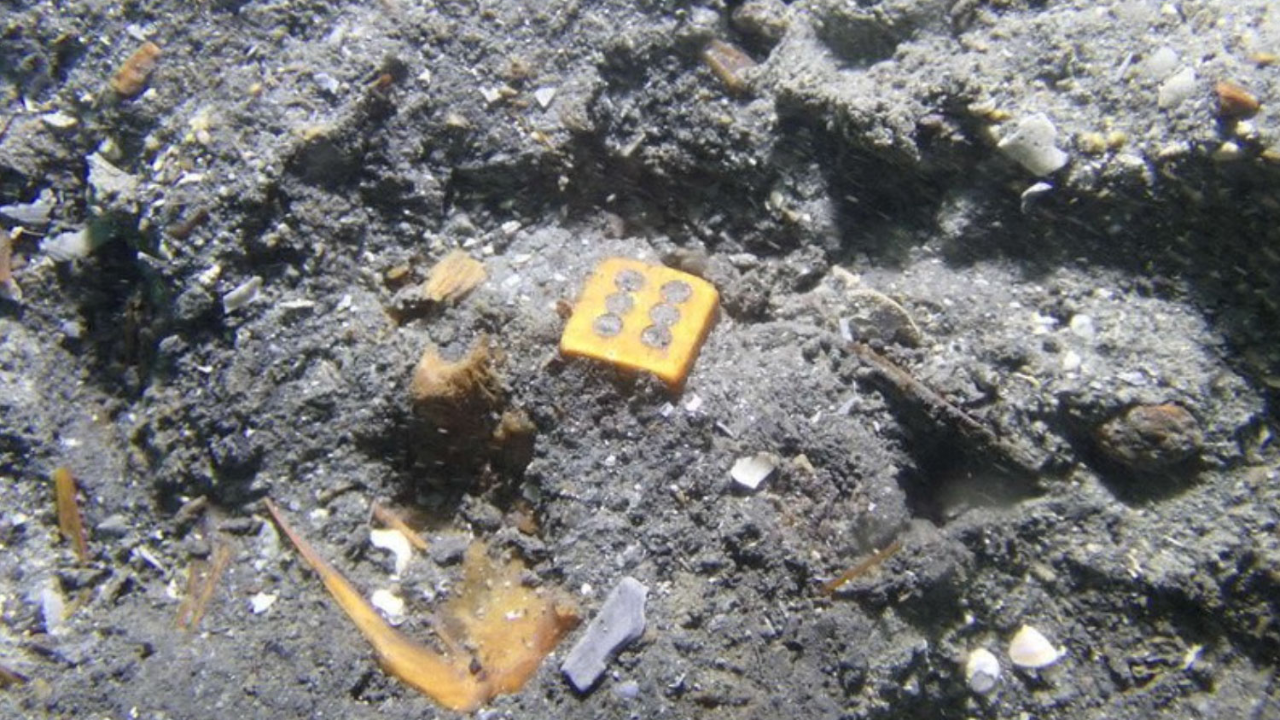
Recent underwater excavations off Takashima Island in Nagasaki Prefecture changed that perspective entirely. Archaeologists pulled small, carved dice out of the silt surrounding a sunken Mongol warship. Those tiny cubes tell a much more human story than any imperial decree ever could.
They prove that medieval soldiers spent their downtime doing the exact same thing modern soldiers do on deployment. They gambled. They killed time. They tried to forget they were floating on overcrowded wooden coffins headed into a meat grinder.
The Reality of the 1281 Mongol Fleet
You've probably heard the legend of the kamikaze, the "divine wind" that wiped out the Mongol armada in August 1281. That part is true. A massive typhoon smashed into Imari Bay and obliterated a fleet carrying roughly 140,000 men across the sea from China and Korea.
What people get wrong is assuming this was some pristine, uniform navy built exclusively for blue-water warfare. It wasn't. Kublai Khan rushed the construction of his second invasion fleet after his first attempt failed in 1274.
To hit his deadlines, the Yuan dynasty commandeered flat-bottomed river boats designed for inland Chinese waterways and shoved them into the open ocean. Imagine crossing the English Channel in a Mississippi river barge. That's basically what these crews were dealing with.
Conditions aboard those vessels were miserable. Thousands of conscripted Song Chinese sailors, Korean shipwrights, and Mongol warriors were packed together for weeks on end. The air smelled like sweat, bilge water, pickled rations, and fear. You couldn't drill with swords on a pitching deck crowded with siege equipment and livestock.
So what did you do between shifts? You sat on the planks, pulled out a pair of dice, and rolled for copper coins or extra rations.
What Archaeologists Actually Found at Takashima
Underwater archaeology in Imari Bay isn't like diving on a clear Caribbean reef. Visibility near Takashima Island is terrible, often dropping to just a few inches because of thick seabed mud. Yet that exact mud is why the artifacts survived for 745 years. Without oxygen, organic materials like wood, leather, and bone don't rot away.
Teams led by researchers from the University of the Ryukyus and local municipal boards have spent decades mapping the Takashima Kozaki seabed site. Alongside iron bolts, ceramic storage jars, bronze Buddha statues, and explosive ceramic bombs (tetsuhau), divers recovered small gaming dice.
These aren't modern plastic cubes with laser-etched dots. They're hand-carved—typically made from animal bone, ivory, or dense wood—showing distinct pip arrangements that match traditional East Asian gaming pieces from the Song and Yuan dynasties.
The layout of the pips matters. On medieval Chinese dice, the one and four spots were often carved larger or painted red, a tradition that still survives in modern Chinese dice and mahjong sets today. Finding them inside the hull debris of a 13th-century warship confirms these weren't ceremonial items. They were pocket litter belonging to regular sailors and marines.
Why Gambling Was Rampant on Medieval Warships
Military commanders across history have tried and failed to ban dice. It never works.
On a 1281 invasion transport, boredom was a bigger daily threat than Japanese samurai. The Southern Route fleet sailing from Quanzhou waited weeks for the Eastern Route fleet from Korea to rendezvous near Hirado Island before pushing into Hakata Bay. During those long delays, anchored ships bobbed in the summer heat while coastal skirmishes raged nearby.
Gambling served three practical purposes for a stressed crew:
- Stress relief: Rolling dice gave conscripted soldiers a tiny illusion of control in a campaign where their lives depended entirely on the weather and their officers' orders.
- Currency circulation: Soldiers carried strings of copper cash coins (wen). Dice games kept money moving around the ship when there were no ports or taverns to spend it in.
- Social bonding: Kublai Khan’s army was a chaotic mix of ethnic groups—Mongols, Jurchens, Koreans, and newly conquered Southern Song Chinese who didn't even share a common spoken language. You don't need a translator to understand a high roll.
Honestly, it's wild to think about a former Song dynasty soldier—someone who had been fighting against Kublai Khan just two years earlier before the empire fell in 1279—shooting dice with a Korean sailor while waiting to invade Kyushu.
Separating Hollywood Myths From Archaeological Evidence
When people picture the Mongol invasions, they imagine unstoppable hordes of mounted archers charging across the steppes. That image falls apart the second those warriors step onto a boat.
The Takashima shipwreck discoveries repeatedly debunk the idea of an elite, disciplined maritime force. Look at the physical evidence pulled from the seabed over the last twenty years:
- Rushed shipbuilding: Excavated keel timbers and bulkheads show signs of hasty repairs and mismatched wood types, backing up historical accounts that builders cut corners to meet Kublai Khan’s impossible schedule.
- Mixed weaponry: Divers found everything from high-end Mongol composite bow parts to cheap, mass-produced iron arrowheads and ceramic bombs packed with gunpowder and shrapnel.
- Personal effects: Inkstones, wooden combs, ceramic bowls with crew members' names scratched onto the bottom, and gaming dice paint a picture of men who expected a long occupation, not a quick raid.
The presence of the dice rounds out that human profile. These weren't faceless villains from a medieval scroll. They were guys trying to pass the afternoon.
How the Typhoon Sealed a Time Capsule
When the typhoon struck in mid-August 1281, it didn't just sink the ships; it flash-froze an entire floating society in place.
Historical records from both the Yuan Shi (History of Yuan) and Japanese accounts describe ships slamming into one another at the narrow mouth of Imari Bay as crews tried desperately to flee back to open water. Anchors dragged. Hulls splintered. Thousands drowned within hours, and the survivors who washed ashore were largely executed by samurai forces on the beaches.
Because the hulls sank rapidly into soft silt and stayed buried beneath centuries of sediment, the contents of sailors' pockets and sea chests remained right where they fell. When an archaeologist brushes silt off a tiny bone die today, they're looking at the exact object someone dropped right before the wind picked up and everything went sideways.
Where to See These Artifacts Yourself
If you're ever traveling through Kyushu, you don't have to take anyone's word for this. You can go look at the Takashima shipwreck recoveries in person.
Head to the Matsuura Municipal Takashima History and Folklore Museum in Nagasaki Prefecture. It sits right next to the bay where the fleet went down and houses hundreds of items pulled from the seabed, including anchors, weapons, personal items, and gaming pieces. The Kyushu National Museum in Dazaifu, Fukuoka, also displays major artifacts from the Mongol invasions alongside the famous Moko Shurai Ekotoba—the illustrated scrolls commissioned by samurai Takezaki Suenaga to prove his battlefield bravery to the shogunate.
Start by checking the museum exhibition schedules online before planning a trip to Nagasaki, since smaller conservation items rotate out of display cases for preservation treatment. Once you stand in front of a glass case looking at a 745-year-old bone die, those old history textbook maps suddenly feel a whole lot more real.