Mainstream commentary frames South Africa’s 2024 general election as the death rattle of the African National Congress. Commentators point to the party dropping from 57.5% in 2019 to just over 40% in 2024 as proof of an irreversible collapse.
That reading is comforting, simple, and fundamentally incomplete.
According to election data from the Electoral Commission of South Africa (IEC) and analyses from institutions like the Institute for Security Studies (ISS) and the Brenthurst Foundation, the 2024 results did not mark the disappearance of ANC dominance so much as the fragmentation of its historical coalition into competing ideological factions. When you look closely at where the missing votes went, the narrative of a unified democratic rejection falls apart.
The Math Behind the "Collapse"
To understand what actually happened at the ballot box, look at the arithmetic of the opposition. If South African voters had decisively turned toward market-oriented reform or centrist governance, the Democratic Alliance (DA) would have surged past 30%.
Instead, the DA moved from 20.77% in 2019 to 21.81% in 2024—a gain of barely one percentage point. The Economic Freedom Fighters (EFF) actually lost ground, slipping from 10.8% to 9.52%.
So where did the ANC’s 17-point drop go?
Nearly all of it went to uMkhonto weSizwe (MK), the newly formed party led by former ANC president Jacob Zuma, which captured 14.58% of the national vote and 45% in KwaZulu-Natal.
Add the ANC’s 40.18% to MK’s 14.58%, and you get 54.76%.
That is not a rejection of the liberation movement's political DNA. It is a civil war inside it.
Political analysts at the Centre for Risk Analysis (CRA) and the Social Research Foundation (SRF) have noted that South Africa’s electorate has not suddenly abandoned ANC-style patronage or state-centric economics. Rather, a massive regional and populist bloc peeled away from Cyril Ramaphosa’s faction to follow Jacob Zuma. Treating MK as an "opposition" victory in the traditional sense misdiagnoses the electorate's actual preferences.
Why Voters Actually Turned Away
Observers outside South Africa often assume voters punish ruling parties purely over macroeconomic metrics like GDP growth or sovereign debt ratings. On the ground, municipal failure drives political realignment far more reliably than national policy papers.
Consider the tangible daily friction voters faced heading into the election:
- Grid collapse: Eskom’s rolling blackouts (load shedding) reached record levels in 2023, crippling small businesses and household routines.
- Water and sanitation: Municipalities across Gauteng and KwaZulu-Natal experienced prolonged water outages caused by decaying infrastructure and unpaid bulk water bills.
- Logistics bottlenecks: Transnet’s rail and port failures cost the mining and agricultural sectors billions of rand in lost exports, directly suppressing job creation.
- Unemployment: Official joblessness hovered above 32%, with youth unemployment exceeding 45% according to Statistics South Africa.
When power is off for ten hours a day and taps run dry, voters do not read party manifestos. They punish incumbents. Yet even under these severe conditions, four out of ten voters still ticked the ANC box, and another one-and-a-half ticked a party led by its former president.
The Government of National Unity Is a Tactical Reset, Not Surrender
Following the loss of its parliamentary majority, the ANC entered into a Government of National Unity (GNU) alongside the Democratic Alliance, the Inkatha Freedom Party (IFP), and several smaller parties. Critics on the left called it a sellout to white monopoly capital; critics on the right called it a desperate life-support machine for a failing party.
Both interpretations miss the strategic mechanics of coalition politics.
By bringing the DA into the cabinet while excluding the EFF and MK, Cyril Ramaphosa achieved three things simultaneously:
- Neutralized the radical flank: Keeping the EFF and MK out of executive power prevented the immediate implementation of destabilizing policies like nationalizing the South African Reserve Bank or expropriating land without compensation.
- Shared the blame for hard choices: Fixing state-owned enterprises requires tariff hikes, restructuring, and austerity. With the DA holding key ministries like Public Works and Infrastructure, Home Affairs, and Basic Education, the ANC no longer owns the political cost of reform alone.
- Preserved the core state apparatus: The ANC retained control of the Presidency, Finance, Defense, Police, International Relations, and Mineral and Petroleum Resources. The levers of executive authority remain firmly in Luthuli House's hands.
Imagine a scenario where the ANC had formed a coalition with the EFF and MK instead. Capital flight would have accelerated immediately, the rand would have tumbled, and sovereign borrowing costs would have spiked. By choosing the GNU, the ANC traded unilateral control for institutional stability—buying itself time to rebuild before the 2026 local government elections.
The Real Threat Nobody Is Watching
If you want to know whether the ANC is truly finished, stop staring at national parliamentary seat counts and start looking at voter turnout and municipal balance sheets.
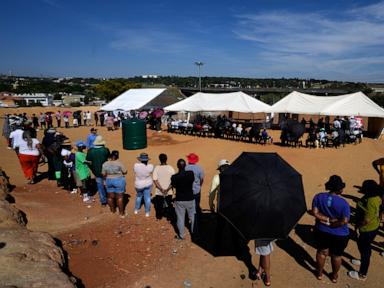
In 2024, turnout dropped to roughly 58.6% of registered voters—the lowest in South Africa’s democratic history. Millions of eligible young South Africans did not even register to vote. The ANC is not losing its base to rival ideologies; it is losing its base to apathy. Apathy is quieter than protest, and far harder to reverse.
At the same time, the party's internal funding model has been disrupted by the Political Party Funding Act, which forces disclosure of large private donations. Combined with shrinking patronage networks in hung municipalities like Johannesburg, Tshwane, and eThekwini, the financial glue that held local ANC branches together is dissolving.
A political machine runs on two fuels: ideological legitimacy and material patronage. The first eroded under years of state capture inquiries; the second is drying up as municipal coffers empty.
What People Get Wrong About South Africa's Trajectory
Does losing a majority mean the ANC will dissolve like other liberation movements?
Not necessarily. Unlike Zambia’s UNIP or Kenya’s KANU, which collapsed rapidly after losing power, the ANC retains deep institutional roots across provincial administrations, state-owned entities, and rural traditional authorities. The 2024 result stripped its parliamentary monopoly, not its organizational footprint.
Will the GNU fix South Africa’s economy overnight?
No. Coalition governments in South Africa have a rocky track record at the municipal level, frequently collapsing over speaker elections and procurement disputes. While Operation Vulindlela—a joint initiative between the Presidency and National Treasury—has already reduced load shedding and begun opening rail networks to private operators, deep structural reforms face constant friction between the ANC's leftist alliance partners (COSATU and the SACP) and the DA's free-market agenda.
Is the Democratic Alliance now in the driver's seat?
Hardly. The DA holds roughly a fifth of the cabinet seats and operates within policy parameters still heavily shaped by the ANC. If the DA pushes too hard on labor market deregulation or scrapping Black Economic Empowerment (BEE) requirements, the ANC can pivot toward smaller parties or threaten a cabinet reshuffle. Conversely, if the DA compromises too much, it risks bleeding conservative voters to the Freedom Front Plus or Patriotic Alliance.
The Vulnerability of the Contrarian View
Betting on the ANC’s adaptability carries an obvious risk: internal party discipline is notoriously fragile. The party’s 2027 elective conference will inevitably trigger another succession battle, and the temptation to abandon fiscal discipline for pre-election populism will be intense. If the GNU fractures over contentious legislation like the National Health Insurance (NHI) Act or the Basic Education Laws Amendment (BELA) Act, South Africa could easily slide back into legislative paralysis.
Stop Reading Obits and Watch the Plumbing
Analysts who write off the ANC because it dropped to 40% are measuring a twentieth-century liberation movement with a twenty-first-century Western parliamentary ruler.
In proportional representation systems, 40% is not political death; it is a plurality that still dictates who sits in the Union Buildings. The 2024 election did not end the ANC era—it forced the party to outsource its survival to the very rivals it spent thirty years fighting.