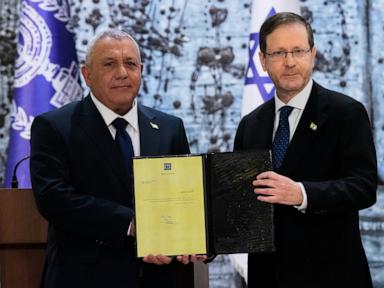
Israeli President Isaac Herzog has officially handed opposition leader Gadi Eisenkot the first mandate to form the nation's next governing coalition, triggering a high-stakes 28-day constitutional countdown in Jerusalem. Under Israel's Basic Law, this formal designation follows mandatory post-election consultations with every faction elected to the 120-seat Knesset, where party leaders recommend the candidate they believe commands the most viable path to a parliamentary majority. While securing the presidential nod places Eisenkot in the driver's seat, the arithmetic of Israeli coalition politics means that receiving the mandate is merely the opening bell of a grueling negotiation marathon rather than a guarantee of the premiership.
The mechanics of this transition are often misunderstood outside the corridors of the Knesset. In Israel's proportional representation system, no single party has ever won an outright majority of 61 seats on its own. Consequently, the president does not automatically tap the leader of the largest party, though that is frequently the outcome. Instead, the president evaluates which lawmaker holds the highest statistical and political probability of assembling a functioning alliance. By selecting Eisenkot—a former Chief of the General Staff of the Israel Defense Forces who transitioned from military brass to senior political leadership—the presidency has signaled that the alignment of recommendations currently favors an alternative to the outgoing political configuration.
The Constitutional Clock and the Math of 61
Numbers dictate everything in Jerusalem. Once the president formally entrusts a candidate with the task of forming a government, a strict statutory clock begins to tick.
Eisenkot now has exactly 28 days to present a coalition agreement backed by at least 61 members of the Knesset. If those four weeks expire without a signed deal, the president holds the discretionary power to grant a single extension of up to 14 days, provided the candidate can demonstrate genuine progress toward a breakthrough. Should Eisenkot fail to reach the 61-seat threshold within that maximum 42-day window, the mandate does not automatically pass to a runner-up. At that point, the president can either assign the task to a different Knesset member—who receives a shorter, non-renewable 28-day window—or inform the Speaker of the Knesset that no candidate appears capable of forming a government. If the latter occurs, a 21-day period opens during which any group of 61 lawmakers can petition the president in writing to task a specific member with forming a coalition, serving as a final safety valve before the country is forced back to the ballot box.
Understanding this timeline reveals why the initial weeks are rarely about policy and almost entirely about the distribution of leverage. Party leaders know that Eisenkot's bargaining power peaks on day one and erodes steadily as the deadline approaches. Smaller factions routinely withhold their final signatures until the final hours of the 28th day, extracting maximum concessions on ministerial portfolios, committee chairmanships, and budget allocations in exchange for their vital seats.
Why Eisenkot Emerged as the Consensus Pivot
To understand how a career general who entered politics relatively late became the focal point of coalition building, one must examine the structural fatigue within the Israeli electorate and parliament. For years, Israeli politics was defined by rigid ideological blocs and intense personal loyalties that repeatedly deadlocked the legislature, producing multiple inconclusive elections in rapid succession. Voters across the political center and moderate right grew weary of legislative paralysis, creating demand for a figure perceived as pragmatic, institutional, and focused on statecraft rather than partisan warfare.
Eisenkot's trajectory reflects that demand. Having served as the IDF's 21st Chief of Staff between 2015 and 2019, he built a reputation as a methodical strategist who favored measured force over rhetorical escalation. When he entered the Knesset, initially aligning with Benny Gantz's National Unity camp before emerging as a central opposition figure in his own right, his appeal rested on an ability to speak the language of both security hawks and center-left reformers. According to political analysts tracking the post-election consultations at the President's Residence, it was precisely this cross-aisle credibility that allowed him to secure enough recommendations to edge out rivals.
Yet the very qualities that made Eisenkot acceptable to a broad range of recommending factions also complicate his task now. A coalition built on the premise of broad national consensus inherently contains deep internal contradictions. Bringing together secular liberals, moderate conservatives, and potentially religious or Arab factions requires bridging irreconcilable positions on state-and-religion issues, judicial authority, and long-term security strategy.
The Structural Obstacles Inside the Negotiating Room
Securing recommendations to receive the mandate is fundamentally different from signing binding coalition agreements. During consultations with the president, a party leader might recommend Eisenkot simply to block a rival from receiving the first opportunity, without committing to join the resulting government. Now, those tentative endorsements must be converted into hard votes of confidence on the Knesset floor.
Three primary fault lines threaten to stall the negotiations:
- The Ultra-Orthodox Conscription Dilemma: Few issues have proven more combustible in Israeli politics than the military draft exemptions historically granted to Haredi yeshiva students. Secular parties within the opposition insist on strict, enforceable recruitment quotas and financial penalties for non-compliance. Conversely, any ultra-Orthodox faction considering cooperation will demand legislative protections preserving traditional study frameworks. Eisenkot, as a former military chief who has publicly championed equal burden-sharing, faces intense pressure from his base not to compromise on core principles of military service, even if doing so costs him potential coalition partners.
- Judicial Authority and Institutional Guardrails: The deep societal rifts over the balance of power between the Knesset and the Supreme Court have not vanished. Center-left and centrist lawmakers demand entrenched Basic Laws that safeguard judicial independence and prevent rapid constitutional alterations by narrow majorities. Right-leaning partners, however, remain committed to curbing judicial review over executive decisions and altering the composition of the Judicial Selection Committee. Drafting coalition guidelines that satisfy both camps without triggering immediate defections will test the limits of creative ambiguity.
- Security Policy and Diplomatic Strategy: While Eisenkot's military background grants him immediate authority on defense matters, coalition partners hold sharply divergent views on long-term regional diplomacy, governance arrangements in disputed territories, and the calibration of military operations. Right-wing factions push for assertive sovereignty measures and uncompromising security control, whereas center-left partners emphasize diplomatic coordination with international allies and regional integration frameworks.
The Minority Government Trap
If a 61-seat majority proves unreachable through traditional ideological alliances, Eisenkot's negotiating team will confront a recurring temptation in Israeli politics: forming a minority government relying on external parliamentary support.
In theory, a coalition holding fewer than 61 seats can survive an investiture vote if outside factions—such as predominantly Arab parties or ideological holdouts—agree to abstain or vote in favor of establishing the government without formally joining the cabinet. History, however, offers a sobering warning about the fragility of such arrangements. Without a disciplined majority on routine legislative votes, a minority government lives from week to week, vulnerable to ambushes by the opposition on every budget bill and no-confidence motion.
Furthermore, relying on external support carries steep political costs. Opponents immediately frame a minority coalition as illegitimate or hostage to outside actors, eroding public trust from its inception. For a leader whose brand is built on national unity and institutional stability, entering the Prime Minister's Office at the head of a precarious 58- or 59-seat administration would severely constrain his ability to govern effectively during crises.
The Opposition's Counter-Strategy
While Eisenkot sets up his negotiating headquarters—traditionally hosted in a Jerusalem hotel or Knesset conference suite—his political rivals will not sit idly by. The outgoing leadership and opposing bloc possess well-honed tactics designed to run down the 28-day clock.
The primary strategy for an opposition bloc during coalition talks is surgical poaching. Rather than negotiating as a unified front, rivals target individual Knesset members or vulnerable splinter factions within Eisenkot's prospective alliance, offering them inflated ministerial portfolios, safe spots on future electoral slates, or policy vetoes if they defect. Under Israeli law, individual lawmakers who split from their party face strict penalties—such as being barred from running with an existing faction in the next election—unless at least one-third of the faction breaks away together. Consequently, political operatives spend weeks calculating the exact math required to engineer a legal faction split.
Simultaneously, the opposing camp will work to lock its own members into airtight loyalty pledges, ensuring that no peripheral right-wing or religious party breaks ranks to give Eisenkot the final two or three seats he needs to cross the 61-seat finish line. If they can successfully deny him a majority for 42 days, the psychological momentum shifts dramatically, opening the door for them to argue that only their bloc can deliver a stable, cohesive government.
What History Tells Us About First-Mandate Holders
Receiving the first mandate from the president is an undeniable advantage, granting the recipient control over the initial narrative and the first right of refusal on key ministries like Defense, Finance, and Foreign Affairs. Yet Israeli political history is littered with first-mandate holders who failed to close the deal.
In recent election cycles, multiple candidates tapped first by the presidency—including seasoned political operators—ultimately returned the mandate empty-handed after weeks of fruitless bargaining. In 2019, the failure of the initial mandate holder triggered an unprecedented chain reaction that plunged the country into repeat elections. Even when a first-mandate recipient succeeds, the resulting coalition often bears little resemblance to the platform presented to voters, reshaped by last-minute concessions made under the pressure of an expiring deadline.
The decisive factor in these negotiations is rarely the charisma of the candidate at the top; it is the willingness of secondary party leaders to swallow bitter ideological pills for the sake of executive power. Every faction entering the room with Eisenkot must weigh two competing risks: the political price of compromising on core campaign promises versus the existential gamble of forcing another general election in which their voter base might punish them for obstinacy.
The Real Test of Leadership Begins Now
For Gadi Eisenkot, the transition from military command to coalition architecture represents a fundamental shift in operational rules. In the military, a Chief of Staff issues orders through a clear hierarchy, backed by institutional discipline. In the Knesset, a prime minister-designate commands nothing until the final signature dries on the coalition agreements. Every potential partner is an independent power center capable of walking out of the room and collapsing the entire enterprise.
Over the next four weeks, the public will see a steady stream of staged handshakes, leaked draft agreements, and dramatic ultimatums issued through television studios. Behind closed doors, however, the real work will be reduced to cold arithmetic: trading ministries, dividing state budgets, and drafting legal formulas vague enough to survive an investiture vote yet binding enough to prevent immediate mutiny. Whether Eisenkot can convert his presidential mandate into a durable government will depend entirely on his capacity to convince rival factions that a shared, imperfect administration is preferable to the certainty of continued political deadlock.