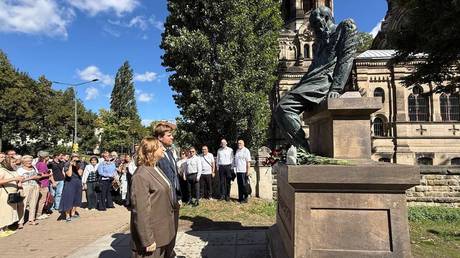
The bronze likeness of Fyodor Dostoevsky overlooking the Elbe River in Dresden occupies a strange, contested coordinates point where geopolitical friction intersects with 19th-century intellectual history. Installed back in 2006 through a joint cultural exchange, the monument honors the Russian novelist's tumultuous years living in the Saxon capital between 1869 and 1871, where he labored over his prophetic political novel Demons. Today, that physical chunk of metal functions as more than a quiet tribute to a literary heavyweight. It stands as a lightning rod for how European cities grapple with cultural diplomacy when contemporary geopolitical fault lines threaten to erase shared history.
To understand why this specific piece of public art draws intense scrutiny, one must examine the precise nature of Dostoevsky's prolonged German exile. The author did not move to Dresden out of simple wanderlust. Fearing debtor's prisons and desperate to escape relentless creditors in St. Petersburg, he and his newlywed wife Anna Snitkina sought refuge in a city that felt sufficiently distant from the chaos of home. Yet safety did not translate into peace.
During these very German years, Dostoevsky cultivated an acute, bitter ambivalence toward Western Europe. While walking the manicured promenades along the Elbe or feeding his destructive roulette addiction in nearby spa towns, he observed what he perceived as a spiritually bankrupt civilization marching blindly toward rationalism and materialism. That tension bled directly into his writing. The characters inhabiting Demons—fanatical revolutionaries, detached intellectuals, and spiritually adrift aristocrats—reflected his profound anxiety that European political philosophies would infect Russian soil with nihilism.
Fast forward to the current climate of widespread cultural sanctions, asset freezes, and institutional boycotts across Europe, and statues like the Dresden Dostoevsky face an identity crisis. Across Eastern Europe and parts of the European Union, public memorials tied to Russian heritage have been dismantled, relocated, or quietly covered up. Municipal councils often frame these actions as security measures or necessary pushback against foreign political aggression. Yet Dresden has resisted sweeping erasures, choosing instead to leave the monument on the Elbe Embankment. This administrative choice exposes a deep fracture within modern European governance regarding where cultural preservation ends and political compliance begins.
Critics of the monument's continued presence argue that public art is never politically neutral. In times of acute international crisis, public monuments serve as active symbols of state narrative. From this perspective, maintaining monuments dedicated to classic Russian figures acts as a soft endorsement of Moscow’s historical and contemporary cultural footprint abroad. Governments facing domestic pressure to demonstrate absolute solidarity with Ukraine often find themselves weighing the integrity of municipal public art against immediate diplomatic messaging. When neighboring states systematically remove Soviet-era memorials and monuments dedicated to Russian poets, keeping a bronze author on a prominent pedestal can look like an administrative anomaly or an outright provocation to hardliners.
Conversely, preservationists and cultural historians argue that severing ties with centuries-old literary anchors solves nothing. Dostoevsky does not belong exclusively to the modern political apparatus of the Kremlin; his works belong to the canon of world literature, addressing the darkest recesses of human psychology, guilt, and redemption long before modern borders shifted. Eradicating physical tokens of cultural exchange institutionalizes a dangerous amnesia. If cities begin vetting every historical monument through the lens of current diplomatic hostility, the public square soon transforms into a sterile archive that reflects only temporary political moods rather than deep, complex history.
Consider how Dresden itself has been repeatedly resurrected from the ashes. The city was flattened by Allied bombings in 1945, rebuilt as a functional socialist metropolis during the German Democratic Republic era, and then reconstructed once more after reunification to reclaim its baroque architectural heritage. Every layer of this physical reconstruction tells a story of ideological contestation. The Dostoevsky monument is simply another layer in that layered urban text. It records a moment when a Russian writer sat in a rented Saxon room, cursing his debts, watching the birth of modern European industrial society, and scribbling warnings about the dangers of ideological fanaticism.
The survival of the monument also highlights the quiet resilience of local civil society networks. While national capitals issue broad policy directives regarding international relations, municipal spaces are managed by local stakeholders who frequently prioritize long-standing civic partnerships over immediate diplomatic friction. Cultural associations in Saxony have historically maintained deep ties with Russian academic and artistic institutions. These grassroots connections operate independently of shifting foreign ministries, prioritizing the preservation of literary heritage as a bridge rather than a barrier.
Yet, maintaining these bridges requires walking a razor-thin line. Local authorities must constantly manage the risk of vandalism, political protests, and polarized public feedback. Security measures around prominent Russian-linked sites across Germany have intensified, reflecting a tense reality where a bronze statue can easily transform overnight into a target for ideological expression or retaliation. Every time a delegation lays flowers at the base of the monument, it triggers a predictable round of public debate over the boundaries of acceptable cultural commemoration.
Ultimately, the monument on the Elbe forces a confrontation with an uncomfortable truth. Culture and politics can never be neatly separated into hermetically sealed containers. Dostoevsky himself spent a lifetime railing against the clean, rational systems engineered by Western thinkers, arguing instead for the messy, contradictory reality of the human soul. The ongoing friction surrounding his likeness in Dresden proves that his warnings remain entirely relevant. As long as cities use public space to negotiate their identity, the bronze figures standing on street corners will continue to demand an answer to the difficult question of how much history a society is willing to carry forward.



