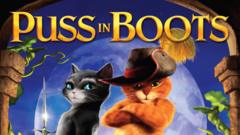
The commercial viability of a legacy film franchise depends on the tension between brand equity and narrative exhaustion. While most animated sequels suffer from a diminishing marginal utility, the Puss in Boots sub-franchise operates on a distinct economic model: the rehabilitation of a secondary asset into a primary revenue driver. Puss in Boots, voiced by Antonio Banderas, represents more than a character; he is a portable, high-retention IP unit that bridges the gap between the satire-heavy Shrek era and the modern demand for high-stakes, visually distinct storytelling.
The Strategic Pivot from Satire to Sincerity
The initial success of the Shrek franchise was built on the subversion of fairy tale tropes. However, subversion has a shelf life. Once the "anti-fairy tale" becomes the standard, it loses its edge. The Puss in Boots standalone entries shifted the tactical objective from parody to archetypal sincerity.
This transition involves three specific structural adjustments:
- Mythic Scaling: Moving the character away from the Far Far Away ensemble allows for a focused exploration of Spanish and Latin American folklore, creating a unique visual and tonal "moat" that distinguishes the spin-off from the parent franchise.
- Emotional Stakes Reinforcement: By introducing the concept of mortality—specifically the "Last Wish" arc—the narrative creates a finite resource. In economic terms, this is a scarcity play. When a character with "nine lives" is reduced to one, every action carries a higher cost-benefit requirement, forcing deeper character development that a comedy-first ensemble cannot support.
- Visual Differentiation: The shift from a standard 3D render to a stylized, painterly aesthetic (often called "step-printing") serves as a branding signal. It tells the audience that this is a premium, artisanal product rather than a factory-line sequel.
The Mechanics of Voice-Driven IP
Antonio Banderas provides the fundamental acoustic identity for the character. In international film markets, the "star power" of a voice actor often yields diminishing returns, yet Banderas functions as a localized and global bridge. His performance utilizes a specific dialectal charm that serves as a shorthand for a "swashbuckler" archetype, reducing the need for heavy exposition.
This creates a low-friction entry point for new viewers. A child in 2024 does not need to have seen Shrek 2 (2004) to understand the Puss in Boots character. The character is self-contained. The "quest" structure—a fundamental narrative algorithm—allows the protagonist to move through episodic challenges that showcase his agility, ego, and eventual vulnerability. This modular storytelling makes the IP highly adaptable for theme park integrations, video games, and shorter-form streaming content.
Quantifying the Quest Logic
The "quest" is the engine of the film's pacing. To analyze why this specific quest works where others fail, we must look at the Objective Function:
- The Primary Goal: Attaining the "Wishing Star."
- The Constraint Set: One remaining life, a rival group of antagonists (The Bear Clan, Jack Horner), and internal psychological friction (fear of death).
- The Catalyst: The introduction of "Death" as a literal, physical antagonist rather than a metaphorical concept.
The presence of a terrifying, competent antagonist like the Wolf (Death) changes the film’s genre from "family adventure" to "existential thriller." This expands the target demographic. By capturing the 18–35 "animation enthusiast" segment alongside the primary 6–12 family demographic, the film maximizes its box office ceiling. This is not accidental; it is a calculated effort to increase the LTV (Lifetime Value) of the character by making him relevant to an aging audience that grew up with the original films.
The Bottleneck of Legacy Continuity
The greatest threat to Puss in Boots is the "Gravity of the Green Ogre." As the narrative winds back toward a potential Shrek 5, the risk of brand dilution increases.
The current Puss in Boots model is lean and focused. Re-integrating him into a larger ensemble risks:
- Screen Time Cannibalization: In an ensemble, Puss is a comic relief tool. In his own films, he is a complex lead.
- Tonal Inconsistency: The "painterly" style of the spin-off may clash with the more traditional, literal 3D style of the core Shrek films.
- Simplified Stakes: It is difficult to maintain a high-stakes meditation on mortality when the surrounding world is focused on fart jokes and pop-culture references.
The strategic play for DreamWorks is to maintain these as "parallel tracks." Puss in Boots should exist as the prestige wing of the franchise—the segment that wins Academy Award nominations and pushes technical boundaries—while the core Shrek films serve as the mass-market, high-volume comedy anchors.
Operationalizing the "Last Wish" Framework
The success of recent Puss in Boots content suggests a new blueprint for legacy animation. Studios should stop trying to "reboot" entire universes and instead isolate and elevate high-performing sub-assets.
- Step 1: Asset Audit. Identify characters with high recognition but low narrative baggage.
- Step 2: Aesthetic Pivot. Change the visual language to signal a departure from the "stale" parent brand.
- Step 3: Stakes Escalation. Introduce a consequence that cannot be undone by "magic" or "cartoon physics."
Puss in Boots succeeds because he stopped being a sidekick and started being a protagonist with something to lose. The "exciting quest" is merely the delivery mechanism for a sophisticated exploration of legacy and fear. To replicate this success, competitors must look past the "funny cat" surface and analyze the structural integrity of a character who is finally being treated as a finite resource.
The final move is to transition the character from a "period piece" hero into a meta-textual icon who can bridge multiple animation styles, ensuring the IP remains liquid across various media platforms for the next two decades.