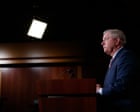
The death of Senator Lindsey Graham at age 71 removes the primary practitioner of asymmetric legislative leverage from the United States Senate. Conventional political analysis views modern legislative mechanics through a binary lens: a lawmaker is either an ideological purist or a bipartisan institutionalist. This framework fails to explain Graham’s 33-year tenure across the House and Senate. His career demands a more precise model—one that treats legislative influence as a dynamic optimization function maximizing access to executive power while exploiting structural vulnerabilities in both major parties.
Graham operated not on ideological consistency, but on an explicit transaction model. By analyzing his participation in historic bipartisan coalitions alongside his rapid alignment with the populist transformation of the Republican party, we can isolate the exact variables that allowed a senator from a mid-sized state to dictate foreign and domestic policy across four presidencies.
The Asymmetric Bipartisan Framework: The "Gang" Mechanism
The legislative branch routinely suffers from a structural coordination problem. When party leadership enforces strict polarization, the transaction costs of passing complex, high-stakes legislation become prohibitive. Graham bypassed this bottleneck by utilizing what political scientists and reporters termed the "Gang" mechanism—small, self-selected, cross-party cohorts designed to insulate members from primary election penalties while constructing a veto-proof centrist voting bloc.
We can model Graham’s strategy through three distinct structural phases:
[Phase 1: Alignment]     Identify structural gridlock (e.g., Judicial nominations, Immigration)
         │
         ▼
[Phase 2: Insulation]    Form an elite bipartisan cohort ("Gang") to absorb electoral risk
         │
         ▼
[Phase 3: Execution]     Deploy the bloc to force concessions from party leadership
1. The Gang of 14 (2005)
The structural problem was a looming "nuclear option" threat by Senate Republicans to eliminate the filibuster for judicial nominees. Graham co-engineered a 14-member bipartisan pact that agreed to vote against the rules change in exchange for the confirmation of specific conservative judges. This action preserved the institutional status quo while delivering tangible judicial utility to his party's base.
2. The Gang of Eight (2013)
Faced with systemic immigration friction, Graham joined a bipartisan cohort to draft a comprehensive reform bill (S.744). The strategic objective was to provide the Republican party with a demographic hedge ahead of future presidential cycles while securing hardline border enforcement metrics. Though the bill died in the House, the mechanism successfully forced a Senate floor vote through a 68-32 supermajority.
3. The Bipartisan Safer Communities Act (2022)
Following acute public pressure regarding gun violence, Graham was one of 15 Republican senators who crossed party lines to pass modest firearms restrictions. His participation was calculated: by trading a minor concession on background checks for minors, he de-escalated a major legislative vulnerability for the GOP ahead of a midterm cycle.
The limitation of this framework is its fragility. The "Gang" model relies entirely on the existence of partners willing to absorb severe internal party dissent. As geographic sorting and primary election dynamics systematically eliminated moderate Democrats and traditional Republicans, the structural viability of these cohorts decayed.
The Executive Alignment Optimization Function
The defining pivot of Graham’s career occurred between 2016 and 2017. After characterizing Donald Trump during the 2016 primary as a "race-baiting, xenophobic, religious bigot," Graham rapidly transitioned into one of the administration's most reliable legislative enforcement mechanisms.
This was not an ideological conversion; it was a rational optimization calculation. Graham understood that under a populist executive, access is the ultimate currency of legislative leverage. By surrendering public dissent on domestic rhetoric, Graham acquired a direct transmission vector for his primary policy objective: neoconservative foreign interventionism and the preservation of global defense funding.
We can analyze this trade-off using a basic cost-benefit utility model:
$$U_L = \beta_1(A_E) + \beta_2(P_D) - \gamma(C_R)$$
Where:
- $U_L$ is total legislative utility.
- $A_E$ is direct access to executive decision-making.
- $P_D$ is the realization of specific policy domains (e.g., Defense appropriations, judicial confirmations).
- $C_R$ is the reputational cost among legacy institutionalists.
When the executive branch centralized power away from committee chairs and into the Oval Office, $A_E$ became the dominant variable. Graham maximized $U_L$ by depressing $C_R$.
This optimization yielded highly tangible results. During Trump's first term, Graham secured the confirmation of three conservative Supreme Court Justices, notably managing the high-friction Brett Kavanaugh hearings as a fierce partisan advocate. Upon Trump’s return to office, Graham leveraged his chairmanship of the Senate Budget Committee to engineer the passage of the One Big Beautiful Bill Act, successfully funding administration priorities while protecting core defense interests.
The systemic risk of this model is its absolute dependence on the political survival of the executive. By tying his legislative efficacy to a singular populist figure, Graham exposed his entire leverage apparatus to the volatility of executive whim, as evidenced by his frequent, high-stakes maneuvers to keep the administration aligned on international security commitments.
The Foreign Policy Dichotomy: Multilateralism vs. Aggressive Deterrence
Graham’s foreign policy apparatus operated on an dual-track strategy that often baffled conventional commentators but remained structurally coherent to defense strategists. He combined a classical, post-WWII commitment to multilateral alliances like NATO with an aggressive, preemptive willingness to deploy American military force.
                  [Traditional Multilateralism]
                  • Unwavering NATO advocacy
                  • Funding global stabilization
                                │
                                ▼
                       LINDSEY GRAHAM
                       FOREIGN POLICY
                                ▲
                                │
                  [Preemptive Deterrence]
                  • Aggressive sanctions scaling
                  • Unilateral kinetic operations
This dual-track approach manifest in two distinct arenas:
The Eastern European Theater
While the populist wing of the Republican party shifted toward isolationism, Graham remained a fierce defender of Ukraine. Just prior to his death, he completed his tenth trip to Kyiv since 2022, immediately returning to Washington to announce a bilateral agreement with the White House to advance an aggressive new package of sanctions against the Russian Federation. He recognized that allowing a revisionist power to alter European borders by force would fundamentally destabilize the global economic architecture, a position that placed him in direct conflict with his own party's ascendant base.
The Middle Eastern Theater
Conversely, Graham rejected diplomatic containment strategies regarding state sponsors of terrorism. He routinely advocated for unilateral kinetic action against Iran, recently calling for the U.S. military to seize Kharg Island to choke off Iranian oil processing capability. To Graham, international alliances were not mechanisms for restraint, but force multipliers designed to legitimize the projection of Western power.
The strategic vulnerability of this framework is its massive resource requirements. In an era defined by deep domestic fiscal deficits and a growing national debt, maintaining a global military footprint while simultaneously funding complex proxy conflicts creates a structural bottleneck that the American electorate is increasingly unwilling to sustain.
Tactical Execution: The Budget Committee Lever
Following the political realignments that shaped the current legislative landscape, Graham’s assumption of the Senate Budget Committee chairmanship provided him with the ultimate structural lever. In modern congressional mechanics, authorized policy is meaningless without explicit appropriations. Graham utilized the budget reconciliation process to enforce party discipline and drive policy execution.
The most clear operational example occurred during the recent Department of Homeland Security funding crisis. When the Republican conference fractured over the funding mechanisms for mass deportation campaigns, Graham utilized his committee's jurisdictional authority to craft a targeted budget measure that funded the specific executive enforcement agencies while simultaneously averting a broader government shutdown.
He did not manage the committee as a fiscal hawk intent on absolute deficit reduction; he managed it as a strategic allocator of capital. He understood that the budget process could be used to force recalcitrant members into line. If a senator threatened to defect on a critical floor vote, the budget allocation framework provided an immediate, quantifiable mechanism for internal discipline.
The Institutional Vacuum
The sudden vacancy created by Graham’s aortic dissection alters the legislative math in the Senate. Under South Carolina statutory law, Governor Henry McMaster is empowered to appoint a temporary successor, setting up a highly compressed special primary on August 11 to choose the party nominee for the upcoming November election cycles.
The immediate consequence of his removal from the legislative matrix is a severe drop in the Senate's institutional fluid dynamics. Graham served as a critical informational broker. Because he maintained open channels with populist executives, legacy institutionalists, and senior opposition leadership, he frequently functioned as a human clearinghouse for viable legislative compromises.
Without an experienced broker capable of absorbing partisan blowback while translating executive intent to the Senate floor, the institution faces a period of structural paralysis. The Republican conference loses its most effective budget tactician and its most prominent bridge between the "America First" foreign policy wing and traditional internationalist defense hawks.
The immediate tactical play for Senate leadership is not to attempt to replicate Graham’s unique, personality-driven access model, but to institutionalize the broker function. Committees must reassert their traditional jurisdictional authority over spending and foreign policy to fill the governance void. Individual lawmakers seeking to maximize their own leverage must realize that in the modern legislative ecosystem, influence is no longer built on seniority alone, but on the precise, calculated deployment of voting blocs at moments of maximum structural gridlock.