The sound of a shovel hitting dry earth in southern Lebanon does not sound like news. It sounds like a metallic scrape, followed by the heavy thud of red clay dropping onto wood. It is a dull, repetitive rhythm. Yet, in the square kilometer that comprises the Bourj Al-Chemali Palestinian refugee camp, just east of the coastal city of Tyre, this sound has become the metronome of daily life.
To the outside world, conflict is measured in airstrikes, casualty counts, and geopolitical maps shaded in escalating hues of red. But inside the camp, the war is measured in centimeters. It is measured by how close the new graves must be dug next to the old ones because the perimeter of their displacement has not changed since 1948, even as the number of the dead continues to swell.
Grief here is compressed. Like the architecture itself, it has nowhere to go but up, or deeper into the ground.
The Geography of an Ultimate Refuge
Bourj Al-Chemali was never meant to be permanent. Built initially to provide shelter for refugees from Hanajir, Saliha, and other villages in Upper Galilee, its borders were fixed decades ago by invisible bureaucratic lines. Imagine squeezing more than twenty thousand lives into a space roughly the size of a few city blocks. Over seventy-six years, tents turned into cinderblock shelters, and shelters grew into precarious multi-story towers, leaning against one another like exhausted soldiers.
When military operations intensify across southern Lebanon, the camp becomes a strange kind of sanctuary. It is an ironic safety. The people living here know that their concrete alleys offer no real protection against modern ordnance. Yet, thousands of displaced families from surrounding border villages have flooded into the camp anyway. They come because poverty and shared history leave them nowhere else to turn.
Consider a mother named Fatmeh. She is a composite of the three different women who sat on plastic chairs near the camp’s entrance last week, their hands stained with the soot of makeshift cooking fires. Fatmeh fled her agricultural village near the border with nothing but a plastic bag of documents and her youngest son’s asthma inhaler. She chose Bourj Al-Chemali because her cousin’s family lives in a two-room shelter there. Now, fourteen people sleep on the same damp floor, listening to the low hum of drones overhead.
The influx has strained the camp's already failing infrastructure to a breaking point. Water is pumped only a few hours a week. The electricity grid is a terrifying web of exposed, tangled wires drooping across narrow alleys, dripping with condensation from illegal water hookups. It is a labyrinth where life is lived at a frantic, crowded pace, even while the shadow of sudden destruction hangs over every rooftop.
When the Sky Splinters
The real crisis shifts from discomfort to stark tragedy when the violence breaches the camp’s psychological perimeter. In recent weeks, targeted strikes and nearby bombardments have brought the war directly to Bourj Al-Chemali’s doorstep. The casualties are not abstract numbers listed in a scrolling news ticker. They are the local baker who kept his shop open during the worst of the shelling, the teenager who volunteered to clear rubble, the grandmother who refused to leave her porch.
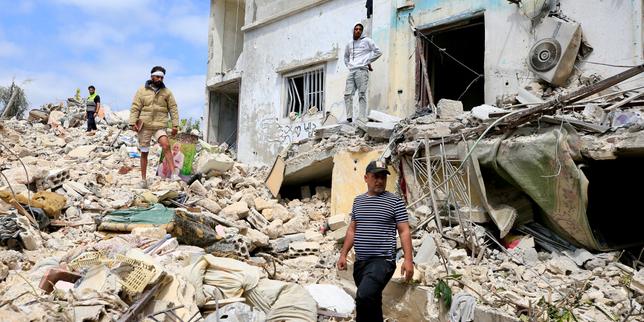
When a strike occurs, the sensory assault is overwhelming. The smell of pulverized concrete is distinct from any other odor; it is a sharp, chemical dust that coats the back of the throat and tastes like iron. The sound waves rattle the chest cavity before the ears even register the explosion. In an instant, a home built over three generations becomes a mountain of gray powder.
But the most difficult part of the war in Bourj Al-Chemali is not the moment of impact. It is the morning after.
The rituals of burial in the camp have become an exercise in spatial logistics. The local cemetery is full. It has been full for years. To bury the newly martyred, gravediggers must carefully navigate between existing headstones, sometimes reopening family plots to lay relatives together. The soil is turned over so frequently that it never quite settles.
During a recent funeral procession, hundreds of men shuffled through the alleys, carrying a wooden litter draped in a simple cloth. There were no grand political speeches. There was only the collective murmur of prayers, drowned out occasionally by the roar of a jet breaking the sound barrier high above the clouds. The mourners did not look up. To look up is to acknowledge an enemy that cannot be reasoned with; to look down at the stretcher is to focus on a duty that can still be performed.
The Economics of Post-Mortem Dignity
Living under siege exposes the brutal mechanics of survival. In Bourj Al-Chemali, even dying has a cost that many cannot afford. The United Nations Relief and Works Agency (UNRWA) struggles under severe funding shortages, leaving local committees and cash-strapped families to manage the logistics of emergency care and burial entirely on their own.
A single cinderblock to reinforce a collapsing grave costs more than a day's wages in the current hyper-inflated Lebanese economy. Fuel for the ambulance that carries the wounded to the remaining, overwhelmed hospitals in Tyre must be bartered for on the black market. The mutual aid networks within the camp are heroic, but they are running on fumes. Neighbors split their remaining bread; youth groups organize civilian defense teams with little more than flashlights and plastic helmets.
This is the invisible reality that standard news dispatches fail to capture. They report on the political stalemates and the military strategies, but they miss the ledger of survival kept by the camp’s elders. They miss the price of a shroud. They miss the calculation of whether to use the remaining clean water to wash a body or to keep a toddler hydrated for another afternoon.
The Endurance of the Unseen
It is easy to look at Bourj Al-Chemali and see only victimhood. That is a mistake. The human core of this place is defined by a fierce, almost defiant refusal to be erased.
Even as the funerals continue, life insists on asserting itself in the margins. A vendor sets out a crate of bruised mint leaves on a corner, determined to maintain a semblance of commerce. Children play a game of football in an alleyway so narrow their shoulders brush the walls on either side, their laughter cutting through the tense silence of the afternoon. These actions are not a denial of the danger; they are an active resistance against the despair that threatens to consume the community from within.
The camp exists in a state of suspended animation, caught between a past that was stolen and a future that feels entirely unpredictable. The people here are acutely aware that they are living on the periphery of global consciousness. They know their deaths are recorded as statistics, their history viewed as a footnote to a larger, more glamorous geopolitical chess match.
As dusk falls over southern Lebanon, the sea breeze from Tyre carries the smell of salt water into the camp, mixing with the odor of diesel smoke and wet dust. The digging at the cemetery finally stops for the night. The tools are put away. A quiet settles over the cinderblock maze, broken only by the occasional cry of a child or the distant, rhythmic thud of artillery along the border. The camp waits for the morning, clinging to its concrete foundations, determined to endure another day in the shadow of a war it did not choose, but cannot escape.


