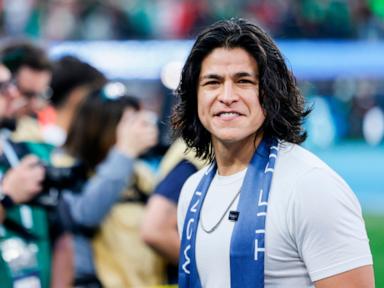
The grass at the Broadwater Post Ground isn't the manicured velvet of a Premier League stage. It is honest. It is often damp, smelling of crushed clover and the looming threat of a South East Counties League winter. There are no carbon-fiber tunnels here. No shimmering light shows. Just the rhythmic thwack of leather against a boot and the sharp, misted breath of men who play for the love of a game that rarely loves them back.
To the world, Toheeb Jimoh is Sam Obisanya. He is the beaming, soulful heart of AFC Richmond, the fictional Nigerian right-back who reminded millions that being a "good man" was just as important as being a "good footballer." We watched him on our screens, bathed in the high-definition glow of a streaming giant, executing scripted headers and navigating the sparkling drama of a Hollywood locker room.
But script-work has a ceiling. You can act the sweat, but you can’t act the exhaustion. You can mimic the strike, but you can’t replicate the bone-deep vibration of a semi-professional tackle on a Tuesday night in Godalming.
Toheeb Jimoh decided he was done pretending.
He didn't just sign a contract. He stepped through the screen and into the mud. By joining Godalming Town FC, Jimoh has performed a rare act of cultural alchemy. He has traded the safety of the "Diamond" for the brutal, beautiful reality of the English football pyramid.
The Weight of the Shirt
There is a specific kind of pressure that comes with being a "celebrity" athlete. Usually, it involves a retired pro trying to squeeze one last paycheck out of a desert league or a YouTuber staging a boxing match for clicks. This is different. Godalming Town sits in the tenth tier of English football. This is the bedrock of the sport. Here, the fans are close enough to smell the liniment on your legs, and the defenders don't care about your Emmy nominations. In fact, they’d probably prefer to slide-tackle a star than a stranger.
Imagine the locker room. It’s tight. It’s functional. Jimoh walks in not as a television icon, but as a teammate. The stakes for a club like Godalming are invisible to the casual observer but heavy for those involved. They aren't playing for global TV rights; they are playing for the pride of a town, for the continuity of a club founded in 1888, and for the sheer, stubborn refusal to let the sport become nothing more than a corporate product.
When Jimoh puts on that jersey, he isn't Sam Obisanya anymore. Sam is a character owned by writers and producers. This new man on the pitch is a person testing his own limits. It is a terrifying transition. In Hollywood, if you miss the shot, you reset the camera and go again. At the Broadwater Post Ground, if you miss the shot, the silence of the crowd is a physical weight. The "Take Two" doesn't exist.
Why the Tenth Tier Matters
To understand why this move resonates, you have to understand the ecosystem of English football. It is a massive, sprawling organism. At the top, you have the billionaire owners and the private jets. At the bottom—where Jimoh has landed—you have the soul.
- The Community Hub: Small clubs are the social glue of their towns.
- The Meritocracy: In the tenth tier, your name doesn't buy you a yard of space.
- The Physicality: It is a rugged, uncompromising brand of football that demands genuine fitness.
Consider the hypothetical defender Jimoh might face on a rainy afternoon. Let’s call him Miller. Miller works a 9-to-5 in construction or insurance. He’s been playing for Godalming for six years. He has a sore knee and a mortgage. When he sees a famous actor lining up against him, Miller isn't thinking about a selfie. He’s thinking about making sure that actor knows exactly what a wet Saturday in the Surrey County League feels like.
Jimoh is inviting that confrontation. He is seeking the friction. In a world where most stars curate their lives to avoid any hint of failure or "unprofessional" optics, he has chosen a path where failure is public and inevitable. You will lose games. You will be fouled. You will be cold.
The Ghost of Sam Obisanya
There is a poetic symmetry here that is impossible to ignore. In the narrative of Ted Lasso, Jimoh’s character was often the moral compass, a man who believed in the purity of the sport despite the corruption and commercialism surrounding it. By signing with a non-league side, Jimoh is living out the ethos he helped popularize.
He is bridging the gap between the myth of the athlete and the reality of the player.
We often talk about "authenticity" as if it’s a brand strategy. It isn’t. Authenticity is what happens when you do something that doesn't benefit your "brand" but satisfies your soul. There is no massive financial windfall for Jimoh at Godalming Town. There are no red carpets. There is only the chance to prove to himself—and perhaps to the ghosts of the characters he’s played—that he can actually do it.
The transition from the screen to the pitch requires a stripping away of ego. On a film set, Jimoh is the center of a universe. Hundreds of people work to make sure he looks good, sounds clear, and stays hydrated. On a pitch in the tenth tier, he is one of eleven. He is a cog in a machine that requires sweat, not charisma.
The Silent Stakes
Why does this matter to us, the people watching from the sidelines?
Because we live in a curated age. We are surrounded by "content" that is polished until the humanity is rubbed off. We see athletes who are brands and actors who are industries. When someone like Jimoh breaks the fourth wall of his own life to do something gritty and unglamorous, it reminds us that the best parts of life are often found in the struggle, not the highlight reel.
There is a vulnerability in this move that is deeply moving. He is opening himself up to the sneers of cynics who will call it a publicity stunt. He is risking injury. He is risking being "not good enough." But that risk is exactly what makes the endeavor worth watching.
Football is a game of moments. A singular, perfect pass. A desperate, sliding block. A ball that hits the back of the net and for one second, makes the entire world go quiet. Jimoh has chased those moments in a recording studio and on a soundstage. Now, he is chasing them where they live: in the mud, under the dim floodlights of a town that most of his fans couldn't find on a map.
The whistle blows. The air is cold. The grass is uneven.
He isn't Sam. He isn't a star. He is a footballer.
The ball is rolling, and for the first time in a long time, the script hasn't been written yet. Only he can decide how the story ends, one stride at a time, across the damp Surrey earth.