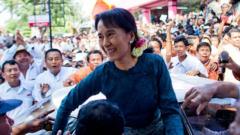
Aung San Suu Kyi was once the gold standard for moral courage. For nearly two decades, she lived under house arrest in a lakeside villa in Yangon, a defiant symbol against a brutal military junta. She had the Nobel Peace Prize. She had the support of every Western leader from Obama to Blair. She was the "Lady" of Myanmar.
Now, she sits in a prison cell again. But this time, the international community isn't lighting candles for her. The narrative shifted from saint to pariah long before the 2021 coup put her back behind bars. To understand why, you have to look past the "democracy icon" label and see the cold reality of Myanmar's internal power struggles. She wasn't just a victim of the military; she became their most effective shield for a time.
The Myth of the Reluctant Politician
People often forget that Suu Kyi didn't start as a politician. She was the daughter of General Aung San, the father of modern Myanmar. Her lineage gave her a kind of secular divinity in the eyes of the Burmese people. When she returned to the country in 1988 to care for her dying mother, she stumbled into a revolution.
The military had just crushed a student uprising. Thousands died. Suu Kyi stepped onto the stage because she was the only one with a name big enough to challenge the generals. She didn't choose the life of a martyr; the military chose it for her by locking her up.
Throughout the 1990s and 2000s, she became a screen onto which the West projected its own ideals. We wanted a Mandela in Southeast Asia. We saw a woman in silk sarongs with flowers in her hair, speaking perfect English, and we assumed she shared every single one of our liberal values. That was our first mistake. She was always a nationalist first.
The 2015 Victory and the Deal with the Devil
When her party, the National League for Democracy (NLD), won a landslide victory in 2015, the world cheered. It looked like the movie ending we’d all been waiting for. But the constitution, written by the military, specifically banned her from being President because her children are British citizens. They literally wrote a law to stop her.
She got around it by creating the title of State Counsellor. She was the de facto leader, but she was leading a government where the military still controlled the three most powerful ministries: Home Affairs, Border Affairs, and Defense.
This created a "diarchy," a dual-power system. To get anything done, she had to stay in the generals' good graces. She stopped talking about human rights abuses. She stopped meeting with activists. She became a bureaucrat focused on keeping her fragile grip on power. Many of us watched this transition and felt a sense of dread. It’s hard to keep your soul when you’re sharing a cabinet table with the men who kept you in a cage for twenty years.
The Rohingya Crisis and the Fall from Grace
The breaking point for her global reputation came in 2017. The Myanmar military launched a "cleansweep" operation in Rakhine State. They burned villages. They committed mass rape. They forced over 700,000 Rohingya Muslims to flee into Bangladesh.
The UN called it a textbook example of ethnic cleansing.
The world waited for the Nobel laureate to speak up. She didn't. When she finally did, she claimed the government was "not afraid of international scrutiny" and suggested the violence was a two-sided conflict. In 2019, she went to the International Court of Justice (ICJ) in The Hague to personally defend the military against charges of genocide.
Seeing a former human rights icon sitting in a courtroom defending the very generals who once oppressed her was a gut punch to the international community. Her defense wasn't just a political miscalculation; it was a moral abandonment. She gambled her international legacy to maintain domestic popularity among the Buddhist majority who largely despise the Rohingya. She won the gamble at home, but she lost the world.
The 2021 Coup and the Return to the Beginning
The military never intended to let her stay in power forever. They just wanted the sanctions lifted. Once the economy was somewhat stable and they felt their interests were threatened by her massive popularity, they struck.
On February 1, 2021, the morning the new parliament was supposed to convene, the army arrested her again. They claimed the 2020 election, which she won by an even larger margin, was fraudulent. It was a classic power grab.
Since then, she’s been hit with a laundry list of ridiculous charges.
- Illegally importing walkie-talkies.
- Violating COVID-19 protocols.
- Election fraud.
- Corruption and accepting bribes in gold.
She’s been sentenced to decades in prison. She’s in her late 70s now. The reality is that she’ll likely die in custody. The tragedy is that while the Burmese people still love her and fight for her, the rest of the world has moved on to other crises. We don't see her as the solution anymore.
Why the NLD Model Failed
The NLD was built entirely around her personality. It wasn't a party of ideas; it was a cult of Aung San Suu Kyi. When she was arrested, the leadership structure collapsed because she had spent years ensuring no clear successor could emerge.
The younger generation of protesters, the "Gen Z" of Myanmar, are different. They aren't just fighting for her release. They’re fighting for a federal democracy that actually includes ethnic minorities. They’ve realized that the old way—relying on one "saviour" figure—doesn't work.
The current resistance, the People's Defense Forces (PDF), is more radical than Suu Kyi ever was. They've picked up guns. She always preached non-violence, even when the army was shooting people in the streets. Her brand of "peaceful transition" is dead. The kids in the jungle aren't waiting for her to come save them; they're building a new country without her.
What You Can Actually Do
If you're looking at the situation in Myanmar and wondering how to help, don't focus on the "Free Suu Kyi" posters. Focus on the humanitarian crisis that the coup created.
- Support the Milk Tea Alliance. This is a network of pro-democracy activists across Asia (Thailand, Hong Kong, Myanmar). They share resources and digital security tips.
- Donate to Border Relief. Organizations like the Free Burma Rangers provide actual medical aid and food to those displaced by the ongoing civil war.
- Pressure for Sanctions. The military stays in power because of oil and gas revenue. Support campaigns that target the Myanma Oil and Gas Enterprise (MOGE).
- Read Independent News. Follow outlets like Myanmar Now or The Irrawaddy. They’re the ones on the ground, often in hiding, telling the stories that big Western media outlets ignore now that the "celebrity" leader is gone.
The story of Aung San Suu Kyi is a warning. It's what happens when we turn a complicated political figure into a secular saint. She was never a goddess. She was a politician who made a deal with a monster and got swallowed by it. The future of Myanmar isn't in a prison cell in Naypyidaw; it’s in the hands of the people who realized they don't need a name to fight for their lives.