The wind does not ask permission to erase things. Out on Block Island, twelve miles off the Rhode Island coast, the Atlantic gale hits the bluffs with a physical weight, scouring the bayberry bushes, salt-blistering the paint on weathered houses, and roaring through the scrub. It is a place of perpetual motion and sudden vanishings. Dunes shift overnight. Sea cliffs crumble into the froth. In a landscape so relentlessly transient, permanence feels like a quiet defiance.
Consider how easy it is to lose track of what lived here yesterday. For an alternative perspective, see: this related article.
Enter a small, unheated room on a gray morning in 1912. Elizabeth Dickens sits at a wooden table, her fingers stiff against the winter chill. She opens a blank notebook. She dips her pen in ink.
She does not know it yet, but she is about to anchor an entire ecosystem to paper. Further reporting regarding this has been shared by ELLE.
For the next fifty-one years, Elizabeth will repeat this solitary ritual. Day after day, through Nor'easters that rattle the windowpanes and stifling summer afternoons when the sea glass glimmers on the shore, she records every single bird she sees. She writes down the common sparrows, the sudden explosion of warblers during a autumn push, the strange and solitary wanderers blown off course by a hurricane.
She is not a professor from an Ivy League institution. She has no grant money, no government backing, and no fancy optics. She is an eighth-generation islander, born in 1877, whose world is bounded by the horizon and defined by the winged creatures that pause briefly on their arduous journey along the Atlantic Flyway.
The Currency of Quiet Observation
To understand what Elizabeth achieved, you have to understand the invisible geometry of migration. Block Island is not just a scenic outcrop; it is a vital ecological stepping stone. Millions of birds cross the Gulf of Maine and the open ocean, exhausted, looking for a patch of green, a safe harbor, a place to rest before pressing south or north. They drop out of the sky onto the island by the thousands.
Most people see a blur of feathers and hear a morning chorus. Elizabeth saw a ledger.
Her journals, now housed safely with the Audubon Society of Rhode Island, are marvels of disciplined humility. They are thick with dates, weather conditions, species names, and casual counts that, when stacked together, form a monumental baseline of natural history. Before climate change had a common name, before modern conservation movements mapped the decline of avian populations, Elizabeth was quietly taking the pulse of the continent's wildlife.
Think of her notebooks as a long, unbroken musical note held across half a century. If you change a single note, the song breaks. But Elizabeth held the note steady.
Biologists decades later would look at her entries and find something miraculous: a clear picture of how the island's birdlife shifted across generations. They would realize that without her patient tally, entire decades of ecological history would simply have evaporated into the salt air.
The Classroom of the Bluffs
Elizabeth knew that a record written on paper alone dies with the writer. Knowledge must walk around on two legs if it is going to survive.
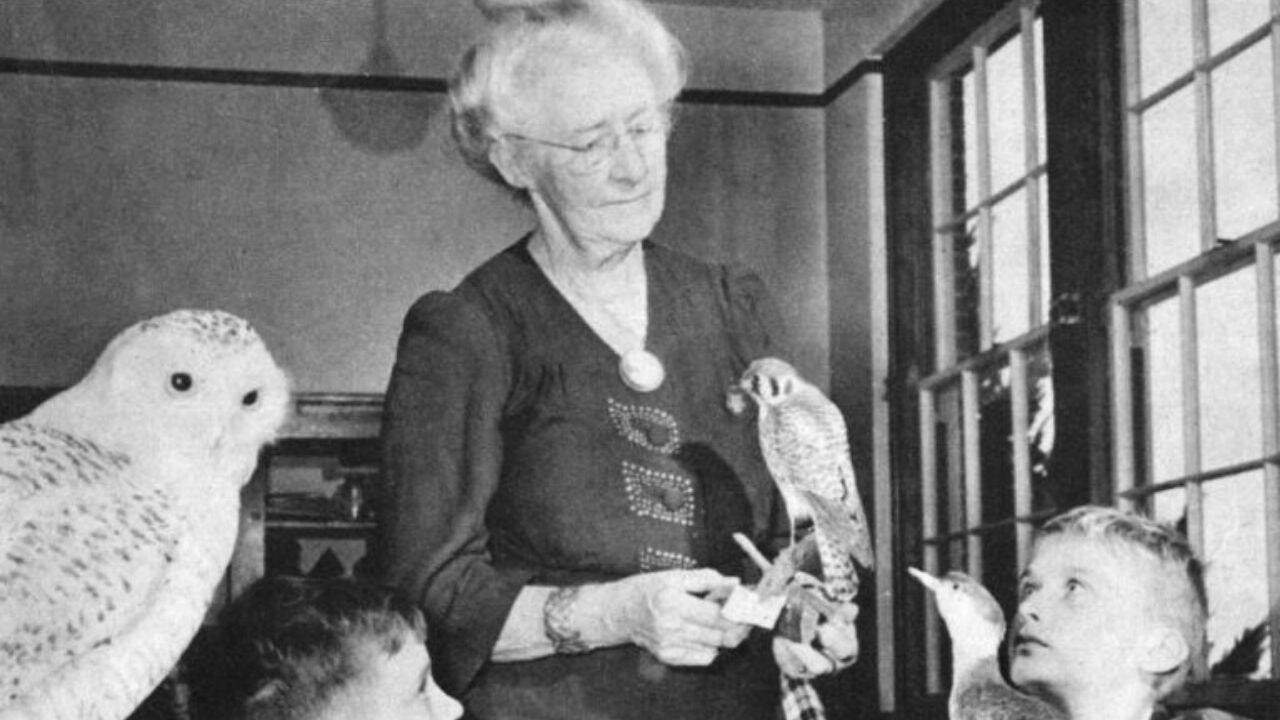
Beginning in 1911 and continuing for nearly fifty years, she walked into the local schoolrooms once a month to teach a class simply called Bird Study. Picture the scene: children shifting restlessly in wooden desks, smelling of wet wool and pine wood, turning the pages of Audubon bird leaflets handed down by museum curators from the mainland. Elizabeth did not lecture from a pedestal. She spoke with the quiet authority of someone who watched the red-winged blackbirds return before the snow melted.
She infected those children with a dangerous, beautiful affliction: paying attention.
Soon, the kids were roaming the island's hillsides with sharper eyes. When they found a bird that had met an untimely end—perhaps a yellow-billed cuckoo that struck the lighthouse glass, or an unfortunate casualty of a sharp-shinned hawk—they didn't just leave it in the grass. They brought it to Miss Dickens.
There was a strict rule in Elizabeth's house. She would never accept a bird that had been shot by a hunter. Her collection was built exclusively on tragedy and accident—window strikes, lighthouse collisions, natural predation. With steady hands and careful taxidermy, she preserved them. One hundred and seventy-two mounted specimens eventually filled her cabinets, a silent, frozen assembly of wanderers: a magnificent frigatebird, a northern lapwing, a rare snowy owl.
To look at Katherine Wolkoff's modern photographic silhouettes of these specimens is to feel an eerie, poignant transcendence. The birds blur the line between life and death, standing not just as individual creatures, but as monuments to the sheer peril of the migratory gauntlet. They are physical proof that survival is never guaranteed.
The Weight of a Single Life
It is easy to romanticize isolation. We imagine island life as a peaceful idyll, far from the grinding gears of modern history. But isolation is also heavy. It requires endurance. Elizabeth lived through two World Wars, the Great Depression, and the slow, creeping transformation of her beloved island as roads were paved and summer cottages began to multiply.
Through it all, she kept writing in her books.
When John W. Aldrich of the U.S. Fish and Wildlife Service wrote in 1956 that virtually all human knowledge of Block Island's crucial role in the Atlantic Flyway stemmed directly from her work, he wasn't exaggerating. A federal agency relied on the handwritten notes of a woman sitting by her kitchen window.
She didn't travel much. She didn't seek fame or honorary degrees. When people started calling her the Bird Lady of Block Island, she accepted the moniker with the same dry grace she brought to a blizzard. It was simply what she did. The birds came; she counted them. The children asked; she taught them. The record needed keeping; she kept it.
We live in an era obsessed with scale, metrics, and instant global reach. We look for impact in viral spikes and massive institutional projects. We forget the terrifying power of accumulated days.
Elizabeth Dickens died in 1963, closing her final journal after more than fifty years of unbroken observation. Her name now lives on through the Lewis-Dickens Farm nature preserve, where coastal meadows roll down to the crashing surf, and harriers quarter the salt grass just as they did a century ago.
The wind still tears across the bluffs, indifferent to human memory, chewing away at the edge of the island. But down in the quiet archives, the ink hasn't faded. Every page stands as a stubborn proof that a single human life, armed with nothing more than a pen and unyielding attention, can hold back the tide of oblivion.