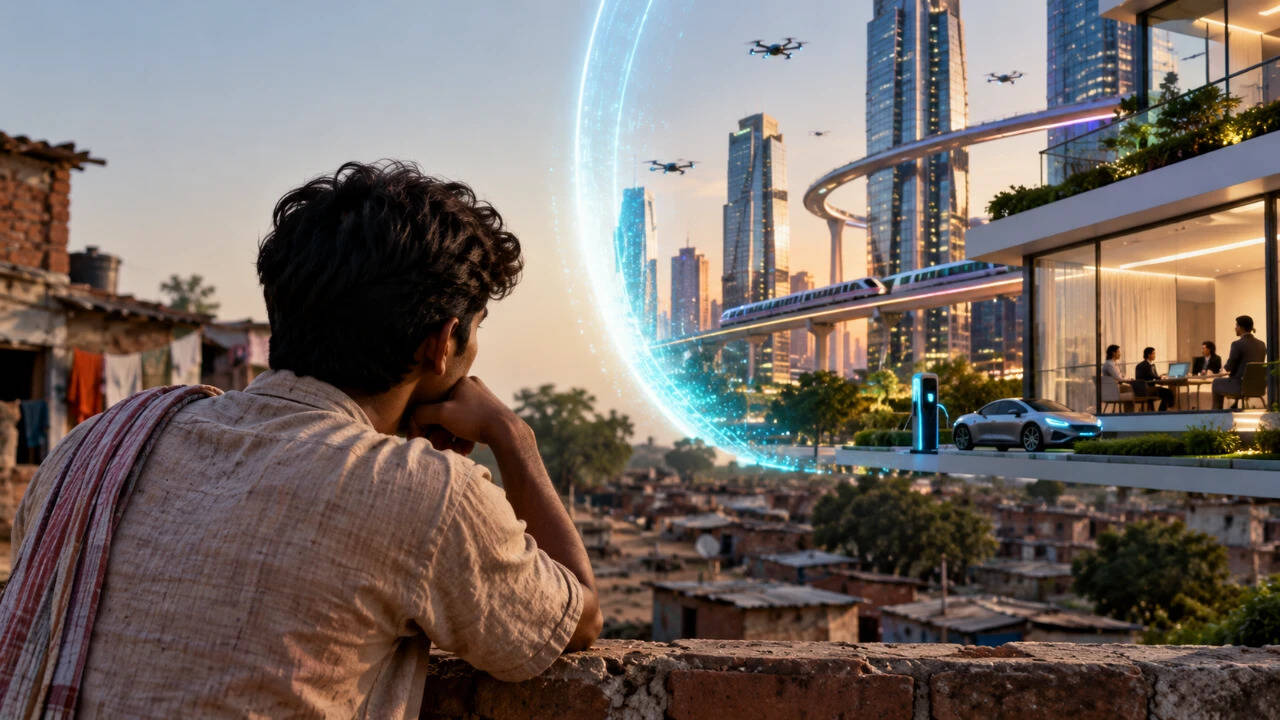
A programmer in San Francisco uses a brain-computer interface to draft emails by thinking. He doesn't touch a keyboard. He just stares at a screen and lets the cursor move. Less than a hundred miles away in California's Central Valley, farmworkers lack reliable broadband access to check their bank accounts.
This is the reality of our world. It isn't a sci-fi dystopia. It is just Tuesday.
When sci-fi novelist William Gibson famously remarked that the future is already here, just not evenly distributed, he wasn't making a cute observation about gadgets. He was describing a systemic law of human progress. People often treat the future as a destination we all arrive at together on a scheduled flight. We don't. We arrive in waves, some of us decades late, while others have been living there for years.
Understanding this concept changes how you see everything from global politics to your own career. Once you see the gaps, you can stop waiting for the world to change and start looking for where the change has already taken root.
The origin of a legendary insight
Gibson didn't actually write his most famous line in Neuromancer or any of his other novels. He said it during a radio interview in the early 1990s. He was trying to explain how he came up with his gritty, high-tech worlds. He didn't invent his fictional technology out of thin air. He just looked at what already existed in advanced military labs, university research basements, and Tokyo subcultures, then wrote about what would happen if those things became slightly more common.
Most people think science fiction writers predict the future. They don't. The good ones just look closely at the present.
Think about the early days of the internet. In 1995, a tiny fraction of the global population had an email address. If you were one of them, you were living in the future. To your neighbors, you were a wizard sending electronic letters through the phone line. To you, it was just your daily routine. The future had arrived in your home, but it was still years away from theirs.
This distribution lag is not a bug in the system. It is the system. Technology requires capital, infrastructure, education, and political stability to spread. Because those things are never distributed evenly, technology never will be either.
Compute wealth versus compute poverty
We see this distribution gap clearly in the world of artificial intelligence. If you read tech blogs, you might think everyone is using advanced AI agents to run their businesses.
They aren't.
We are currently seeing a massive divide between the compute-rich and the compute-poor. On one side, you have well-funded startups and tech giants with direct access to massive server farms. They can run complex models that analyze millions of data points in seconds. On the other side, you have small business owners in rural areas who still manage their inventory on paper ledgers because their local cellular network can't handle heavy cloud applications.
This isn't just about convenience. It is about economic survival. The businesses with access to these tools run circles around those without them. The gap doesn't close naturally over time. Without deliberate effort, it widens. The compute-rich get richer because their tools allow them to optimize faster, while the compute-poor get left further behind.
The biotech divide and the lottery of longevity
Nowhere is the uneven future more obvious than in healthcare and biotechnology.
Right now, ultra-wealthy individuals are spending millions of dollars annually on experimental therapies. They undergo regular blood plasma exchanges, take custom peptide cocktails, and use advanced gene therapies to slow down cellular aging. Some of these treatments actually work. These people are effectively living in a future where human life expectancy is pushed past a hundred years.
Meanwhile, millions of people die every year from diseases we figured out how to cure a century ago.
Tuberculosis is treatable. We have the medicine. Yet, because of distribution failures, supply chain bottlenecks, and poverty, it remains a major killer in developing countries. You don't even have to look globally to see this. Look at the life expectancy gap between different ZIP codes in the same American city. Sometimes a ten-minute drive represents a ten-year difference in lifespan.
The future of medicine is incredible. It just belongs to the people who can afford the ticket.
Why technology does not trickle down on its own
For decades, economists pushed the idea of inevitable technological adoption. The theory was simple. Rich people buy the expensive new technology first. Their money funds the production scale-up, which lowers the price, making it affordable for the middle class, and eventually, everyone else.
This model worked well for consumer electronics like televisions and mobile phones. It fails miserably for infrastructure.
Think about clean energy. Solar panels and battery walls are fantastic. If you own a suburban home in a wealthy neighborhood, you can install them, disconnect from the unstable power grid, and enjoy cheap, green electricity. But if you rent an apartment in an older building with outdated wiring, you can't just buy a solar roof. You depend on a public grid that might be crumbling.
The same applies to autonomous vehicles. Self-driving cars require high-definition mapping, reliable cellular signals, and well-paved roads. They work beautifully in wealthy suburbs. They don't work in rural towns with dirt roads and no cell service. The technology cannot trickle down to these places because the underlying foundation isn't there to support it.
How to spot the pockets of tomorrow today
If you want to know what the mainstream world will look like in ten years, you don't need a crystal ball. You just need to look at the margins of society right now.
To spot these pockets of the future, look at three specific groups.
First, watch the hackers and hobbyists. Long before personal computers were a massive industry, members of the Homebrew Computer Club were building their own machines in garages. They weren't doing it for money. They did it because they were obsessed. If you want to know what the next major consumer platform is, find out what smart teenagers are building in their spare time for fun.
Second, watch the desperate. When survival is on the line, people find creative ways to use whatever tools they have. During hyperinflation crises in places like Venezuela, everyday citizens turned to digital currencies not as a speculative investment, but as a way to buy groceries. They adopted digital finance years before Western consumers started taking it seriously. Desperation accelerates adoption.
Third, watch the ultra-wealthy. This is the most obvious one, but it is still true. The luxury services of today are the mass-market products of tomorrow. Private chauffeurs became Uber. Private chefs became meal delivery apps. If you see rich people paying exorbitant amounts of money for a service that saves them time, try to figure out how to automate that service for the masses.
Build your own distribution channels
We can't just sit around and wait for the future to arrive at our doorstep. If you are running a business, managing a team, or just trying to navigate your own career, you have to actively seek out these pockets of advancement.
Find the tools that the top one percent of your industry are using right now. Learn them. Figure out how they work. Master them before they become standard requirements on every job posting.
At the same time, look at where your own work is lagging behind. Are you still using outdated processes just because that's how you've always done it? If so, you are living in someone else's past.
The divide between the present and the future is not a geographic border. It is a state of mind and a willingness to adapt. The tools are out there. The knowledge is available. You just have to go find it, pull it into your daily life, and distribute it to the people around you. Don't wait for the wave to hit you. Go find the deep water.