The human eye is remarkably adept at negotiating the difference between a cloud and a crisis. To someone looking out the window of a commercial airliner, the sky is a predictable expanse of grey and blue. But when the cloud begins to materialize inside the pressurized steel cylinder of an aircraft cabin, the physics of comfort quickly dissolve into something primal.
It started as a subtle alteration of the air. A faint, sweetish metallic tang that initially tasted like the standard byproduct of a heavy machine waking up. Passengers on the Cathay Pacific flight routing from India toward Hong Kong began to shift in their seats. Some looked up at the overhead ventilation nozzles. Others glanced nervously down the aisle, waiting for the reassuring click of a flight attendant’s heels.
Air travel relies on a fragile psychology. We willingly hurtle through the upper troposphere, suspended by thrust and lift, relying entirely on the assumption that the machine keeping us alive is completely indifferent to the chaos of the world below. When that illusion falters, time slows down.
Then came the mist. White, vaporous, and uninvited, it drifted lazily into the cabin as the plane began its long descent toward Hong Kong International Airport.
The Chemistry of Panic
To understand what happens to a human mind when smoke appears at thirty thousand feet, you have to look past the technical manuals. Consider a hypothetical passenger, an executive returning home, her fingers hovering over a laptop keyboard. She notices the mist curling around the edges of the overhead luggage bins. In aviation jargon, this is an "unreported cabin event." In human terms, it is a moment where the heartbeat spikes and the brain starts calculating the distance to the ground.
Smoke in a closed cockpit or cabin is the ultimate nightmare for any flight crew. It represents an unknown variable, an invisible fire that could be chewing through miles of complex wiring just beneath the floorboards. The pilots know the statistics. They know that an uncontained in-flight fire can compromise critical flight control systems in mere minutes.
On this particular morning, the flight deck worked with quiet, practiced urgency. Checklists were pulled up on electronic flight bags. The air traffic control towers at Chek Lap Kok were notified. Emergency ground services began to assemble along the runways, their red lights flashing against the morning sky, waiting for a bird that was coming in hot.
Yet, as the aircraft lined up with the runway, the true nature of the threat remained elusive. The air grew thicker, but there was no heat. There was no crackle of flames.
The Overheated Lifeline
The irony of modern aviation is that the very systems designed to keep us comfortable are often the ones that mimic our destruction.
An aircraft's environmental control system is a marvel of engineering. It takes scorching, high-pressure air bled directly from the jet engines, cools it through a complex series of heat exchangers and air cycle machines, and pumps it into the cabin so passengers can breathe comfortably at altitudes where the atmospheric pressure would otherwise kill them. It is a closed loop of survival.
But machines, like humans, get tired.
A preliminary investigation by emergency teams and engineering crews revealed that the terrifying haze drifting through the Cathay Pacific cabin did not come from an electrical fire or an exploding battery pack. The culprit was far more mundane: an overheated air conditioning system. When a component within the environmental pack malfunctions or runs too hot, the lubricants and moisture within the system can vaporize. The result is a thick, white smoke that looks identical to the preamble of an inferno.
Fear, however, does not wait for a maintenance report.
For the passengers on board, the descent was an exercise in collective restraint. People held hands. Parents quietly adjusted the oxygen masks of their children, even though the cabin pressure remained stable. The silence was heavy, broken only by the steady roar of the twin engines and the occasional muffled sob.
The Hard Ground
The tires hit the tarmac with a definitive, violent thud. Relief was instantaneous, yet incomplete.
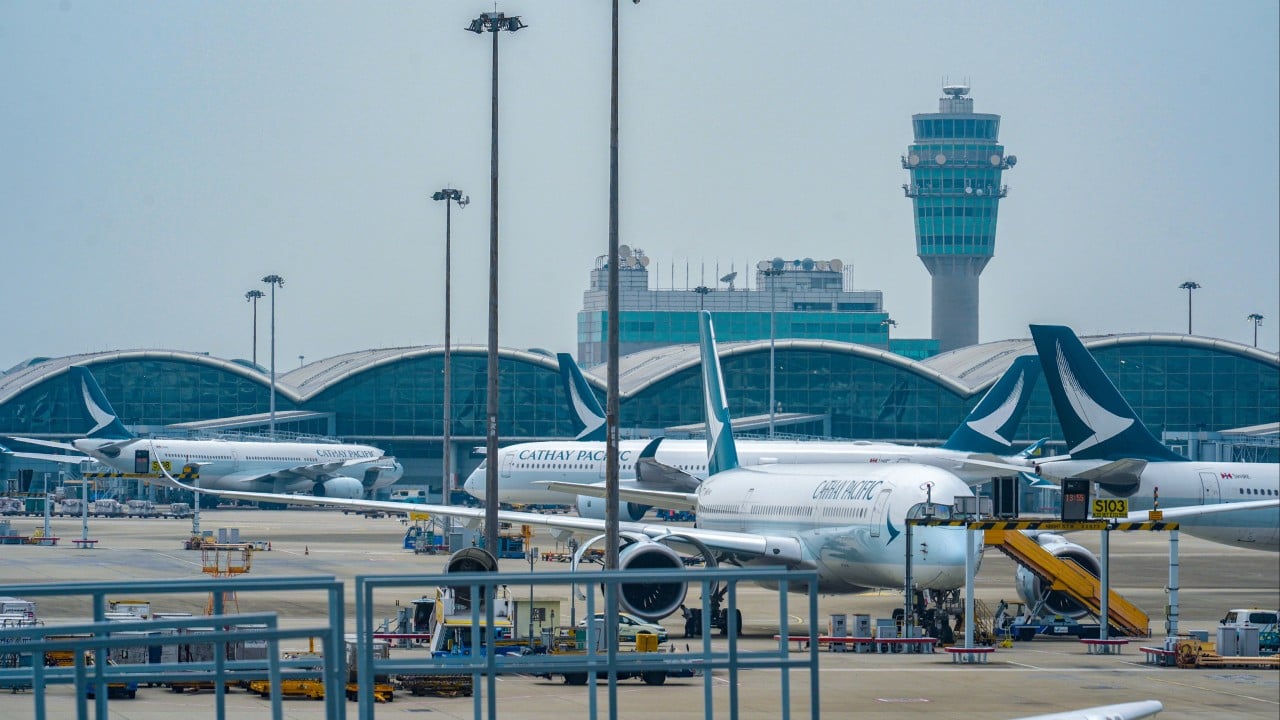
As the Cathay Pacific jet slowed down on the Hong Kong runway, the smoke began to dissipate, cooling as the broken air conditioning units finally spun down. Fire engines flanked the aluminum hull, their crews dressed in silver heat-resistant suits, ready to douse a fire that ultimately wasn't there.
All passengers and crew members were evacuated safely. No injuries were reported. The physical machinery of the plane had held together, and the human crew had navigated the panic with flawless professionalism.
We live in an age where the mechanics of flight have become so reliable that we treat them as boring. We complain about legroom, bad coffee, and delayed departures. It takes a plume of harmless white vapor to remind us of the invisible stakes we accept every time we step through an boarding gate. We trust our lives to a grid of wires, turbines, and the steady hands of strangers sitting in a cockpit we will never see.
When the passengers stepped out onto the solid concrete of Hong Kong, the morning air felt colder, sharper, and infinitely sweeter than it had just an hour before. The crisis had vanished back into the machinery, leaving behind only the quiet, shaking gratitude of those who had watched the sky find its way inside.