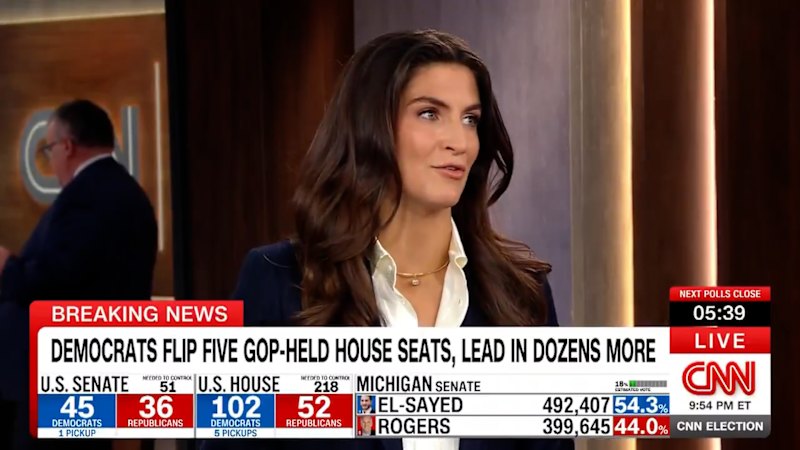
You've heard the line a dozen times after an off-year election night goes sideways for the party in power. Press secretaries step up to the podium, adjust their notes, and tell the briefing room that the president wasn't on the ballot.
It sounds like a cheap deflection. Honestly, it is a deflection, at least partly. When a White House uses the phrase "Trump was not on the ballot" to explain away statehouse losses, gubernatorial upsets, or rocky midterm returns, they're trying to build a firewall between local political gravity and the person sitting in the Oval Office. Discover more on a connected topic: this related article.
They want you to believe that local races stay local. That voters in Virginia, Kentucky, or Ohio are only thinking about property taxes, school boards, and pothole budgets when they step into the booth.
History tells a completely different story. More reporting by BBC News explores similar perspectives on the subject.
Why Press Secretaries Always Reach for This Line
If you've ever watched political communications teams work the morning after a rough Tuesday in November, you know the playbook is practically laminated. Nobody in the West Wing wants the morning headlines to read as a personal rejection of the president's agenda. So they pivot immediately to hyper-local variables.
They'll point to a weak candidate who couldn't fundraise. They'll blame a messy primary that left the party base bruised and unmotivated. Sometimes they'll argue that local turnout models simply didn't favor their side in an odd-numbered year.
There's a kernel of truth buried inside the spin. Off-year elections do have smaller, older, and more partisan electorates than presidential contests. A candidate running for governor in New Jersey or attorney general in Mississippi has to manage state-specific baggage that has nothing to do with Washington.
Still, claiming a president is irrelevant because his name isn't printed on the paper ignores how modern American voters actually behave.
The Reality of the Midterm and Off-Year Referendum
American politics has become aggressively nationalized over the last twenty years. Political scientists at institutions like the Pew Research Center and the University of Virginia's Center for Politics have documented this shift across cycle after cycle. Split-ticket voting—where someone backs a Democrat for president and a Republican for Senate, or vice versa—has dropped to historic lows.
When people vote in November 2025 or November 2026, they aren't evaluating their local congressional representative in a vacuum. They're grading the person in the White House.
Look at the historical track record. It's brutal for sitting presidents, regardless of party:
- In 2010, Barack Obama wasn't on the ballot, yet Democrats lost 63 House seats in what he famously called a "shellacking."
- In 2018, Donald Trump wasn't on the ballot, and Republicans lost 41 House seats as suburban voters used the midterms to check the administration.
- In 2022, Joe Biden wasn't on the ballot, and while Democrats held the Senate, they still surrendered control of the House in a cycle defined by inflation and presidential approval ratings.
The president's name doesn't need to be on the ballot for the president to be the main character of the election. In fact, his absence from the ballot is often the exact problem for his own party.
The Turnout Trap When the Top of the Ticket Is Missing
Here's what campaign strategists worry about behind closed doors, even when they're putting on a brave face for cable news.
Donald Trump has a unique ability to pull low-propensity voters to the polls. These are folks who don't follow daily Washington gossip, rarely show up for municipal elections, and don't care much about traditional party infrastructure. They show up when Trump is running.
When he isn't on the ballot, keeping that coalition engaged becomes an uphill slog.
You saw this dynamic play out repeatedly during his first term and in the cycles that followed. In 2017, Democrats swept statewide races in Virginia and New Jersey. In 2019, Andy Beshear won the governor's mansion in deep-red Kentucky, and Democrats flipped control of the Virginia General Assembly. In each of those moments, White House surrogates argued the results couldn't be extrapolated to a presidential year because Trump wasn't running.
They were right about one thing: presidential years bring out a much larger, different electorate. They were wrong to assume those off-year losses didn't carry massive warning signs about suburban erosion and opposition enthusiasm.
The Enthusiasm Gap Is Real
Opposition voters don't need the president's name on the ballot to feel motivated. Anger and frustration are reliable fuel. When voters are unhappy with the direction of the country, the economy, or specific executive actions, they treat every available race—from city council to the U.S. Senate—as a way to send a message to Washington.
Meanwhile, the president's supporters often feel a false sense of security. Their guy already won. The big fight feels over until the next presidential cycle rolls around. That asymmetry creates a turnout gap that no amount of clever White House spin can erase on election night.
How Local Candidates Get Caught in the Crossfire
Saying the president isn't on the ballot also glosses over the impossible tightrope down-ballot candidates have to walk.
If you're a Republican running in a swing district in Pennsylvania or California, you can't just pretend the White House doesn't exist. Voters won't let you. Reporters will ask you about every executive order, every tariff threat, and every social media post coming out of Washington.
If you embrace the White House completely, you risk alienating independent voters in the suburbs who decided the outcome of the race. If you distance yourself too aggressively, you risk depressing your own base—the exact voters who need a reason to show up when Trump isn't personally asking for their vote.
It's a lose-lose bind. When the White House later steps to the microphone and says "Trump was not on the ballot," it can actually rub salt in the wound for local candidates who spent months answering for Washington's decisions.
What Voters and Political Watchers Should Actually Track
If you want to understand what an election result really means without getting distracted by press room spin, skip the post-game talking points and look at the underlying data. Spin is designed to protect egos; precinct math tells the truth.
Start by checking county-level shifts compared to the most recent presidential election. Did suburban counties outside major metro areas swing five or ten points toward the opposition? Did rural turnout drop off dramatically compared to a presidential year? Those numbers tell you whether a loss was a fluke caused by a bad local candidate or part of a broader structural trend.
Look next at special elections happening throughout the calendar year. Analysts at outlets like The Cook Political Report and Sabato's Crystal Ball track special legislative and congressional races closely because they strip away big-budget national ad campaigns and show raw voter motivation. When one party consistently outperforms its baseline in random Tuesday special elections in state house districts, a wave is usually building.
Pay attention to generic ballot polling as well. When pollsters ask voters which party they want controlling Congress, they're measuring the national environment stripped of individual personalities. If a president's party is trailing badly on the generic ballot, claiming the president isn't on the ballot won't save vulnerable incumbents.
Finally, watch how donors and sitting lawmakers react over the next two weeks, not what spokespeople say in the first two hours. When big donors start hedging their bets or members of Congress suddenly announce they aren't seeking reelection, you know they don't buy the "not on the ballot" excuse either. They can read the numbers on the wall, even when the podium insists everything is fine.


