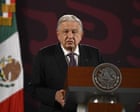
The heat in Mexico City doesn’t just sit on the skin; it weight-presses against the chest. In the high-ceilinged rooms of the National Palace, where the air smells of old stone and centuries of friction, words carry a specific kind of gravity. When a leader speaks here, the echoes travel north, vibrating across thousands of miles of wire, concrete, and desert sand until they hit the air-conditioned offices of Washington, D.C.
Power is rarely loud when it is being executed. It is quiet. It is a signature on a memo, a withheld funding grant, a closed-door briefing between intelligence officials who share a glance but never a paper trail.
But when that power is challenged, the response is deafening.
Recently, the political landscape of North America experienced a seismic tremor. A former Mexican president broke the unspoken code of diplomatic restraint, openly accusing the United States government of orchestrating a quiet, calculated campaign to undermine Mexico’s ruling party. This is not a standard policy dispute over tariffs or border security. This is an allegation of a modern, invisible war for the soul of a nation's sovereignty.
To understand the weight of this accusation, we have to look past the sterile headlines and enter the room where the decisions are made.
The Weight of the Accusation
Imagine a chess board where the pieces aren't made of wood, but of economic leverage, public perception, and national pride.
For decades, the relationship between the United States and Mexico has been sold to the public as a partnership. We hear about trade agreements. We see photos of presidents shaking hands, smiling under the flashbulbs of international press corps. But beneath the surface veneer of cooperation lies a historical undercurrent of deep mistrust.
When the former Mexican executive leveled the charge that Washington is actively plotting to weaken the current governing administration, it tapped into a collective historical trauma. For Mexico, foreign intervention is not a theoretical concept debated in university lecture halls. It is history. It is the memory of lost territory, of economic restructuring forced by international lenders, and of intelligence agencies operating in the shadows of their cities.
The claim is specific: the U.S. is utilizing its vast apparatus—funding non-governmental organizations, channeling resources to opposition groups, and leveraging media narratives—to tilt the scales of upcoming democratic processes.
Washington, of course, denies this. The official stance is one of practiced indifference mixed with standard bureaucratic reassurance. They claim they respect Mexican sovereignty. They say they only support democracy, transparency, and the rule of law.
But words are cheap when the stakes are survival.
The Human Cost of High-Stakes Diplomacy
Let us step away from the presidential palaces for a moment. Consider a hypothetical citizen named Elena. She runs a small convenience store, a tiendita, on the outskirts of Puebla. She does not read bilateral security briefings. She does not know the names of the undersecretaries at the U.S. State Department.
But Elena feels the narrative.
When Washington signals dissatisfaction with Mexico's ruling party, the peso flinches. When the peso flinches, the price of the wholesale goods Elena buys fluctuates. When the United States media portrays Mexico as a failing state overrun by chaos—a narrative the former president claims is intentionally manufactured to weaken the government—tourism drops. The economy tightens.
Elena’s reality is shaped by the whispers of men in dark suits thousands of miles away.
+-------------------------------------------------------------+
|               THE ANATOMY OF AN ALLEGED INFLUENCE           |
+-------------------------------------------------------------+
|  [U.S. Funding Channels] -> [NGOs & Opposition Groups]      |
|                                       |                     |
|                                       v                     |
|  [Economic Pressure]     -> [Market Fluctuation & Anxiety]  |
|                                       |                     |
|                                       v                     |
|  [Media Narratives]      -> [Public Discontent & Doubt]     |
+-------------------------------------------------------------+
This is the true mechanism of modern geopolitical influence. It does not arrive with tanks. It arrives with funding for "civil society organizations" that happen to heavily criticize the government's energy policies. It arrives with carefully timed reports from think tanks highlighting corruption, published precisely when the ruling party seeks to pass major legislative reforms.
The former president’s public outcry is an attempt to make the invisible visible. By pointing the finger directly at the northern neighbor, the administration seeks to reframe the domestic political struggle. The message to the Mexican electorate is simple: When you criticize us, you are inadvertently playing into the hands of the empire.
The Bureaucratic Machinery of Soft Power
How does an administration actually weaken a foreign political party without firing a single bullet?
It happens through the allocation of capital. The United States Agency for International Development (USAID) and various democratic endowments route millions of dollars annually into foreign nations. On paper, this money is earmarked for noble causes: human rights defenses, journalistic integrity, and judicial training.
But the selection of who receives these funds is entirely political.
If a government in Mexico City decides to nationalize its lithium reserves or prioritize state-owned energy companies over American corporate interests, the friction begins. Suddenly, the funding for local organizations that oppose these specific policies sees a marked increase. The rhetoric in Washington shifts. Lawmakers hold congressional hearings focusing on the "investment climate" and "rule of law" in Mexico.
It is a slow, grinding pressure. It is designed to wear down a government’s resolve until compliance becomes the only viable path to economic stability.
The complexity of this dynamic is dizzying. It forces us to confront a uncomfortable question: Where does legitimate international aid end, and subversion begin? There is no clear line. It is a gray zone, intentionally kept murky so that both sides can maintain plausible deniability. The United States can claim it is merely supporting civic engagement, while the Mexican government can claim it is being targeted by a foreign conspiracy.
A Legacy of Shadows and Sovereignty
The tension we are witnessing today is the latest chapter in a long, fraught story. To truly comprehend why a former president's accusations resonate so deeply with the Mexican public, one must understand the ghost that haunts the room.
Throughout the twentieth century, Latin America served as a playground for Cold War strategy. Governments were overthrown, economies were blockaded, and leaders who dared to chart an independent path often found themselves replaced by regimes more palatable to Washington.
While the methods have evolved from military coups to financial and digital maneuvers, the fundamental objective remains unchanged: stability, defined entirely on American terms.
The current ruling party in Mexico has built its entire political identity on the concept of a national renaissance, a reclamation of sovereignty from foreign and neoliberal influences. For their supporters, the accusation of U.S. meddling is completely believable. It aligns with everything they have been taught about their country's history.
Conversely, critics of the Mexican administration view the accusation as a smoke screen. They argue it is a classic populist tactic: when domestic policies fail, when violence remains high, or when the economy stagnates, invent an external enemy. Blame Washington. Blame the imperialists. It is an effective way to rally the base and deflect accountability.
The truth, as it usually does, exists somewhere in the middle, obscured by the dust of political warfare.
The Cracks in the Alliance
What happens when the trust between two deeply interdependent nations completely erodes?
The United States and Mexico share more than just a border; they share an ecosystem. Millions of jobs on both sides depend on the seamless movement of goods. Security cooperation is vital to stemming the flow of narcotics northward and firearms southward. If the political rhetoric becomes too toxic, this cooperative machinery begins to lock up.
Consider the intelligence sharing required to combat transnational cartels. If the Mexican government genuinely believes that U.S. intelligence agencies are working concurrently to destabilize their political party, the willingness to share sensitive data evaporates. High-level meetings are canceled. Joint operations stall.
The immediate beneficiaries of this paralysis are not the politicians in Washington or Mexico City. It is the criminal organizations operating in the vacuums left by state gridlock.
This is the dangerous game being played. The political survival of a domestic party is being weighed against the systemic stability of the entire region. The former president's statement is a high-stakes gamble, an attempt to draw a line in the sand and force Washington to step back, or at least to make the cost of their perceived intervention too high to justify.
The View from the Border
If you stand on the border at Tijuana, looking out through the rusted iron slats toward the hills of San Diego, the grand narratives of geopolitics break down into raw human reality.
Every day, thousands of people cross these lines to work, to visit family, to survive. They are the living tissue that connects these two massive political bodies. They care little for the rhetorical battles over party dominance or imperial overreach, yet they are the ones who will ultimately bear the brunt of a diplomatic deep freeze.
The accusations leveled by Mexico's political elite are a reminder that the border is not just a geographic line; it is a fault line. It is a place where two vastly different levels of wealth, power, and historical perspective meet.
The current conflict will not be resolved by a treaty or a single diplomatic summit. The suspicions run too deep, baked into the very foundations of how these two nations view one another. Washington will continue to protect its interests using the quiet levers of soft power, and Mexico City will continue to use the bully pulpit of national sovereignty to shield itself from that pressure.
As the sun sets over the National Palace, casting long shadows across the Zócalo, the rhetoric fades into the evening air, but the tension remains. It sits in the offices of the strategists, the pages of the intelligence briefings, and the quiet anxieties of the people who know that when empires wrestle, it is the ground beneath them that breaks.


