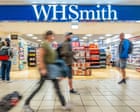
Blaming macroeconomics is the oldest trick in the corporate handbook. When a business starts to sink, executives point frantically at things they can't control—interest rates, consumer confidence, or in the case of WH Smith, the outbreak of the Iran war.
Don't buy the narrative.
While the conflict in the Middle East is certainly hammering global aviation, WH Smith's brutal 16% share price collapse to a 16-year low of 412.6p isn't just a story about geopolitical bad luck. It's a story of a business that stripped away its safety nets, gambled everything on a single sector, and got caught carrying an unsustainable debt load when the music stopped.
The retailer just completed a frantic £102 million emergency capital raise. At the same time, it chopped its full-year profit guidance for the second time in three months, now expecting between £75 million and £90 million. To make matters worse, they're swallowing a massive £150 million non-cash impairment charge and shuttering underperforming stores.
If you think this is just a temporary blip caused by fewer people flying, you're missing the real structural rot underneath.
The Danger of Putting All Your Eggs in the Airport Basket
Last year, WH Smith made a massive strategic pivot. They completely cut ties with the British high street, selling off all 480 of their traditional town centre stores to Modella Capital. Those shops were quickly rebranded as TG Jones.
The logic seemed sound enough at the time. The high street was dying, margins were thin, and the travel sector was a money machine. By operating exclusively in airports, train stations, and hospitals, WH Smith could charge captive audiences premium prices for a bottle of water and a paperback thriller.
But when you tie your entire corporate survival to global airline passenger numbers, you become incredibly fragile.
The Iran war and the resulting blockade of the Strait of Hormuz hit global aviation like a sledgehammer. Airlines are scrambling to secure jet fuel, forcing widespread flight cancellations and capacity cuts across Europe and Asia. Airfares have skyrocketed, meaning the people who are still traveling have significantly less disposable income to blow on overpriced snacks at the terminal.
Look at the numbers from WH Smith's latest trading update for the period ending June 6.
- Group-wide like-for-like sales growth slowed to a dismal 1% over the last seven weeks.
- UK airport store revenues flatlined completely.
- The real disaster is hitting across the Atlantic. North American airport revenues dropped 2% year-on-year, with like-for-like sales plunging 4% in the last seven weeks.
When footfall drops in an airport, an airport retailer can't just run a local radio ad to bring people in. You're entirely dependent on the airlines delivering bodies to your storefront. Right now, those bodies aren't showing up.
The Accounting Ghost Haunting the Balance Sheet
If the travel downturn was the only issue, institutional investors might be more forgiving. But the City's patience has completely run out because WH Smith is already reeling from a massive, self-inflicted wound.
The company is still dealing with the toxic fallout of an accounting scandal at its North American division, which includes the InMotion digital accessories brand. Last year, an independent review by Deloitte revealed that the retailer had been aggressively overstating its US revenues and profits by as much as £50 million. The issue stemmed from how the company recognized promotional payments from suppliers.
That blunder wiped £600 million off the company’s market value, forced former CEO Carl Cowling to resign, and triggered ongoing investigations by the Financial Conduct Authority (FCA). Just this week, the Financial Reporting Council (FRC) announced it is officially investigating PwC’s audit of those inflated financial statements.
When a company loses its financial credibility, its ability to weather an external crisis vanishes.
The new Executive Chair, Leo Quinn—famous for turning around construction giant Balfour Beatty—was brought in to clean up the mess. But instead of executing a orderly turnaround, he's spent his first few months playing firefighter. The £150 million impairment charge the company just announced is a direct acknowledgment that the assets they bought in North America are worth nowhere near what they paid for them.
Why the Emergency Cash Raise Was a Last Resort
Let's look at the mechanics of this £102 million capital raise.
WH Smith flooded the market by issuing 26 million new shares, which represents roughly 20% of its entire existing share capital. They priced the placing at 410p, a deep discount that dilutes existing shareholders significantly.
Why do this now, when the share price is sitting at its lowest level since 2010? Because they had no choice.
The retailer’s balance sheet is choked with debt. Net debt was sitting at roughly £496 million, which is nearly three times its earnings before tax, interest, depreciation, and amortization (EBITDA). In a world of high interest rates, that's a terrifying place to be, especially when cash flow is drying up.
By raising this cash, Quinn is trying to desperately drag that leverage ratio down to a safer target of 2x EBITDA by the end of the financial year. They already suspended the shareholder dividend earlier this year to claw back cash, but it clearly wasn't enough.
Interactive Investor’s head of markets, Richard Hunter, didn't mince words about the situation, calling the move "little more than a kitchen sink exercise" and suggesting it could represent "the last roll of the dice for the company."
The Reality of the Self Help Plan
Quinn is calling this a "self-help" programme, but the actual execution looks a lot like a retreat. The company is actively trying to sell, exit, or renegotiate leases on loss-making and low-return stores across Europe and North American resorts. Where they can't make a profit directly, they're trying to hand operations over to third-party franchises.
To survive this environment, you have to look at the immediate steps management is forced to take. They're slashed brand marketing spend to save pennies, which forces them to rely heavily on aggressive store promotions to clear inventory. This eats directly into gross margins, creating a vicious cycle where they have to sell more items just to make the same amount of profit.
If you're holding WH Smith shares, or thinking about buying the dip, you need to ignore the corporate spin about "future profit expansion." The reality is that the company is trapped in a pincer movement between an unresolved domestic accounting scandal and a global geopolitical crisis that is directly throttling their only remaining revenue stream.
Until jet fuel supplies stabilize and airline capacities return to normal, no amount of financial engineering or emergency share placement will fix the underlying problem. The travel-only strategy was meant to be WH Smith's salvation, but right now, it looks like its trap.