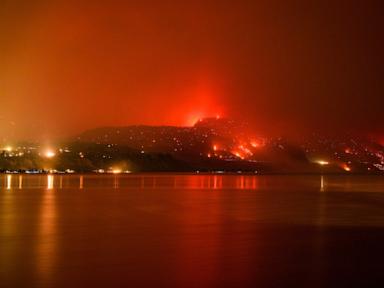
More than twenty thousand residents fled their homes across western Canada while international aid, including specialized wildfire crews from Mexico, arrived to reinforce overstretched domestic lines. The arrival of international personnel highlights a deepening crisis in resource allocation and the structural vulnerabilities facing modern disaster management.
When the air turns the color of a bruised plum and the ash falls like coarse snow, the calculus of emergency management changes entirely. We are no longer talking about seasonal firefighting. We are looking at a protracted war of attrition.
The Strain on Global Mutual Aid
Wildfire mutual aid agreements have existed for decades. Canadian crews routinely pack their gear and head south to California or Oregon during severe American droughts. American, Australian, and New Zealand firefighters deploy north when the Canadian boreal forest ignites.
Now, the math has broken.
Seasons overlap. The historic window where the Southern Hemisphere could lend resources to the Northern Hemisphere—and vice versa—has compressed into a vanishing sliver. When Mexico dispatches elite personnel to western Canada, it is a testament to international solidarity. It is also an admission that traditional domestic capacity is wholly insufficient.
The Economics of Permanent Emergency
Governments budget for emergencies based on historical averages. Those averages are dead. They belong to a climate regime that no longer exists.
Municipalities and provincial treasuries find themselves trapped in a reactive spending cycle. Millions vanish into emergency evacuations, temporary housing, and immediate asset protection. Little remains for long-term fire mitigation, controlled burns, or upgrading rural infrastructure.
+-------------------------------------------------------+
|              THE REACTIVE SPEND CYCLE                 |
|                                                       |
|   Emergency Evacuation -> Asset Protection -> Burnout  |
|          ^                                       |       |
|          +--- Depleted Budgets & Overtime -------+       |
+-------------------------------------------------------+
When every dollar goes toward keeping the perimeter from jumping a highway, prevention dies on the vine. This is how a temporary emergency morphs into a permanent structural crisis.
Logistics on the Front Lines
Deploying international reinforcements sounds simple on paper. Put boots on a plane, hand them a radio, point them at the smoke. The reality on the ground is infinitely more complex.
- Communication barriers: Tactical radio frequencies must be programmed and coordinated instantly under high-stress conditions.
- Equipment compatibility: Different jurisdictions use distinct pump fittings, hose threads, and personal protective gear standards.
- Topography adaptation: Fire behavior in the Canadian Rockies or the dense timber of British Columbia differs wildly from brush fires in central Mexico.
Crew leaders spend critical hours bridging these gaps. Every minute spent translating tactical orders or adapting foreign equipment to local conditions is a minute the fire uses to gain ground.
The Human Toll Beneath the Statistics
Numbers sanitize catastrophe. Twenty thousand evacuees sounds like a data point in a morning briefing. It is actually twenty thousand individual disruptions.
It is the dairy farmer forced to turn livestock loose because trailers are unavailable. It is the small-business owner watching generations of sweat turn to cinders on a live news feed. It is the firefighter working twenty-one days straight without a proper night's sleep, haunted by the sound of crown fires roaring through timber like freight trains.
Mental health infrastructure in rural fire zones is virtually non-existent. We ask seasonal contractors and volunteer brigades to stare down climate-fueled infernos, then wonder why retention rates plummet and burnout rates soar.
What Comes After the Smoke Clears
The arrival of international crews buys time. It does not buy solutions.
Until regional authorities shift from suppression to comprehensive landscape adaptation, western Canada will remain tethered to the goodwill of global partners. That goodwill is finite. As climate pressure mounts globally, every nation will eventually need every firefighter it has just to defend its own borders.
The smoke will eventually clear. The ash will settle into the soil. Unless the fundamental architecture of disaster response changes, the next dry season will find us waiting on planes that never arrive.