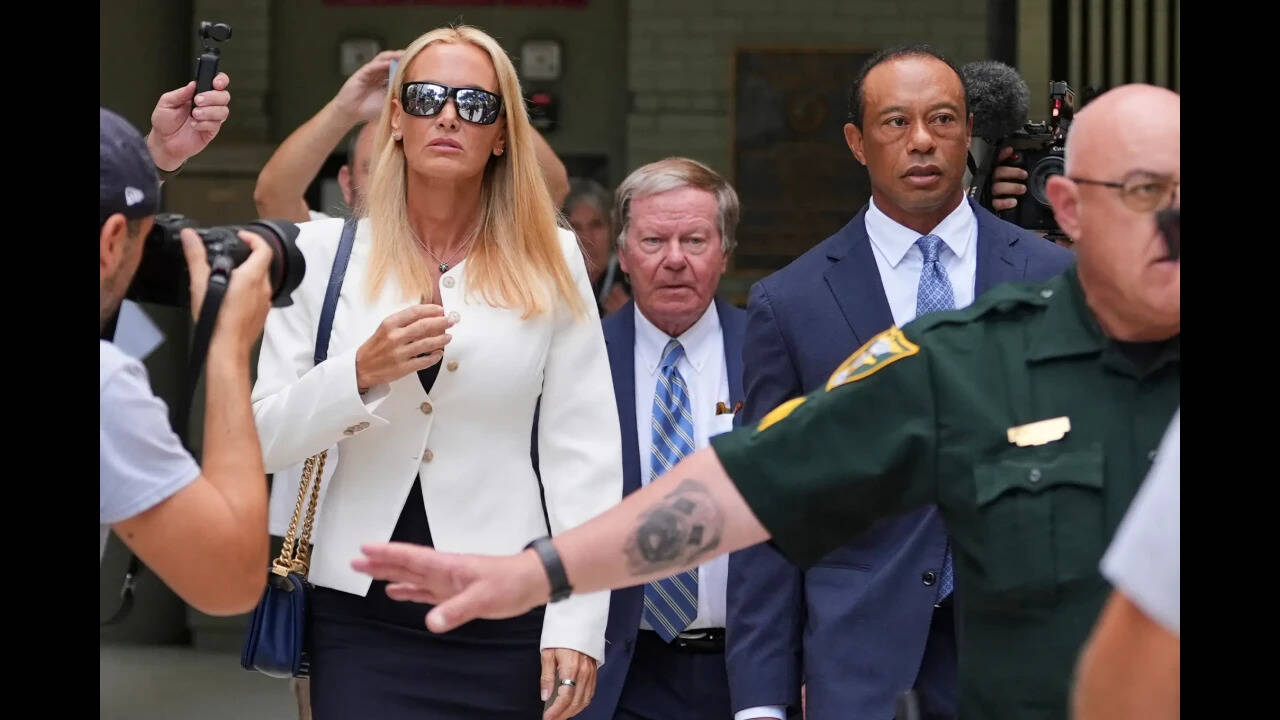
The marble of a courthouse hallway always feels a little colder than the outside air. It absorbs the sound of a hundred hurried steps and gives back only an echo of institutional indifference. On a Tuesday that felt entirely too heavy, Vanessa Trump stood quietly within that familiar, cavernous hum. There were no cameras flashing inside the secure perimeter, no performative waves for the morning news cycle, just the quiet gravity of a legal proceeding playing out under fluorescent lights.
You do not end up in a courthouse by accident. You drift there, pulled by the slow-moving current of life choices, public scrutiny, and the inescapable friction of private lives colliding with public ledgers. Meanwhile, you can find related events here: The Arithmetic of Attrition When Empires Run Out of Bodies.
Miles away, another kind of courtroom reckoning was unfolding, though this one involved asphalt, legal limits, and a five-year revocation of a privilege most of us take for granted. Tiger Woods did not need to be present to feel the weight of his own signature on a plea agreement. A suspended driver's license for half a decade is not merely a bureaucratic penalty. It is an abrupt, total grounding. It is the sudden immobilization of a man whose entire existence was defined by motion, trajectory, and the precise, terrifying calculation of velocity.
We live in a culture obsessed with speed. We worship the driver who takes the corner too fast, the celebrity who outruns the gossip, the public figure who manages to bounce back from the brink before the ink on the police report has even dried. But speed has a terrible tax. Eventually, the bill comes due. To understand the complete picture, we recommend the excellent article by NPR.
Consider what happens in the split second before a crash. Not a car crash, necessarily, though those are loud enough to shatter the quiet. I mean the internal collision. That microsecond where a decision is made to turn the ignition, to ignore the warning signs, to assume that the rules written for ordinary mortals somehow bend around exceptional talent or famous surnames.
I have smelled the stale air of a holding room. I know what it looks like when an empire of public adoration shrinks down to the dimensions of a wooden bench and a court-appointed clerk reading charges off a laminated sheet. It strips away the sponsors, the championship jackets, the glossy magazine covers, and the well-rehearsed public relations statements. What remains is remarkably small. A person. A choice. A consequence.
When the news broke about Tiger Woods accepting a five-year license suspension following his driving under the influence case, the internet did what it always does. It gasped, it performed righteous indignation for three hours, and then it scrolled down to the next algorithmic distraction. But beneath the digital static lies a sobering human reality. Driving under the influence is not a momentary lapse in judgment. It is a gamble with lives—every pedestrian crossing the street, every family in the oncoming lane, every tired delivery driver heading home for the night.
A five-year ban is the legal system's way of saying: stop.
Just stop.
For someone whose life has been spent navigating fairways, dodging flashbulbs, and outrunning personal demons, immobilization is a profound punishment. You cannot outdrive a suspended license. You cannot buy your way around a state-mandated interlock device. You sit in the passenger seat. You look out the window. You watch the world move past you at seventy miles per hour while you contemplate the invisible cost of invincibility.
Meanwhile, Vanessa Trump’s appearance in court serves as another reminder of how relentlessly the past chases us into the present. Public life is an unyielding theater. Every entrance is scrutinized; every exit is interpreted as a retreat or a triumph. We project our own anxieties onto these figures. We want them to be stronger than us, smarter than us, immune to the heartbreak and legal entanglements that turn ordinary lives upside down. When they stumble, we feel a strange, perverse comfort. See? we whisper to ourselves in the dark. They bleed just like we do.
Except they bleed under a microscope.
There is an art to surviving public ruin. Most people never have to learn it. They make their mistakes in private, patch up the drywall, apologize to their neighbors, and limp back to work on Monday morning. The collateral damage is contained. But when your name is a brand, when your face is a meme, and when your family tree is perpetually planted in the soil of national debate, every misstep is recorded in digital amber.
Look closely at the mechanics of these high-profile downfalls. They rarely happen in a blinding flash of dramatic lightning. They happen in the twilight. They happen when a person surrounded by enablers, sycophants, and yes-men finally runs out of runway.
Tiger Woods spent a lifetime perfecting the art of recovery. From spinal surgeries, from personal scandals, from the unbearable weight of global expectation, he climbed back to the top of the mountain time and time again. But a golf ball can be chipped out of the rough. A life pulled sideways by substance impairment and reckless driving requires a different kind of recovery altogether. It requires radical accountability. It requires surrendering the keys—literally and figuratively.
And that is where the real story lives. Not in the headlines that generate clicks, nor in the dry paragraphs of legal filings, but in the quiet, agonizing work of staying still long enough to realize that you are the problem.
We look at these snapshots—a famous golfer losing his driving privileges for half a decade, a former presidential daughter navigating the machinery of the justice system—and we search for a moral. We want a neat bow on the package. We want to believe that justice is swift, fair, and educational.
The truth is much messier. Justice is slow, grinding, and often deeply anticlimactic. It does not fix the broken trust. It does not erase the danger that was unleashed on the highway. It merely draws a hard, unyielding line in the dirt and tells the transgressor: you may not cross here again for a very long time.
As the courthouse doors close and the evening news cycle pivots to the next manufactured crisis, the silence returns. The cars keep moving down the interstate. The red taillights streak through the dusk like falling stars, burning bright for a second, then disappearing into the dark.