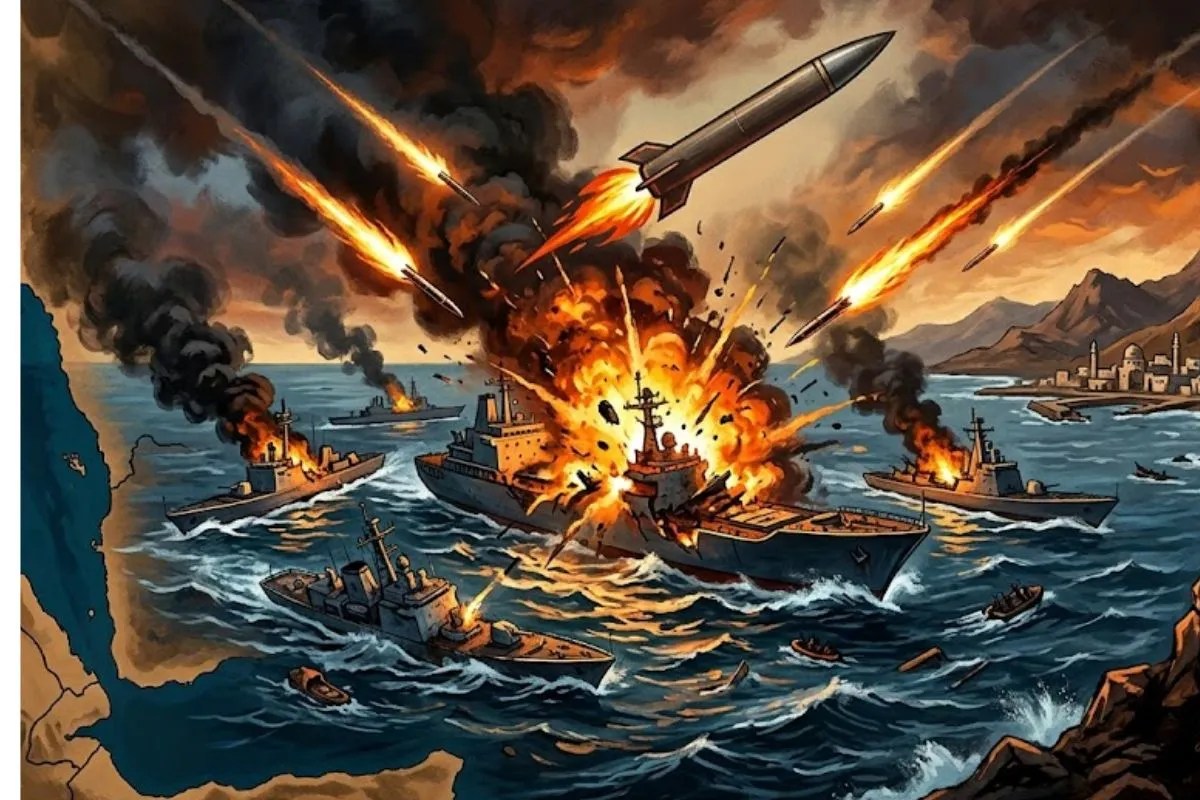
Salt crusts the edges of the bulkhead, a thin, white scar left behind by the spray of the Bab-el-Mandeb Strait.
Down here, two decks below the waterline, the steel hull of a bulk carrier does not merely float; it listens. Every shift of the current, every distant concussive thud carried miles through the dense, saline water, hits the hull like a hammer against an anvil. For the men standing watch in the dim, humming glow of the engine room, silence is no longer an absence of sound. Silence is a predator holding its breath.
We talk about the Red Sea as if it were a blue highway on a cartographer’s map, a neat blue line connecting the Suez Canal to the Indian Ocean, crowded with container ships hauling televisions, grain, and automobile parts from Asia to the markets of Europe. We calculate the price of oil by the barrel, tracking futures on electronic tickers in London and New York. But behind the cold digits of the shipping indexes lies a far more visceral reality.
Danger wears no uniform here. It arrives silently in the dark.
The Geography of Fire
To understand the volatile tension gripping the shipping lanes off the coast of Yemen, one must look at the geography of a choke point. The Red Sea is narrow—barely twenty miles wide at its southern gateway. Vessels the length of three football fields must funnel through a microscopic maritime eye of a needle, flanked by jagged coastlines and invisible alliances.
For years, this corridor felt ancient and eternal. Fishermen hauled nets of silver sardines; dhows with lateen sails drifted lazily on thermal winds; mega-container ships glided past with the indifference of floating skyscrapers.
Then the horizon cracked.
In the mountains of Yemen, hundreds of miles away from the shipping lanes, militant factions known as the Houthis watched the geopolitics of the Middle East shift like sand dunes. Armed with asymmetric coastal defense systems, anti-ship missiles, and low-flying loitering munitions, they discovered a terrifying leverage point. You do not need a blue-water navy to halt global commerce. You only need a coastline overlooking a narrow strait and a willingness to pull the trigger.
The Saudi-led coalition, locked in a brutal multi-year regional conflict, found its maritime supply chains and oil tankers targeted not just by conventional artillery, but by drone boats packed with explosives—maritime kamikazes steered by remote control through the moonlit chop.
Consider what happens next: a sudden flash of orange light on the horizon, a deafening shockwave that rattles coffee cups off the galley tables, and a panicked Mayday call broadcast across international VHF Channel 16.
Inside the Wheelhouse
Captain Tariq stands at the forward windows of his bridge, peering into the pitch-black void. He has spent thirty years navigating these waters, steering steel behemoths through monsoons, pirate-infested waters off the Horn of Africa, and dense Mediterranean fog. Nothing has prepared him for this.
"Distance to target?" his first officer barks, sweat beading on his forehead despite the roaring air conditioning.
"Ten miles and closing," Tariq replies, his voice unnervingly quiet.
They are carrying thousands of metric tons of refined petroleum, a floating bomb disguised as a commercial vessel. They fly the flag of convenience, but convenience offers no immunity against a radar-guided cruise missile descending at Mach speeds from the clouds.
When the warning alarm shrieks—that jagged, pulsing wail that triggers an instant spike of adrenaline in every human cell—there is no heroic speech. There is only the frantic scramble into heavy orange survival suits, the desperate checking of life rafts, and the prayer whispered under the breath of men who haven't seen their families in eight months.
When the missile struck the coalition-aligned tanker two miles off their starboard bow last Tuesday, Tariq didn't see the explosion first. He saw the flash illuminate the bellies of low-hanging cumulus clouds like a sudden, vicious dawn. A second later, the concussion hit—a physical wall of compressed air that slammed against the bridge glass, followed by a deep, subterranean roar that rumbled up through the keel.
The sea does not forgive mistakes. And it certainly does not care about supply chains.
The Invisible Price Tag
Economists call it supply chain friction. Consumers call it inflation. But down here, on the rusted decks of targeted freighters, it is felt as bone-deep exhaustion and a terrifying uncertainty.
When maritime security breaks down in the Red Sea, the ripple effects radiate outward with ruthless efficiency. Insurance premiums for passage through the Bab-el-Mandeb skyrocket overnight, jumping by hundreds of thousands of dollars per voyage. Major shipping lines face an agonizing choice: roll the dice on a missile strike through the strait, or divert entirely.
Diversion means turning south, rounding the entire continent of Africa by the Cape of Good Hope. It adds weeks of transit time. It burns thousands of additional tons of heavy fuel oil. It strangles delivery schedules in Rotterdam, Hamburg, and Antwerp.
The grocery store shelf in Munich or Chicago empty of certain imported goods is the distant echo of a burning tanker off the coast of Hodeidah. Every time a Houthi missile arcs toward a coalition vessel, the invisible cost of global trade ticks upward, paid for by ordinary people who have never looked at a map of the Middle East.
We live in a fragile architecture of glass and steel, heavily dependent on the unbroken rhythm of distant cargo ships moving invisibly through the night.
The Watch in the Dark
Back on the bridge, the radar screen sweeps in a slow, hypnotic circle, painting green lines against the dark room.
The sea is calm tonight. Too calm. The surface of the water reflects the brilliant, indifferent canopy of stars overhead, glittering like scattered diamonds on black velvet. There is no hint of the carnage that transpired here hours before, no lingering trace of the smoke that choked the lungs of sailors scrambling for their lives.
Tariq lifts his thermos of bitter black tea, taking a slow sip. His eyes remain fixed on the dark horizon where the sea meets the sky, searching for a spark that shouldn't be there.
The engines beneath his feet thrum with steady, rhythmic power, driving the massive vessel forward into the unknown, while the dark waters roll on, indifferent to the history being written upon their surface.


