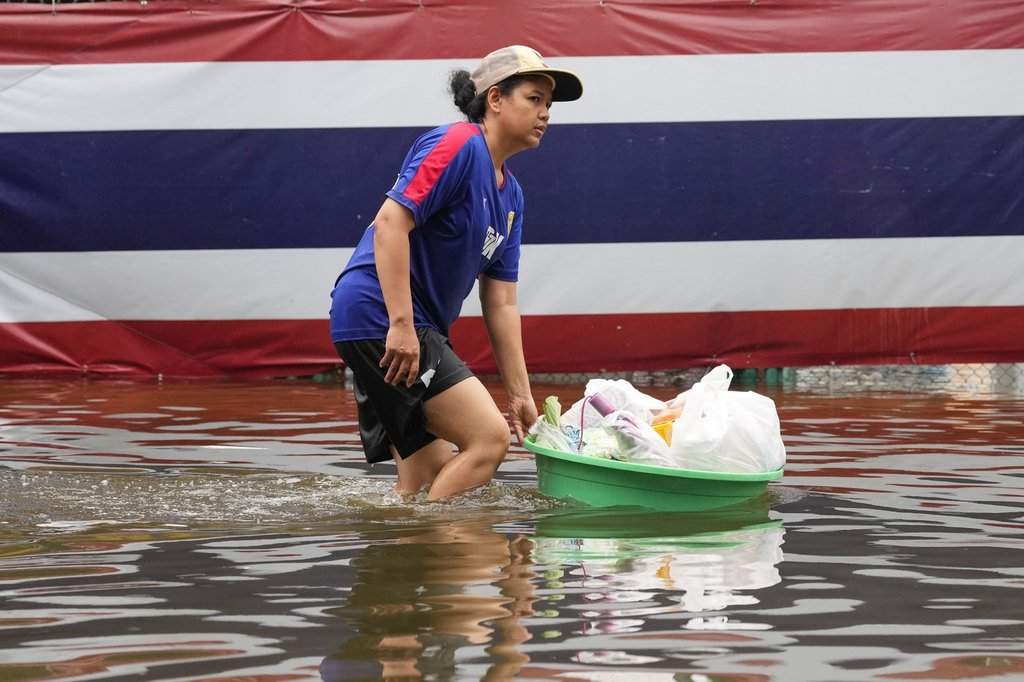
The rain stopped, but the streets did not empty.
In Bangkok, water is an ancient neighbor. It is the lifeblood of the Chao Phraya River, the quiet rhythm of the canals that earned the city its moniker as the Venice of the East. Yet, when the skies finally cleared over Thailand’s sprawling capital, the reprieve felt hollow. The clouds had emptied themselves, but the city was left holding the weight of a slow-moving tide.
Thousands of people were packing backpacks, hoisting children onto shoulders, and locking doors behind them. They were leaving homes where the water had crept across living room floors, turning kitchens into wading pools and soaking the foundations of daily life.
Consider what happens when a river has nowhere left to go.
For weeks, monsoon rains battered the upper regions of Thailand, sending torrents of water south toward the Gulf. Bangkok, sitting flat and low near the coast, acts as a giant basin. When seasonal downpours coincide with high tides, the river swells, spilling over concrete embankments and seeping up through drainage pipes like an underground ghost.
Somchai stands on the second-floor balcony of his home in a suburban district north of the city center. Below him, his neighborhood has vanished beneath a murky, knee-deep brown mirror. Motorbikes are parked precariously on elevated sidewalks; stray dogs cluster on dry patches of elevated concrete.
"We thought it would recede by Tuesday," Somchai says, adjusting the strap of a waterproof bag containing his family's birth certificates, photographs, and a few changes of clothes. "The forecast said the rain was easing. But water does not care about forecasts. Water only cares about gravity."
He is right. Meteorologists noted a decrease in rainfall intensity, bringing a temporary sigh of relief to weather stations. But hydrology tells a different story. Runoff takes days, sometimes weeks, to snake its way through river networks and urban canal systems. The rain stopped falling from the sky, but it was still arriving from the north, inching relentlessly toward residential doorsteps.
Evacuation is rarely a sudden panic. More often, it is a slow erosion of daily routines. It begins with moving the television to a higher table. Then comes unplugging the refrigerator, rolling up rugs, and sleeping on the upper level with the hum of mosquitoes and the smell of stagnant moisture. By the time authorities issue formal advisories, many residents are already exhausted, worn down by days of watching the water line creep up one brick at a time.
For thousands of displaced families, temporary shelters have become crowded ecosystems of uncertainty. Schools and community centers fill with cots, bottled water, and the quiet tension of people waiting for a river to remember its boundaries.
The economic toll is invisible until you look closer. It is the vendor who cannot open her noodle cart because her kitchen is submerged. It is the factory worker whose shift is canceled because the access roads are impassable. It is the constant calculation of risk: stay and guard what little you have against looting, or leave and risk losing your livelihood to the currents.
Bangkok has faced this before. The great floods of 2011 remain a living memory for many residents—a benchmark of devastation that transformed urban planning discussions across Southeast Asia. Since then, millions of dollars have been poured into massive drainage tunnels, pumping stations, and retention basins. These systems work, but they are fighting an uphill battle against a changing climate that delivers heavier, more erratic storms, combined with a city that is slowly sinking under its own weight.
As the sun sets over the flooded suburbs, the water reflects the amber glow of distant streetlights. There is a strange, heavy quiet in the air, broken only by the hum of emergency pumps pushing water back toward the river.
The rain has eased. But the human story is far from over. It lingers in the damp air, in the belongings stacked high on tables, and in the quiet resilience of a city waiting for the ground to emerge once more.