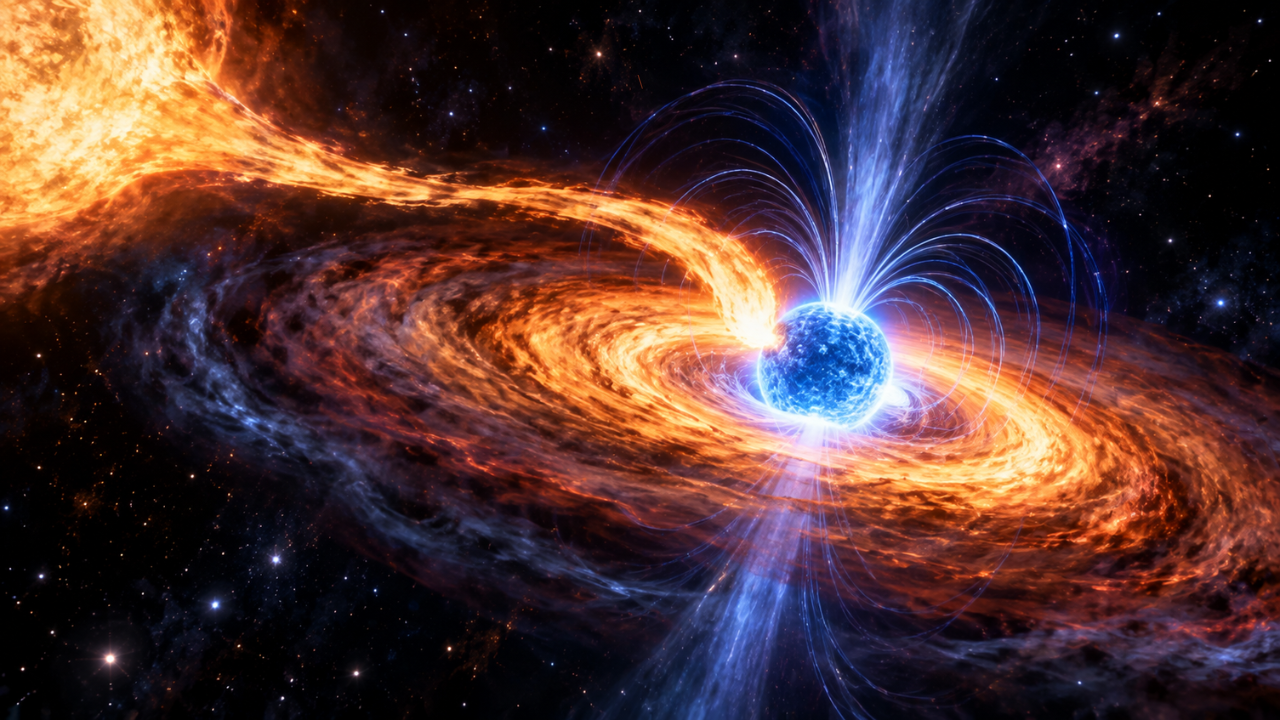
Gravity is relentless. On Earth, it just keeps you anchored to the sidewalk. Out in the cosmos, though, it turns into an absolute monster.
Take a neutron star. You are looking at the crushed, dense core of a dead giant star packed into a sphere about the size of a city. A single teaspoon of this material weighs roughly a billion tons. The gravitational pull here is so violent that if you dropped a marshmallow, it would strike the surface with the energy of a nuclear bomb. For another perspective, read: this related article.
Astronomers recently caught something extraordinary happening in real time. They watched gas actually fall onto the surface of one of these ultra-dense objects, mapping out the final, chaotic miles of a journey that ends in total destruction. This isn't just an abstract astronomy headline. It's a direct look at physics operating at the absolute edge of sanity.
Understanding the Cosmic Heavyweights
You can't talk about neutron stars without grasping just how extreme they are. When massive stars run out of fuel, their cores collapse under their own weight. The outer layers blow away in a supernova, leaving behind a spinning corpse made almost entirely of neutrons. Further coverage regarding this has been shared by Ars Technica.
Their magnetic fields are trillions of times stronger than anything we can generate in our laboratories. Their surfaces are boiling seas of degenerate matter. Because they possess such immense gravity, they act like cosmic vacuum cleaners. They constantly rip material away from companion stars orbiting nearby.
That stolen gas doesn't just crash straight down in a neat little line. It forms a swirling, glowing disc of plasma known as an accretion disk. For decades, scientists understood the theory behind these disks. They knew matter spiraled inward, getting hotter and brighter as friction tore the atoms apart. What they couldn't see clearly was the very end of the line. The final plunge. The exact moment gas transitions from a swirling vortex into the solid crust of the star.
Catching the Fall
Observing this plunge requires looking at X-rays. Ordinary telescopes won't do the job because visible light gets swallowed or completely outshone by the intense heat generated during accretion. Space telescopes designed to detect high-energy X-rays are the only tools sharp enough to peer through the glare.
Researchers analyzed data capturing sudden flares and shifts in X-ray emissions from a feeding neutron star. These fluctuations act like breadcrumbs. They reveal the geometry of the flow right as the gas breaks free from the inner edge of the accretion disk and slams onto the magnetic poles of the star.
Think about what is happening here. Matter that originated light-years away in the outer layers of a companion star gets accelerated to a significant fraction of the speed of light. When it hits the surface, it releases an unimaginable amount of energy. By tracking the timing, spectrum, and intensity of these X-ray pulses, researchers can reconstruct the physical pathway. They can see how the gas funnels down magnetic field lines, bypassing the equator and crashing straight into the polar caps.
Why This Matters Beyond the Lab
You might wonder why anyone cares about gas falling onto a dead star millions of light-years away. It is a fair question. Why spend millions of dollars on X-ray satellites just to watch debris hit a stellar corpse?
The answer comes down to testing the limits of our understanding. Albert Einstein gave us general relativity over a century ago, and it still holds up remarkably well. Yet, extreme environments like the surface of a neutron star push relativity to its breaking point. If gravity behaves slightly differently under these intense conditions, we will find out by watching how matter moves and emits light right at the boundary.
Furthermore, these systems act as natural particle accelerators. They produce conditions we can never replicate on Earth. By studying how gas behaves in strong gravitational fields, astrophysicists gain insights into plasma physics, nuclear fusion reactions, and the behavior of matter under extreme pressure.
There is also the puzzle of how neutron stars grow. As they accrete matter, their mass increases. Push a neutron star past a certain mass limit—known as the Tolman-Oppenheimer-Volkoff limit—and it cannot support its own weight anymore. It collapses entirely into a black hole. Watching the feeding process helps researchers figure out how close some of these objects are to that ultimate tipping point.
The Reality of Cosmic Accretion
The popular image of space is often quiet and serene. Nebulas glow in soft purples and blues. Distant galaxies spin in slow motion.
Accretion is none of that. It is violent, messy, and loud in the language of high-energy radiation. The gas falling onto a neutron star experiences shear forces that tear molecules apart, ionize atoms, and heat the plasma up to millions of degrees. It's a chaotic blender of subatomic particles governed by the harshest laws of physics.
When astronomers map this process, they are filling in gaps that have existed since the early days of X-ray astronomy in the 1960s and 70s. Earlier generations of scientists had the equations. They had the theoretical models sketched out on chalkboards. They lacked the instrumentation to resolve the details. Modern orbital observatories have changed that equation. They provide the resolution needed to separate the signal of the falling gas from the background roar of the star itself.
What Comes Next for Stellar Observatories
The work doesn't stop with one successful observation. Astronomers are already pointing newer instruments at other candidate systems to see if this behavior is universal or if different neutron stars feed in their own unique ways.
Some neutron stars spin hundreds of times every second. Others have weaker magnetic fields that allow the accretion disk to push much closer to the actual surface before the gas gets redirected. Comparing these variations gives scientists a diverse sample size. It turns a single lucky observation into a broader understanding of stellar evolution.
Keep an eye on upcoming missions focusing on X-ray polarimetry. These tools measure the polarization angle of incoming light, adding another layer of data that helps researchers determine the exact 3D geometry of the gas flow. We are moving away from simple flat graphs of light curves and stepping into a era of true spatial mapping of deep-space phenomena.
The universe remains a violent, fascinating laboratory. Every time we manage to catch a glimpse of its most extreme mechanics, we learn a little bit more about the rules that built everything we see around us. Matter falls, gravity pulls, and the cosmos keeps turning.