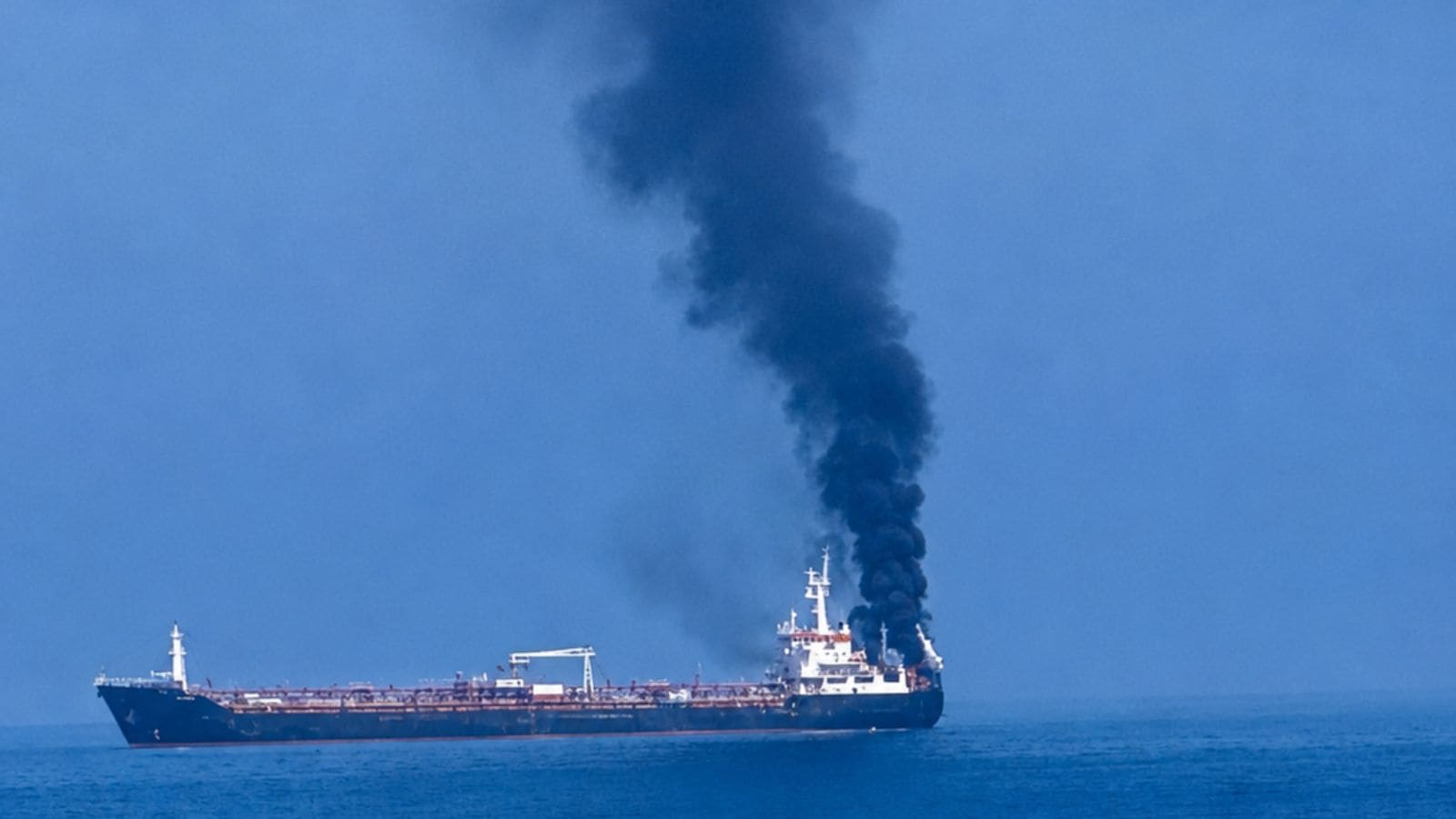
The mainstream media loves a predictable script. When a drone strikes a commercial vessel in the Indian Ocean, the narrative writes itself within minutes. Washington points an accusatory finger at Tehran. Tehran immediately fires back, calling the allegations "baseless." Journalists scurry to report the tennis match of official denials, and the public is left with the impression that geopolitical posturing is the core issue.
This reactive reporting misses the point entirely. The frantic back-and-forth between Donald Trump and the Iranian foreign ministry over the targeting of Indian-flagged chemical tankers is a sideshow. The lazy consensus gripping the maritime security sector asserts that these attacks are merely isolated, state-sponsored provocations meant to test Western diplomatic resolve.
That view is dangerously naive. What we are witnessing is not a temporary geopolitical spat. It is the permanent, decentralized democratization of anti-access warfare. Focusing on whether a specific drone was launched directly from Iranian soil or by a regional proxy completely misdiagnoses the structural vulnerability of global trade.
The Illusion of Pointing Fingers
Mainstream analysts treat drone strikes on commercial shipping lanes as if they require the industrial military might of a superpower. They view the crisis through a 20th-century lens of state-on-state conflict.
Here is the cold reality: the technology required to disrupt global shipping lanes no longer requires a state-level signature.
When a low-cost, long-range loitering munition strikes a tanker like the Chem Pluto off the coast of India, tracking the exact point of origin becomes a political exercise rather than a tactical solution. Western intelligence agencies quickly blame Iran, citing the signature design of Delta-wing drones. Iran rejects the claim because they know the attribution is legally messy and difficult to enforce under maritime law.
But focusing on whether Tehran greenlit a specific strike obscures the deeper systemic shift. Commercial off-the-shelf components, open-source guidance software, and decentralized assembly lines have effectively erased the entry barriers to maritime interdiction. You do not need an active naval fleet or a sophisticated command structure to hold a trillion-dollar trade route hostage. You just need a few thousand dollars and a coastline.
Why the Current Defense Strategy is Broken
The conventional military response to these shipping threats is fundamentally flawed. The Pentagon and its allies rely on deploying multi-billion-dollar naval carrier strike groups to patrol millions of square miles of open ocean. They use million-dollar air defense missiles to intercept ten-thousand-dollar drones.
This economics-of-warfare equation is completely unsustainable.
Imagine a scenario where a non-state actor launches twenty rudimentary loitering munitions toward a bottleneck strait. A modern destroyer can successfully intercept every single one of them. The naval commanders will celebrate a flawless defensive operation. Yet, from an economic standpoint, the defender just spent $40 million to neutralize $200,000 worth of flying fiberglass. The attacker wins by forcing the defender to bleed resources.
Furthermore, these massive naval deployments give commercial shipping companies a false sense of security. Corporate executives assume that because an international coalition is patrolling the waters, their supply chains are insulated. They treat maritime security as a government entitlement program rather than a core corporate liability.
Dismantling the Supply Chain Myth
Global shipping companies operate under the assumption that the high seas are a neutral, permanently open highway guaranteed by global superpowers. This assumption is dead wrong.
For decades, the maritime industry has optimized for absolute efficiency at the expense of resilience. They flags-of-convenience their vessels to micro-nations to evade taxes, hire multinational crews with minimal security training, and cut margins to the absolute bone. They assumed the US Navy would always be there to bail them out for free.
The recent strikes in the Indian Ocean have shattered that framework. It turns out that a single successful strike on an Indian-bound tanker can spike insurance premiums across the entire sector overnight. War-risk premiums can jump by over 200% in a matter of days, completely erasing the profit margins of standard freight routes.
If you are running a logistics firm or an energy conglomerate, waiting for Washington and Tehran to resolve their diplomatic grievances is a losing strategy. The threat matrix has permanently changed. Even if Iran stopped all regional influence tomorrow, the blueprint for cheap, asymmetrical maritime disruption has already been distributed globally.
The Uncomfortable Truth About Attribution
International law is utterly unequipped to handle this era of gray-zone maritime warfare. When a ship owned by a Japanese company, flagged in Liberia, operated by a Dutch crew, and carrying Saudi oil is hit in international waters, determining jurisdiction is a nightmare.
The political shouting match between world leaders is designed to project strength to domestic audiences, not to secure the shipping lanes. Washington issues statements to show it is defending global commerce. Tehran issues denials to avoid direct military retaliation while quietly demonstrating its ability to project leverage across vital trade chokepoints.
+---------------------------+-----------------------------------+
| Traditional Naval Focus   | Modern Asymmetric Reality         |
+---------------------------+-----------------------------------+
| State-on-state fleets     | Non-state drone proliferation     |
| Kinetic deterrence        | Economic attrition tactics        |
| Clear attribution         | Plausible deniability frameworks  |
| Capital warship dominance | Low-cost precision denial         |
+---------------------------+-----------------------------------+
Instead of asking who pulled the trigger on a specific Tuesday, the maritime industry needs to accept that the entire concept of secure international waters is currently a myth. The oceans are now a contested space where anyone with a laptop and a workshop can disrupt the global economy.
Corporate Self-Defense Over Government Reliance
If relying on naval escorts is a losing game of economic attrition, how do commercial enterprises survive this shift? They stop treating security as someone else's problem.
First, hard infrastructure changes are mandatory. Commercial tankers are massive, slow-moving steel targets with virtually zero defensive capabilities. Corporate operators must invest in passive defense systems, including electronic warfare jamming suites, advanced spoofing technology, and structural reinforcement around critical engineering spaces. If a drone cannot acquire a clean GPS or radar lock on a hull, its effectiveness drops off a cliff.
Second, shipping routes must be dynamically priced based on real-time threat telemetry, not historical patterns. Companies need to abandon the rigid insistence on the shortest geographic path when a region turns hot. Rerouting around the Cape of Good Hope or utilizing alternative multi-modal overland networks might hurt quarterly margins, but it avoids the catastrophic loss of an entire vessel and its cargo.
The downside to this approach is obvious: it drives up the cost of doing business. It ends the era of ultra-cheap, friction-free global shipping. Consumers will ultimately pay the price for hardened supply chains. But the alternative is pretending the old rules still apply until a major environmental or economic catastrophe forces a chaotic reckoning.
Stop listening to the diplomatic theater of press releases and formal denials. The finger-pointing between nations is a distraction from a much uglier reality: the oceans are no longer safe, the cavalry isn't coming to save every ship, and the cost of moving goods across the planet just went up permanently. Adjust your operations accordingly or get left drifting.


