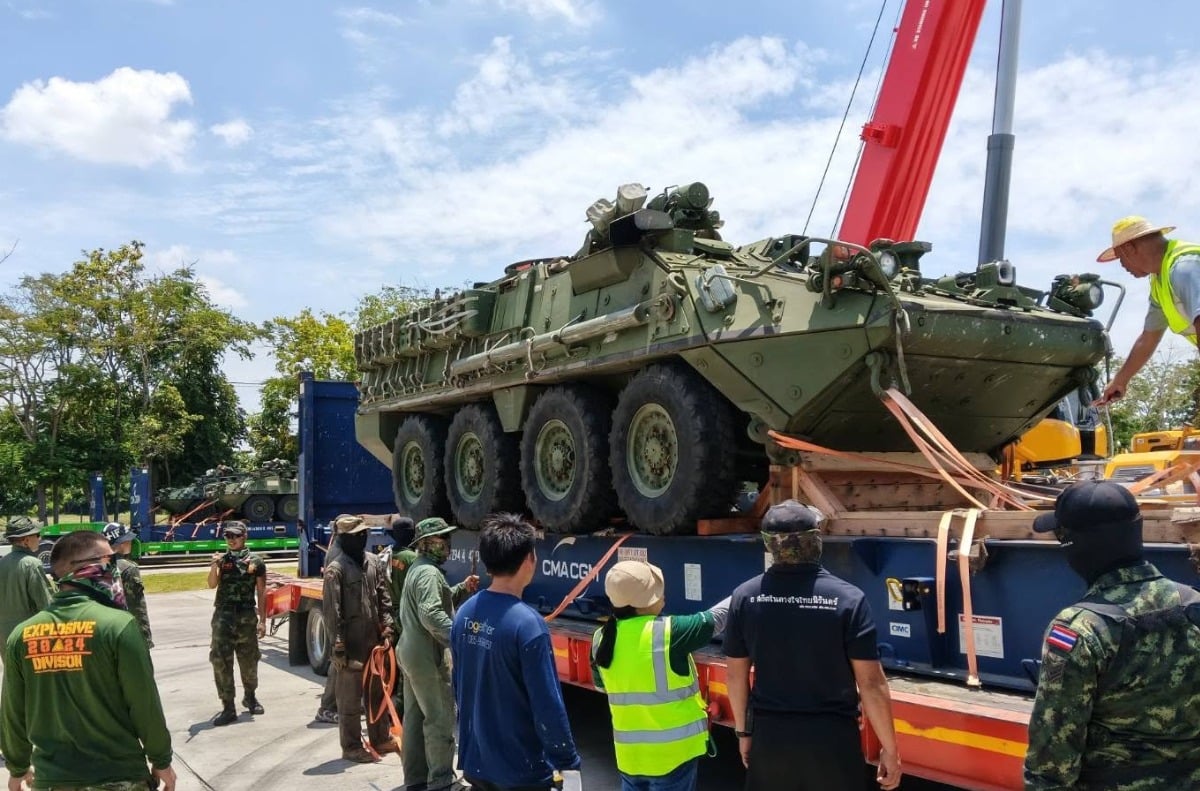
The Royal Thai Army recently absorbed another 17 Stryker armored vehicles from the United States, expanding its inventory well past the 140-vehicle mark. Transferred under the Pentagon's Excess Defense Articles framework during the joint Hanuman Guardian exercise in Lop Buri, official military statements framed the shipment as a routine upgrade for Southeast Asian defense cooperation. That superficial summary misses the core reality.
Thailand is not merely buying or receiving secondhand eight-wheeled combat vehicles to patrol its borders. Washington is actively funding and subsidizing a mechanized wedge directly inside mainland Southeast Asia to offset growing Chinese military influence. For Bangkok, accepting these refurbished American vehicles is part of a complex, decades-old diplomatic hedging strategy that plays global superpowers against one another while internal military factions battle over defense budgets.
The Reality of the Excess Defense Program
The Excess Defense Articles program allows the United States military to unload surplus hardware to foreign allies at reduced prices or as outright grants. On paper, Thailand receives battle-tested 8x8 infantry carriers. Behind closed doors, the mechanics of this arrangement create a deep operational dependency that binds the receiving military to American supply chains for decades.
A refurbished Stryker offloaded from U.S. Army Pacific stocks comes with significant trailing liabilities.
Vehicles pulled from inventory require specialized replacement parts, proprietary digital architecture, and continuous technical oversight. The United States does not simply hand over ignition keys. It sends entire technical advisory teams, contractor logistics support elements, and networked tactical communication packages.
By embedding these systems into the Royal Thai Army’s 111th Infantry Regiment in Chachoengsao, the Pentagon guarantees that Thai mechanization remains tethered to American doctrine and defense contractors.
Consider a hypothetical comparison with commercial aviation. If an airline accepts ten free passenger jets from a donor nation, but those jets require unique fuel, specific hangar infrastructure, and certified mechanics paid at premium overseas rates, the recipient has not received a simple gift. They have adopted a long-term operational budget commitment.
The Thai military faces this exact balance sheet dynamic. While the initial procurement costs under defense grants appear low on paper, keeping an aging fleet of hydropneumatic suspension vehicles combat-ready in tropical environments drains sustained operational funding.
Balancing Beijing and Washington on the Ground
To understand why Bangkok keeps taking these shipments, look at Thailand's broader procurement record over the last decade. Thailand remains one of the few nations in Asia that purchases heavy military hardware simultaneously from Washington, Beijing, and Moscow.
When military coups in 2006 and 2014 strained relations with Washington, Thai defense planners turned toward China. Bangkok signed deals for Chinese VT-4 main battle tanks, VN-1 armored personnel carriers, and S26T Yuan-class submarines.
The purchases were designed to send a explicit message to Western diplomats that Thailand had alternatives.
Yet Chinese hardware brought its own operational headaches. Interoperability between Chinese armor and existing Thai command systems proved difficult. Engine supply disputes delayed the submarine project for years, leaving naval leadership in an awkward political position.
The American Stryker push, initiated during the tenure of former Thai Army Chief Apirat Kongsompong, was engineered to pull the Thai Army's core infantry back into the Pentagon's orbit.
While Thai cavalry units ride in Chinese-built VN-1s, the elite 111th Regiment is built entirely around American Stryker Brigade Combat Team doctrine. The Thai military effectively split its ground forces into competing technological camps, ensuring no single foreign power holds absolute leverage over its defense posture.
Tactical Mobility Versus Local Infrastructure
The Stryker was built for rapid deployment along paved highway networks and open terrain, allowing motorized infantry to cover vast distances fast. In the continental United States or Western Europe, that mobility works cleanly. In mainland Southeast Asia, the tactical calculus is far more complicated.
During monsoon seasons, Thailand’s rural border areas turn into deep mud that bogs down heavy wheeled platforms. A 19-ton 8x8 vehicle carrying an infantry squad exerts immense ground pressure. While the vehicle excels on paved secondary roads and urban thoroughfares, its off-road performance in flooded rice paddies or dense jungle canopy falls well short of tracked alternatives.
Defense analysts inside Bangkok have quietly questioned the tactical utility of building a full Stryker regiment for border defense.
The primary security concerns along Thailand’s borders involve counter-insurgency in the far south, cross-border smuggling networks, and managing irregular militia activity along the Myanmar border. These missions demand light infantry, forward reconnaissance units, and uncrewed aerial surveillance rather than heavy motorized columns.
The Stryker platform provides high survivability against small arms fire and improvised explosive devices. Yet its massive fuel consumption and complex maintenance footprint require a long, vulnerable logistics tail. If a forward unit breaks a specialized steering linkage deep in rural border terrain, repairing that vehicle requires military technicians trained on American tools and diagnostic computers.
The Logistics Trap and Long-Term Costs
Supporters of the Stryker program point out that receiving surplus hulls through defense assistance saves billions of baht compared to buying brand-new armored platforms from European manufacturers. That calculation ignores life-cycle expenses.
Armored vehicles operate on a steep cost curve as they age. Hulls that saw service with U.S. forces in regional conflicts carry frame stress, suspension wear, and electrical fatigue.
Replacing night-vision driver systems, remote weapon stations, and digital battle-management software demands constant capital outlay. Every dollar saved on the initial transfer price is eventually spent down the line on specialized spare parts, technical manuals, and overseas contractor support.
This financial reality leaves the Royal Thai Army locked into continuous defense spending commitments at a time when the domestic public demands greater transparency in military budgets.
Political opponents in Parliament frequently highlight these defense purchases, pointing out that maintaining foreign-made armor diverts funds from pressing domestic economic needs. The military brass counters that national security requires modern equipment to maintain regional parity with neighboring militaries that are also upgrading their mechanized forces.
A Calculated Marriage of Convenience
The arrival of the latest batch of 17 Stryker vehicles is not a routine story of routine hardware delivery. It represents the strategic alignment of two nations acting out of pure self-interest.
For the United States, transferring surplus combat vehicles is a low-cost method to entrench American defense standards, secure long-term military access, and prevent Thailand from drifting entirely into Beijing's security sphere.
For Thailand's military leadership, accepting the vehicles guarantees free access to advanced American tactical training, bolsters domestic force posture, and preserves its balance between global superpowers.
Whether these 19-ton wheeled vehicles ever fire a shot in combat is beside the point. They have already fulfilled their primary purpose as heavy metallic anchors keeping Bangkok tied to Washington's strategic orbit.

/https://i.s3.glbimg.com/v1/AUTH_e84042ef78cb4708aeebdf1c68c6cbd6/internal_photos/bs/2026/g/B/3vpkvHQKizRKAfzDxjXA/vini-jr-antes-e-depois.jpg)