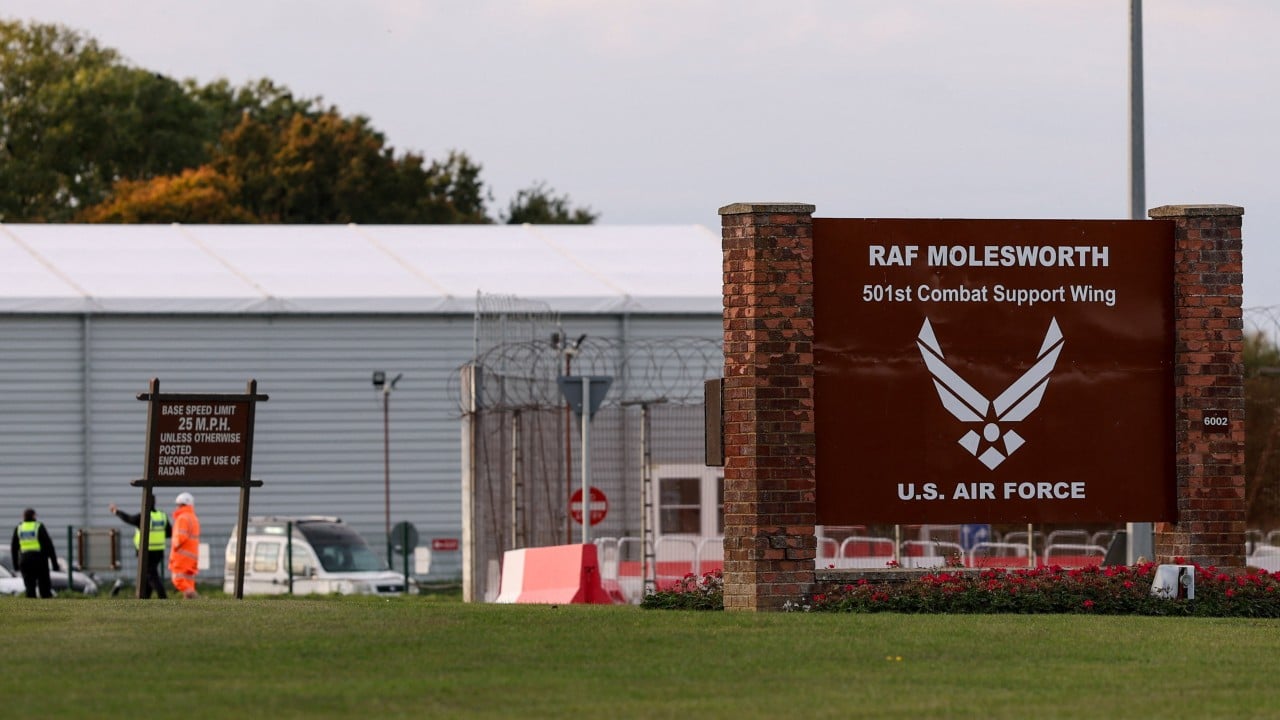
The physical security architecture of sensitive military installations operates on a calculus of layered deterrence, yet single-point anomalies routinely expose systemic friction between static perimeter controls and mobile surveillance response times. The unauthorized entry of two individuals into the perimeter of RAF Molesworth—a facility housing the United States Joint Intelligence Operations Center Europe and NATO's Intelligence Fusion Centre—provides a concrete case study for evaluating perimeter defense efficacy, sensor latency, and the operational friction inherent in joint-jurisdiction installations.
Evaluating the structural components of this incident requires deconstructing the operational variables that govern modern military base security: asset valuation, perimeter integrity mechanics, and counter-intrusion response velocity.
The Threat Vector and Asset Profile
RAF Molesworth functions as an intelligence node rather than an active flight line, altering its risk profile significantly. Intelligence fusion centers prioritize data processing, secure communications routing, and strategic analysis over rapid aircraft mobilization. Consequently, the primary vector of threat transitions from kinetic air defense to electronic espionage, physical reconnaissance, or probing attacks designed to measure security force response signatures.
When security patrols discover an abandoned vehicle near a sensitive perimeter, the operational timeline shifts from routine deterrence to tactical containment. The presence of two foreign nationals within the secure zone forces an immediate reassessment of the baseline assumptions governing perimeter threat levels:
- Reconnaissance Probing: The penetration may represent an intentional test of sensor grid blind spots, camera arc overlaps, and guard force deployment velocity.
- Opportunistic Intrusion: Alternatively, the event may stem from non-malicious trespass compounded by poor situational awareness or inadequate exterior signage.
Because counterterrorism police assumed jurisdiction under suspicion of entering a prohibited place for purposes prejudicial to the state, the institutional response treats the breach through the lens of high-consequence intelligence compromise rather than simple civil trespass.
The Cost Function of Perimeter Defense
Military base defense is governed by an economic trade-off between hardening costs and acceptable residual risk. Absolute security across a perimeter spanning multiple kilometers is cost-prohibitive. Defense planners rely on a defense-in-depth model comprising physical barriers, automated intrusion detection systems, closed-circuit television monitoring, and mobile patrols.
The physical breach at Molesworth highlights the limitations of linear deterrence when confronted with determined human agency. While perimeter fences deter casual trespass, they function primarily as delay mechanisms rather than absolute physical blocks. The delay coefficient must exceed the response time of the internal security force. If the time required to scale a fence and access a target area is shorter than the time required for a patrol to intercept, the defense architecture experiences a structural failure.
In this incident, the discovery of the intruders inside the perimeter demonstrates that the initial detection and delay phases were bypassed or exhibited latency. The subsequent containment and arrest indicate that the inner response layer functioned correctly, successfully arresting the suspects before operational assets could be compromised.
Jurisdictional and Operational Friction
Jointly operated installations involving host-nation military police, domestic civilian law enforcement, and foreign intelligence units introduce operational complexity during security incidents.
- Command and Control Latency: When an intrusion occurs, initial response authority belongs to Ministry of Defence guards. However, once the operational parameters suggest potential espionage or state-level reconnaissance, jurisdiction shifts to specialized counterterrorism commands. This handoff requires standardized communication protocols to prevent evidentiary degradation.
- Evidentiary and Legal Processing: The subsequent release of suspects on bail under strict conditions reflects the evidentiary thresholds required in civilian courts for national security offenses. Military security forces prioritize asset protection and immediate neutralization of threats, whereas civilian investigative bodies must construct a prosecutable case adhering to strict legal statutes. This dual mandate creates a tension between immediate security posture and long-term legal accountability.
Strategic Recommendations for Infrastructure Hardening
To mitigate the systemic vulnerabilities exposed by perimeter penetrations at sensitive intelligence nodes, defense planners must recalibrate their security architecture away from static hardening and toward dynamic threat mitigation:
- Deploy Automated Sensor Integration: Transition from passive closed-circuit monitoring to AI-assisted motion and thermal detection grids that minimize human operator fatigue and reduce false-positive rates along extensive perimeters.
- Optimize Patrol Predictability: Eliminate routine, time-indexed patrol routes that allow external actors to map security gaps and window intervals. Patrol vectors must utilize stochastic routing models.
- Enhance Outer-Zone Deniability: Expand the spatial buffer zone outside the primary fence line using advanced ground-sensor fields to detect intrusion attempts before physical perimeter compromise occurs.