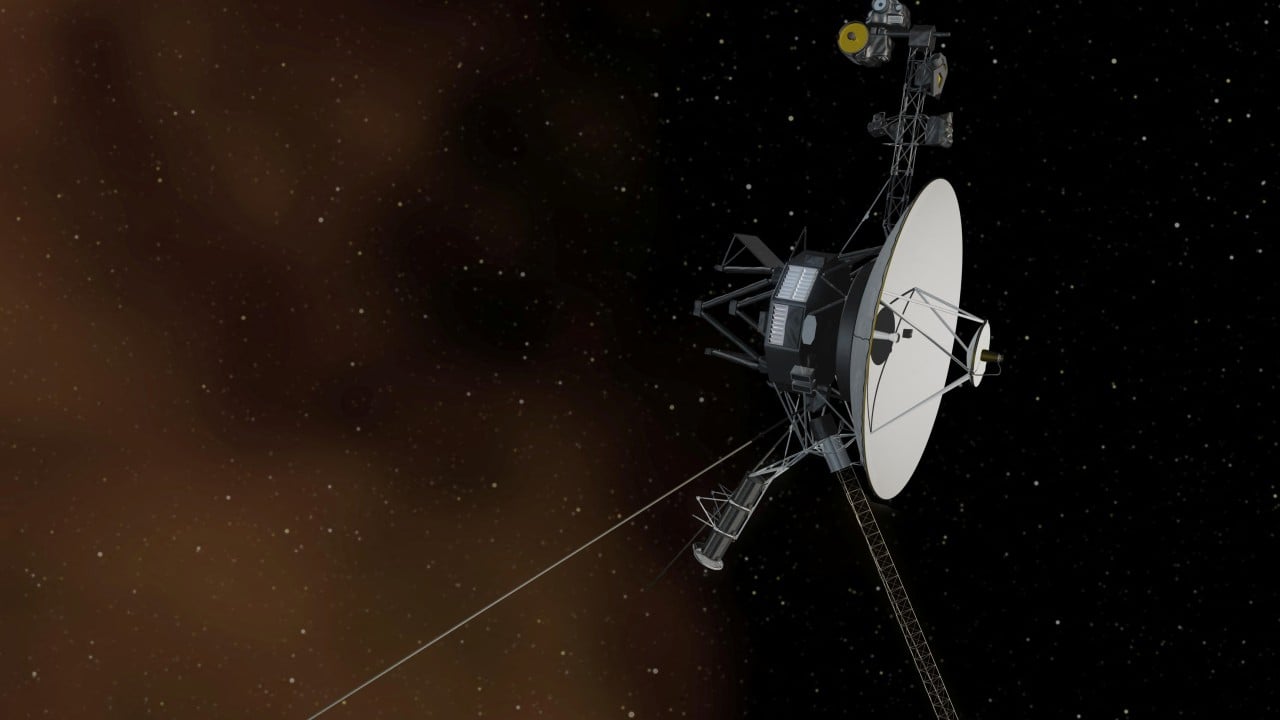
One light-day sounds romantic. It sounds like poetry. It sounds like a headline written by someone who has never done the math on orbital mechanics or read a single telemetry log from the Deep Space Network.
Voyager 1 is not "phoning home" like a college kid calling from a payphone on spring break. It is whispering a faint, 23-watt radio carrier across roughly 25 billion kilometers of interstellar space, where the signal strength hitting Earth's 70-meter dishes measures around $10^{-16}$ watts. That is a fraction of a watt so small it makes a static shock look like a lightning bolt. Calling that a casual phone call is lazy journalism dressed up in awe.
The standard press-release narrative treats distance as the whole story. Reach a milestone. Slap a light-time label on it. Congratulate humanity.
Wrong metric. Wrong framing. Wrong question.
The Lazy Consensus Around Distance
When space writers talk about Voyager 1 hitting a light-day from Earth, they treat distance like a scoreboard. Bigger number means bigger triumph. Twenty-four hours for a photon to travel one way means forty-eight hours for a round-trip command and response. That makes for a neat hook. It also misses almost everything that actually makes the mission extraordinary.
Distance in space is cheap if you have time and a trajectory that avoids burning up your propellant. Any dumb rock—or dead probe—keeps moving once you point it outward and give it enough velocity to escape the Sun's gravity well. Newton took care of that part centuries ago.
What is hard is not going far. What is hard is staying alive, staying pointed, staying powered, and making sense decades after your design life expired.
Voyager 1 launched in 1977 on a mission designed to last through the planetary encounters of Jupiter and Saturn. Four years. Maybe five if the engineers got lucky. Instead, it has been operating for nearly half a century on radioisotope thermoelectric generators whose plutonium-238 fuel decays on a steady 87.7-year half-life. Every year, thermal output drops. Every year, thermocouple degradation trims electrical power. Every year, engineers have to shut down heaters or instruments just to keep the remaining lights on.
Celebrating "one light-day" while ignoring that a 1970s computer with roughly 69 kilobytes of total memory is still surviving in the cold dark is like cheering a marathon runner solely because they crossed a painted line, while ignoring that they are running on a fractured tibia with a 1970s pacemaker.
Light-Time Is a Latency Trap, Not a Triumph
Let's look closely at what one light-day actually does to operations.
A one-way light time of roughly 24 hours means a round-trip time of about two days. You send a command at noon on Monday. It reaches the spacecraft around noon on Tuesday. If the spacecraft executes it and transmits a reply immediately, that reply reaches Earth around noon on Wednesday.
That sounds dramatic. In practice, deep-space engineering has dealt with multi-hour and multi-day communication delays for decades. Engineers do not sit at a joystick flying Voyager 1 like a remote-control car. Sequences are uplinked in batches, vetted rigorously on ground testbeds, and executed autonomously by the onboard fault protection and command systems.
Even more importantly, a light-day is a human-scale benchmark imposed on a non-human regime. Light moves at approximately 299,792 kilometers per second in a vacuum. One light-day is roughly 25.9 billion kilometers. By comparison, the average distance from Earth to the Sun—one astronomical unit—is about 149.6 million kilometers, and light takes roughly eight minutes and twenty seconds to cross it.
Passing one light-day is a neat coordinate marker on a timeline. It does not suddenly rewrite the laws of electromagnetism or turn a routine telemetry pass into a miracle. The miracle happened decades ago when trajectory designers used gravity assists—pioneered in astrodynamics work championed by figures like Michael Minovich and executed across the outer planets by Jet Propulsion Laboratory teams—to sling the spacecraft outward without needing impossible amounts of rocket fuel.
The Real Question You Should Be Asking
People search for whether Voyager 1 can still talk to Earth, how long its battery will last, or what happens when it reaches one light-day. Those are surface questions. They treat the spacecraft like a gadget whose battery meter is blinking.
The better question is this: Why are we still squeezing priceless scientific and engineering lessons out of hardware that predates personal computers as most people know them, while our ability to sustain deep-space architecture remains fragile and budget-bound?
I have spent years watching organizations in high-stakes technical fields burn millions on shiny new platforms that cannot survive their first real stress test. Legacy systems get mocked right up until the moment they outlast the flashy replacements. In aerospace, longevity is earned through ruthless mass budgets, radiation-hardened design, fault tolerance, and disciplined operations—not marketing buzzwords.
When Voyager 1 suffered memory corruption in its flight data subsystem and began beaming back repetitive, garbled telemetry instead of coherent scientific and engineering data, the story wasn't "oh no, it's a light-day away." The story was an aging engineering team digging through decades-old code and hardware schematics, figuring out how to relocate critical routines in limited memory, and restoring clean data from billions of kilometers out.
That is real engineering. Distance is just geometry.
Dismantling Common Misconceptions
"Is Voyager 1 out of power and running on fumes?"
No, and calling it "fumes" gets the physics backwards. Voyager 1 does not run on chemical fuel for electricity. It uses three radioisotope thermoelectric generators (RTGs) that convert heat from the natural radioactive decay of plutonium-238 into electricity.
There is no switch you flip to refill it. Decay is inevitable. Electrical output has been declining steadily for decades, forcing engineers to turn off non-essential heaters and carefully manage power draw so the remaining core systems do not freeze or brown out. It isn't running on fumes; it is running on a shrinking, predictable budget of nuclear heat.
"Does being one light-day away mean it has left the solar system?"
Not in every definition, and conflating the two creates confusion. In space science, "leaving the solar system" depends on which boundary you draw.
If you define the boundary by the reach of the Sun's gravitational dominance—the outer edge of the Oort cloud—Voyager 1 is nowhere close. It will take thousands of years just to reach the inner edge of the Oort cloud and tens of thousands of years to pass through it.
If you define it by the heliosphere—the bubble of solar wind and magnetic field blown outward by the Sun—Voyager 1 crossed the heliopause in August 2012, entering interstellar space. Passing a light-day mark is a measure of light travel time and distance, not a new physical boundary crossing.
"Can NASA just send a software update to fix whatever breaks?"
Think about what you are asking. Uplink bandwidth to a distant probe is tiny. Memory on board is microscopic by modern standards. Every bit sent up takes time, Deep Space Network antenna allocation, and verification against catastrophic failure modes.
Imagine a scenario where a modern smartphone app pushes a 500-megabyte update over a fiber connection in two seconds. Now picture trying to modify code on a decades-old spacecraft where a single misaddressed instruction or unexpected power spike can put the craft into safe mode or sever its lock on Earth. You don't casually "patch" Voyager 1. You nurse it.
The Heavy Hitters and the Downsides of Being Contrarian
Any serious look at outer-planet exploration owes a massive debt to the pioneers who proved gravity-assist trajectories worked and to the generations of Jet Propulsion Laboratory engineers and scientists—from early mission architects to principal investigators like Ed Stone, who led the Voyager project for decades—who kept the mission coherent across changing leadership, shifting priorities, and aging hardware.
Still, let's be honest about the downside of taking a hard, contrarian stance on milestones like "one light-day."
A contrarian critique can sound cynical if you push it too far. Milestones matter to public imagination. Most people do not wake up excited about thermocouple degradation curves, parity bits, or plasma wave instruments. They wake up excited because a human-built machine is so far away that light itself takes a full day to make the trip. If you strip away all wonder in the name of pedantic precision, you win the argument and lose the audience.
That is the trap of pure contrarianism. The fix is not pretending distance is meaningless. The fix is keeping the wonder while refusing to let cheap metaphors replace real understanding.
What Actually Works Instead of Hype
If you want to understand—or build—things that endure in brutal environments, stop worshipping vanity milestones and start looking at failure modes.
- Design for graceful degradation, not peak perfection. Assume parts will age, drift, and fail. Build redundancy and fallback states before you need them.
- Respect your power and resource envelope early. Every extra watt, line of bloat, or unnecessary dependency compounds over time. In deep space—or in any constrained engineering system—discipline at the start buys years of life at the end.
- Measure progress by capability retained, not just distance covered. Going far means very little if you go deaf, blind, or unresponsive along the way. Keeping a signal clear and meaningful across vast space beats simply drifting further into silence.
Distance is a number on a ruler. Survival across decades of deep cold and radiation is a triumph of discipline. Stop cheering the ruler and look at the machine that refused to die.