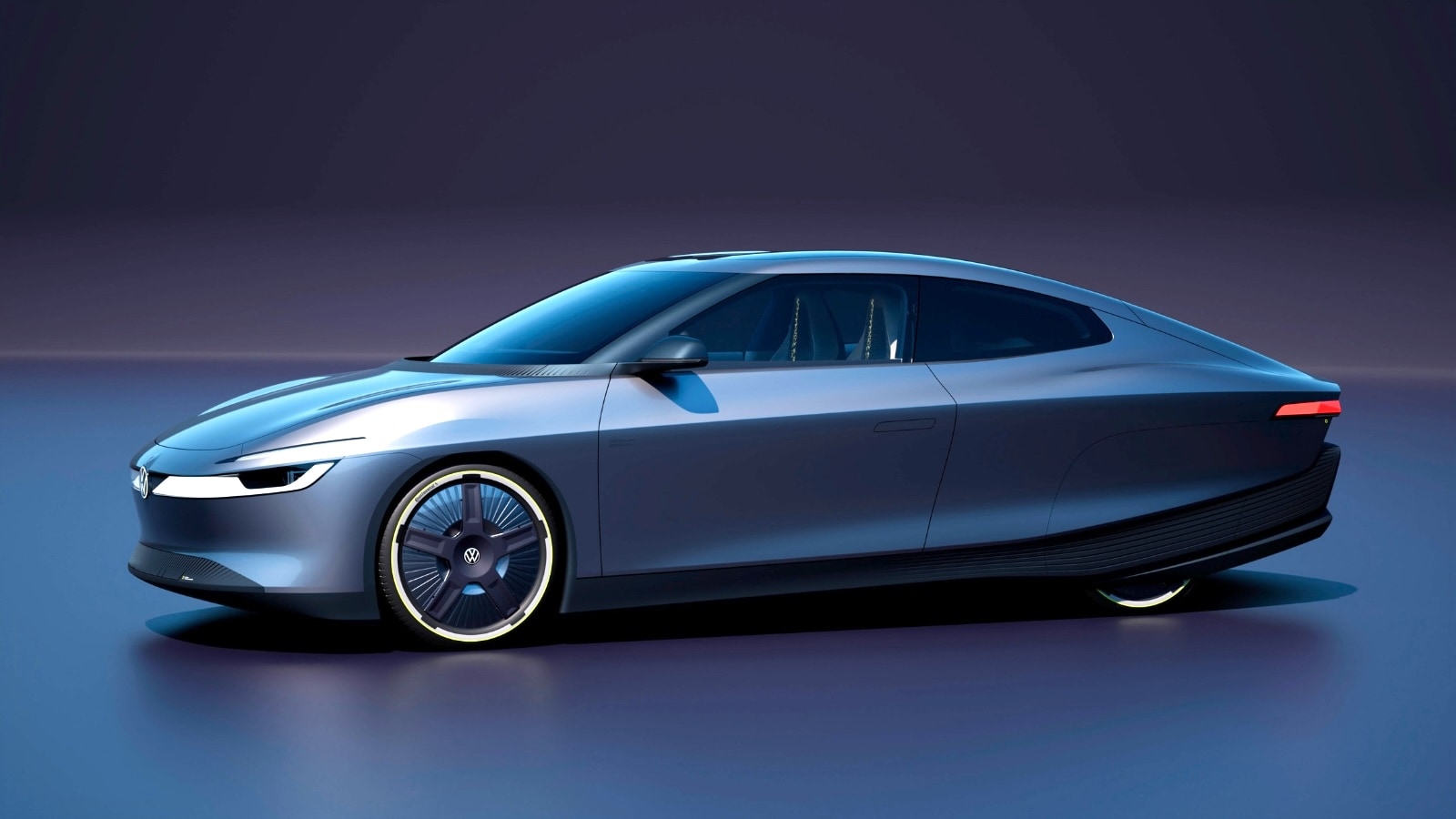
Efficiency has become the ultimate marketing shield in the automotive industry. Whenever a legacy manufacturer struggles with software bugs, high production costs, or slowing adoption curves, engineers roll out a concept car designed to rewrite the laws of physics. The latest entry in this grand tradition is Volkswagen’s ultra-efficient concept, a machine boasting an astonishing 821-kilometer range on a single charge, integrated solar panels on its roof, and foundational electronics borrowed directly from the upcoming ID Polo architecture.
It is a technical marvel on paper. It is also a ghost built to distract you from the messy reality on factory floors.
Beneath the sleek aerodynamics and the promise of solar-assisted commuting lies a fundamental tension that defines modern mobility. The engineering teams in Wolfsburg know how to optimize drag coefficients and wring every last milliamp-hour out of a lithium-ion pack. What corporate leadership has struggled to figure out is how to manufacture those breakthroughs at a price point ordinary drivers can afford without bleeding money on every unit sold.
Let us look closely at what Volkswagen has actually achieved. The vehicle extracts maximum mileage through obsessive mass reduction and a silhouette shaped by wind tunnels rather than consumer vanity. The inclusion of ID Polo components suggests that this technology is meant to trickle down into high-volume, compact segments rather than remaining an unobtainable supercar. That is the good news.
The inconvenient truth is that range anxiety has largely been solved for urban and suburban drivers through high-speed charging infrastructure. What remains unsolved is the cost equation. Integrating photovoltaic roof panels adds manufacturing complexity and modest daily energy yields that struggle to justify the upfront capital expenditure in overcast European or North American climates. When you calculate the actual payback period for solar skin on an automobile, it reads more like an expensive luxury option than a mass-market savior.
Automotive journalism often falls into the trap of treating concept cars as immediate precursors to showroom floors. That is a mistake. Concepts are trial balloons sent up to gauge regulatory reaction, investor sentiment, and consumer appetite. By showcasing an 821-kilometer range, Volkswagen is sending
Volkswagens 821 Kilometer Battery Breakthrough Exposes the Dirty Secret of Modern Electric Vehicles
technology
Efficiency is the single metric that the automotive establishment has systematically avoided discussing for over a decade. While marketing departments hyperventilate over acceleration times that scramble internal organs and screens large enough to outfit a home theater, the underlying engineering problem of the electric vehicle has festered. Range anxiety was never about the battery being too small. It was always about the vehicle being too heavy, too bloated, and entirely too inefficient.
Volkswagen has finally broken cover with a concept architecture that achieves an astonishing 821 kilometers of total range on a single charge. This milestone was not reached by bolting an absurdly massive, heavy, and environmentally destructive battery pack into the floorpan. Instead, the vehicle achieves this metric through a ruthless engineering purge of parasitic electrical losses, structural weight, and aerodynamic drag, all while incorporating advanced solar skin technology and the foundational electronics platform originally engineered for the mass-market ID Polo.
Yet, beneath the polished corporate presentation at Wolfsburg, this concept car highlights an uncomfortable reality for legacy automakers. The technology required to make electric vehicles truly practical already exists on test benches. The real obstacle keeping cars like this out of showrooms is not physics, but profitability, supply chain vulnerabilities, and the entrenched corporate hesitation to cannibalize lucrative internal combustion inventory.
The Weight Trap That Broke the Industry
For years, the dirty secret of the electric vehicle transition has been the brute-force method of engineering. If an engineer needed 500 kilometers of real-world range, the traditional response was simple. Just add more lithium-ion cells.
This approach created a feedback loop of structural obesity. Larger batteries required reinforced crash structures. Reinforced structures added hundreds of kilograms of mass. Increased mass demanded larger electric motors, heavier suspension components, and wider tires to handle the load. A standard family crossover now frequently tips the scales past two metric tons. Moving that much dead weight requires immense amounts of energy, creating a heavy reliance on high-capacity charging infrastructure that remains unevenly distributed globally.
Volkswagen’s new aerodynamic efficiency study shatters this paradigm by focusing heavily on mass reduction and low drag coefficients. By stripping hundreds of pounds of unnecessary structural redundancy and adopting the scaled-down modular componentry derived from the upcoming ID Polo platform, the vehicle manages its energy budget with precision. The car slips through the air rather than bludgeoning its way past it.
The integrated solar roof serves a functional purpose rather than acting as an expensive aesthetic gimmick. On a clear day, the photovoltaic cells embedded across the upper surface can harvest enough ambient energy to supplement auxiliary cabin systems, reducing the parasitic drain on the main propulsion pack during urban commutes. It is an acknowledgment that every single watt matters when the goal is genuine long-distance utility without an environmentally burdensome battery footprint.
The Economics of Efficiency
Engineering a hyper-efficient vehicle in a clean-room laboratory environment is entirely different from mass-producing it profitably on an assembly line. This is where the shadow of the ID Polo architecture looms large over the entire project.
The mainstream automotive market currently faces a severe cost crunch. Raw material expenses for battery-grade nickel, cobalt, and lithium fluctuate wildly, while consumer demand cools under the pressure of macroeconomic uncertainty and high interest rates. Legacy manufacturers built their business models on high-margin luxury SUVs and large crossovers. Shifting industrial capacity toward lightweight, highly optimized small-to-medium platforms requires a complete tear-down of existing factory floors.
Volkswagen's use of ID Polo-derived tech indicates a pragmatic pivot. The company cannot afford another software debacle or cost overrun of the magnitude that plagued the early rollout of the ID family. By utilizing scalable, cost-optimized electronics and simplified battery management systems from their lower-segment programs, they are attempting to engineer a path toward margin parity.
If an automaker can deliver 821 kilometers of range using a fraction of the raw materials required for a heavy flagship sedan, the unit economics change dramatically. Less lithium per vehicle means insulation from supply chain shocks. It means lower shipping weights across rail and cargo networks. It means a product that actually scales globally.
The Infrastructure Myth
The conversation surrounding electric vehicle adoption remains distorted by an obsession with ultra-fast charging corridors. Governments and energy companies pour billions into high-voltage direct current chargers along major highways, treating them as the ultimate cure for range anxiety.
This infrastructure-first mentality ignores the fundamental inefficiency of the underlying vehicles. When cars demand 350-kilowatt charging speeds just to replenish massive, energy-hungry battery packs, the strain on local electrical grids becomes unsustainable. Utilities face transformer overloads, substation upgrades, and soaring peak-load pricing.
A vehicle that pushes efficiency to the extreme alters the equation entirely. When energy consumption drops below sustainable thresholds—measured in exceptionally low kilowatt-hours per hundred kilometers—the dependency on ultra-fast, high-stress charging infrastructure decreases. Vehicles can charge slower, draw less current, and rely on simpler destination charging or residential setups. The solar integration on the roof provides a localized buffer, chipping away at daily charging requirements without ever plugging into the grid.
Yet, transitioning the broader industry toward this efficiency-first ethos faces institutional inertia. Dealership networks have spent decades conditioned to sell size, power, and visual bulk. Convincing a showroom floor to pivot toward lightweight efficiency requires dismantling deeply ingrained consumer expectations that bigger always equals better.
The Road From Concept to Reality
Concepts like this Volkswagen milestone often serve two distinct purposes. Externally, they act as marketing instruments designed to signal technological leadership to nervous investors. Internally, they function as battlegrounds where engineering teams test the absolute limits of corporate willingness to innovate.
The components are no longer theoretical. The aerodynamics are wind-tunnel proven. The software architecture is tethered to the production-bound ID Polo ecosystem. The solar skin is commercially viable at scale. The missing piece is not technical capability. It is executive courage.
Automakers are trapped between the immediate need to satisfy quarterly earnings reports through the sale of high-margin, heavy vehicles and the long-term imperative to build sustainable, ultra-efficient transport for a resource-constrained future. Every month delayed in bringing lightweight architectures to production makes the legacy fleet more vulnerable to agile competitors who treat efficiency as a mandatory baseline rather than an optional concept exercise.
The blueprint for the next generation of electric mobility is already sitting on the drawing boards in Wolfsburg and beyond. Whether it stays there as a monument to what could have been, or rolls off the line to redefine the highway, depends entirely on whether the industry can unlearn the heavy habits of its past.