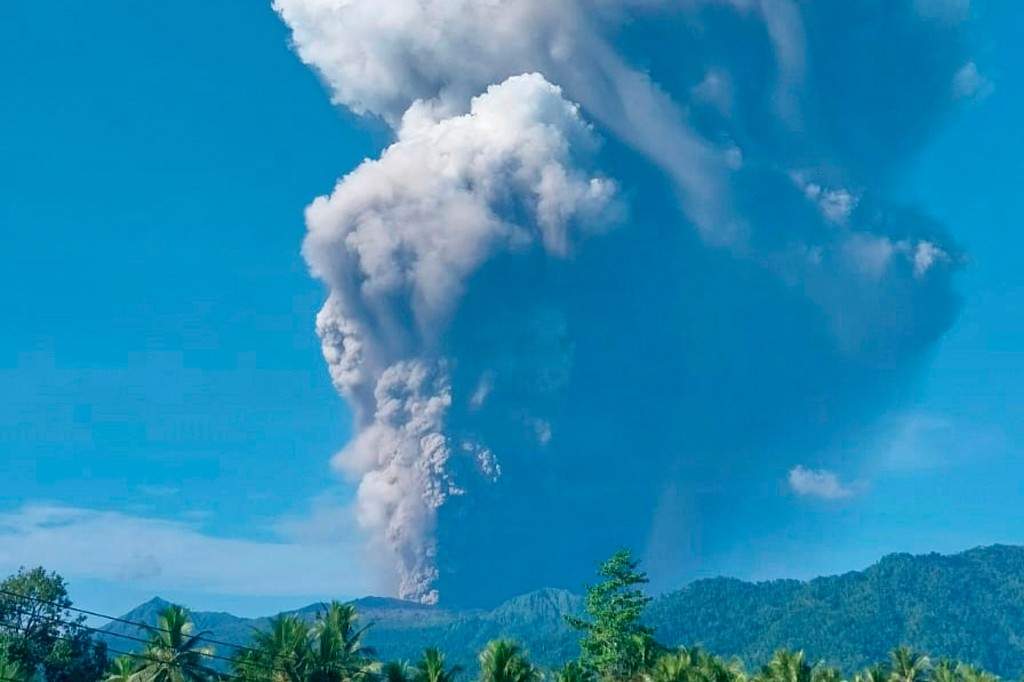
The fatal incident at Mount Dukono in North Maluku, Indonesia, underscores a persistent failure in high-risk recreational management: the gap between perceived geological stability and the reality of stochastic volcanic behavior. When three hikers perished following a sudden eruptive event, the breakdown did not occur solely at the moment of the explosion. The failure was systemic, rooted in the miscalculation of "quiet" periods and the psychological erosion of exclusion zone authority. In volcanic environments characterized by persistent activity, the danger is not the eruption itself, but the compression of the escape window to near-zero.
The Mechanics of Phreatic and Strombolian Volatility
Mount Dukono is one of Indonesia's most active volcanoes, characterized by near-constant Strombolian activity—relatively low-level eruptions consisting of basaltic lava fragments and gas. However, the hazard profile of such a volcano is rarely linear. The transition from routine venting to a lethal event involves two primary mechanisms that hikers and local guides often underestimate.
- Phreatic Overpressurization: This occurs when groundwater or rainwater interacts with hot volcanic rock or magma. The resulting steam expansion happens at supersonic speeds. Unlike magmatic eruptions, which may show seismic precursors (inflation or tremors), phreatic bursts can occur with almost no warning. For a hiker standing on the crater rim, the time between the first audible "crack" and the impact of ballistic fragments is often less than three seconds.
- Ballistic Trajectory Radius: The "lethal zone" is defined by the volcano’s ability to eject incandescent blocks (tephra). At Dukono, these blocks can reach sizes comparable to small vehicles. The kinetic energy of a falling block, combined with its thermal mass, makes survival within a 500-meter radius of the vent statistically improbable during an active pulse.
[Image of the anatomy of a Strombolian eruption]
The Normalization of Deviance in High-Hazard Tourism
The tragedy at Dukono reveals a classic organizational behavior pattern known as the "Normalization of Deviance." This occurs when people become so accustomed to a high-risk environment that they stop perceiving the risk as abnormal. Because Dukono "always" erupts in small ways, the local culture surrounding the climb shifted from caution to complacency.
This decay of safety protocols follows a predictable decay function:
- Initial Threshold: An exclusion zone is set (e.g., 3 kilometers).
- Observation Phase: Hikers observe others entering the zone without consequence.
- Risk Re-calibration: The "safe" line is mentally moved closer to the crater based on a lack of recent fatalities, rather than geological data.
- Catastrophic Alignment: A standard deviation in eruptive intensity occurs while human density is at its highest in the red zone.
The three hikers were caught in this alignment. The local authorities had maintained a Level II (Alert) status, which explicitly prohibited climbing within a specific radius of the crater. The breach of this boundary is a data point in a larger trend where "dark tourism" incentives—the desire for high-impact social media content—outweigh the perceived probability of a low-frequency, high-impact event.
Quantifying the Escape Window
To understand why the fatalities occurred, one must analyze the physics of the summit area. The "Escape Window" is the time required for a human to exit the lethal ballistic radius compared to the time it takes for volcanic ejecta to travel from the vent to the impact point.
$$T_{escape} = \frac{D_{safe}}{V_{human}}$$
Where $D_{safe}$ is the distance to a topographical barrier or the edge of the ballistic zone, and $V_{human}$ is the velocity of a hiker over rugged, ash-covered terrain. In high-altitude volcanic environments, $V_{human}$ drops significantly due to loose tephra and steep gradients.
Conversely, the time of flight for a volcanic block ($T_{flight}$) is governed by initial velocity and gravity. When $T_{flight} < T_{escape}$, the hiker is in a state of terminal risk. At the Dukono crater rim, the distance to safety is often several hundred meters of exposed ridge. If an eruption begins, a hiker moving at 1.5 meters per second cannot outrun a ballistic event that concludes in seconds. The survivors of such events are beneficiaries of luck—the statistical distribution of where blocks land—rather than successful tactical retreat.
The Economic and Regulatory Bottleneck
Indonesia’s "Ring of Fire" contains 127 active volcanoes. Managing these requires a sophisticated interplay between the Center for Volcanology and Geological Hazard Mitigation (PVMBG) and local tourism boards. However, several bottlenecks prevent these agencies from effectively protecting lives:
Information Asymmetry
The PVMBG provides scientific data, but the "last mile" of communication—from the agency to the hiker—is often broken. Local porters and guides, whose livelihoods depend on summit access, have a financial incentive to downplay risks. This creates a conflict of interest where the "expert" on the ground is the person least likely to enforce a restrictive safety boundary.
Resource Constraints in Remote Monitoring
While major peaks like Merapi or Sinabung have dense sensor arrays, remote volcanoes like Dukono receive less frequent satellite-InSAR (Interferometric Synthetic Aperture Radar) analysis and have fewer ground-based seismometers. This lack of high-fidelity, real-time data means that "Alert Levels" remain static for months, losing their psychological impact on the public.
Pathological Risk Assessment by Hikers
The profile of individuals who climb active volcanoes during alert periods often matches that of high-sensation seekers. In these cases, traditional "Warning" signs act as a catalyst rather than a deterrent. To mitigate this, the strategy must shift from passive signage to physical or legal barriers.
Hikers often rely on "visual cues" of safety. If the plume is white (mostly steam) rather than grey (ash), they perceive lower risk. This is a scientific fallacy. Some of the most violent phreatic explosions involve clear or white steam plumes right up until the moment the seal ruptures and ejects the crater floor. The hikers at Dukono likely saw a "routine" plume and assumed the volcano was in a steady state.
Operational Recommendations for Volcanic Regions
The Dukono fatalities demand a shift in how volcanic tourism is managed in Indonesia and globally. Relying on "personal responsibility" in a landscape that generates unpredictable lethal force is an inadequate strategy.
- Geofencing and Digital Enforcement: Integrating exclusion zones into GPS-based hiking apps. If a user crosses a digitized Level II boundary, they receive an immediate, high-frequency alert on their mobile device.
- Mandatory Licensed Escorts with Radios: Prohibiting solo or unguided climbs is insufficient if guides are not integrated into the national seismic warning network. Real-time telemetry from PVMBG should be transmitted directly to handheld units carried by every registered guide on the mountain.
- Physical Barrier Engineering: At specific "bottleneck" points on the trail, physical markers and shelters (reinforced bunkers) should be established. If a hiker is within the ballistic zone, their only hope is a hardened structure.
The strategy for navigating Mount Dukono, or any active Strombolian system, must be predicated on the assumption that the volcano is always in a pre-eruptive state. The moment a hiker views an active vent as a "spectacle" rather than a pressurized vessel is the moment the probability of a fatality begins to climb.
The final strategic pivot for regional authorities is the implementation of steep fines and mandatory insurance for hikers entering restricted zones. By internalizing the cost of potential rescue and recovery operations into the hiker's upfront decision-making process, the "thrill" of the summit is weighed against a concrete financial and legal penalty, providing a necessary counter-weight to the psychological allure of the crater rim.