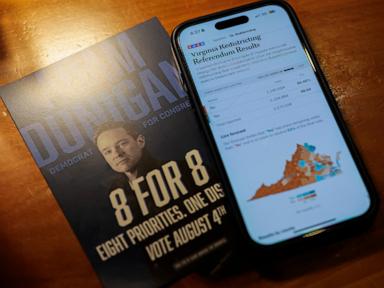
The Virginia Supreme Court didn't just "overturn" a measure. It exposed the fundamental delusion of modern political reform: the idea that you can take the politics out of politics.
Everyone is crying foul. The pundits are screaming about "democratic backsliding" and the death of non-partisan oversight. They are wrong. They are mourning a ghost. The Virginia redistricting commission was a hollow vessel from day one, designed by people who prefer the aesthetics of fairness to the reality of power.
If you think a committee of "independent" citizens and polarized legislators was ever going to draw a map that pleased everyone, you don't understand how geography and voting blocks actually function. The court's intervention isn't a glitch. It is the system finally admitting that "neutrality" in map-making is a mathematical and sociological impossibility.
The Myth of the Neutral Line
Reformers love to talk about "compactness" and "community interest" as if these are objective metrics. They aren't. They are Rorschach tests for whoever holds the pen.
In any redistricting cycle, you have three competing masters:
- The Voting Rights Act (VRA): Protecting minority representation.
- Political Neutrality: The impossible dream of a "fair" map.
- Geographic Reality: People don't live in neat, politically balanced squares.
When the Virginia Supreme Court stepped in, it wasn't an act of judicial overreach. It was an act of clearing the debris. The commission failed because it was built on the "lazy consensus" that good intentions can override partisan self-preservation.
Let’s be clear about the mechanics. When you create a commission that requires bipartisan consensus to pass a map, you aren't creating "fairness." You are creating a veto trap. If the status quo favors one side, that side has zero incentive to agree to a new map. The stalemate isn't a failure of the commission; it's a feature of its design. The court is the only entity with the lack of electoral accountability required to actually draw a line and stick to it.
The Mathematical Trap of Non-Partisanship
Efficiency gaps, mean-median differences, and partisan symmetry scores are the favorite toys of the reform crowd. They believe if the math is "clean," the result is "just."
I have spent years watching consultants burn through six-figure retainers trying to optimize these scores. Here is what they won’t tell you: you can create a map that is perfectly balanced on paper but functionally useless for the people living in it.
Imagine a scenario where you perfectly balance a district by linking a rural farming community with a high-density urban core fifty miles away. On a spreadsheet, that’s a "competitive" 50/50 district. In reality, it’s a district where neither community has a representative who understands their specific needs. By chasing the "neutral" dragon, reformers often end up disenfranchising everyone.
The Virginia court’s decision to take over the process removes the theater. It acknowledges that when two sides cannot agree on how to split the pie, an outside arbiter must simply cut it. The outcry isn't about fairness; it's about the loss of a specific narrative that liberals have used to moralize their legislative goals.
The VRA Paradox
Here is the truth that makes people uncomfortable: strict adherence to the Voting Rights Act often necessitates what reformers call "gerrymandering."
To ensure minority communities have a "functional opportunity" to elect candidates of their choice, you frequently have to draw jagged, non-compact lines. You have to pack voters. You have to "crack" others. You cannot have "pretty" maps and a representative democracy that accounts for historical racial segregation at the same time.
The Virginia commission choked on this reality. Democrats wanted maps that maximized their seat count under the guise of "fairness," while Republicans played the "compactness" card to dilute urban power. Both sides used the VRA as a shield and a sword. The court, by overturning the previous measures, essentially hit the reset button on this hypocrisy.
Stop Trying to "Fix" the Map
The obsession with redistricting reform is a distraction from the real problem: Winner-Take-All elections.
As long as we use single-member districts, someone is going to be "gerrymandered." Whether it’s done by a computer, a commission, or a judge, the act of drawing a line is an act of exclusion. We are fighting over who gets to draw the cage rather than asking why we are in the cage in the first place.
The Virginia Supreme Court didn't "fail" the voters. It showed the voters that the commission was a security blanket—something to make them feel safe while the same power dynamics played out behind the scenes.
The court’s involvement is actually the most "honest" part of the process. It is a raw exercise of power that doesn't pretend to be a community bake sale. If you want a different result, stop looking for "independent" commissions. There is no such thing as an independent person in a political process.
The Cost of the "Fairness" Charade
Virginia spent millions on this experiment. We saw endless public hearings, thousands of submitted comments, and months of "deliberation" that resulted in... nothing. A total deadlock.
That money wasn't spent on democracy. It was spent on a PR campaign for the idea that we can transcend partisanship. We can't. Not as long as the stakes are this high and the geographic divide is this deep.
The court's decision is a cold shower. It's the realization that in the high-stakes game of legislative control, the only "fair" map is the one that someone has the guts to sign off on, regardless of the whining from the losing side.
If you’re angry that the court "overturned" the Democrats' measure, you aren't angry about democracy. You’re angry that your side lost the ability to frame the inevitable partisan outcome as a moral victory.
The lines are drawn. The maps are set. Now, go win an election or shut up.