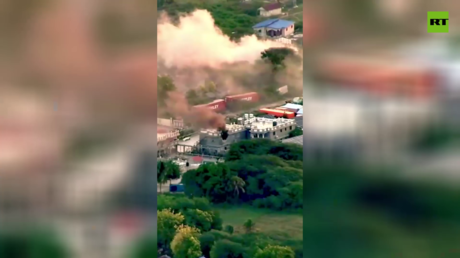
Viral social media clips claiming El Salvador called in a video game style "killstreak" airstrike on a Haitian gang headquarters are completely fabricated. No Salvadoran military aircraft, drones, or special operations units have conducted kinetic strikes inside Haiti. Instead, the footage circulating across X and TikTok combines recycled video game graphics, unrelated military clips, and sensationalized captions designed to exploit public frustration with armed gang violence in Port-au-Prince. While President Nayib Bukele has publicly offered security advice and intelligence support to Haiti, the reality of foreign intervention on the ground involves slow, complex multinational policing rather than Hollywood-style aerial bombardments.
Anatomy of a Viral Hoax
Disinformation moves faster than verification. When a chaotic situation unfolds in a nation with limited press access, the resulting information vacuum invites bad actors to manufacture dramatic narratives for engagement and ad revenue.
The phrase "X killstreak" immediately betrays the origin of the rumor. Borrowed directly from the Call of Duty video game franchise, a killstreak refers to an aerial bombardment or drone strike earned by eliminating a specific number of enemy players without dying. Social media accounts routinely lift thermal imaging footage from tactical shooter games—such as Arma 3 or Call of Duty—apply grainy filters to mimic night-vision optics, and pass the video off as real-world combat. We saw this exact playbook during the early weeks of the Russia-Ukraine conflict, and again during escalations in the Middle East.
In the case of Haiti, the visual ingredients are predictable. Viral posts typically stitch together three distinct elements to fool a scrolling audience:
- Thermal gunship footage pulled from military simulation software or decade-old Middle Eastern conflict archives.
- Audio tracks featuring panicked radio chatter in Spanish or English, often ripped from unrelated police bodycam videos.
- Manipulated captions falsely attributing the operation to the Salvadoran Armed Forces (FAES).
Fact-checkers and open-source intelligence (OSINT) analysts tear these videos apart within hours by examining terrain features, muzzle flash physics, and building architecture. Port-au-Prince has a distinct urban footprint, characterized by dense concrete structures, corrugated metal roofs, and specific mountainous topography surrounding the capital. The viral "killstreak" clips invariably show flat desert compounds, Middle Eastern courtyards, or low-polygon digital trees that do not exist anywhere in the Caribbean.
Why El Salvador Became the Protagonist in Haitian Rumors
To understand why millions of people believed El Salvador launched a unilateral airstrike in Haiti, you have to look at the political brand Nayib Bukele has built over the last five years. Bukele did not just crack down on MS-13 and Barrio 18; he turned state security into a global media spectacle.
Under the state of exception declared in March 2022, Salvadoran security forces arrested tens of thousands of suspected gang members, slashed the country's homicide rate from one of the highest in the world to one of the lowest in the Western Hemisphere, and built the massive Terrorism Confinement Center (CECOT). Bukele's communications team packaged these operations with high-definition cinematography—rows of tattooed prisoners marching in lockstep, heavily armed commandos raiding jungle hideouts, and sleek drone shots of megaprojects.
For citizens living under the terror of armed criminal syndicates across Latin America and the Caribbean, the "Bukele model" became shorthand for instant, uncompromising results.
When Haitian gang coalitions like Viv Ansanm (Live Together), led by figures such as Jimmy "Barbecue" Chérizier, overran critical infrastructure, emptied prisons, and forced the resignation of Prime Minister Ariel Henry in 2024, desperate observers looked outward for a savior. Traditional diplomatic channels looked paralyzed. The United Nations debated resolutions while neighborhoods burned.
Bukele stepped directly into that psychological gap. In March 2024, he posted on X that El Salvador could "fix" the gang crisis in Haiti, provided the international community passed a UN Security Council resolution, granted full authorization, and covered all financial expenses. That single social media post planted a seed in the public imagination. Months later, when El Salvador officially agreed to send a small contingent of security personnel to assist the international mission, online rumor mills twisted a modest advisory deployment into an all-out aerial assault.
The Operational Reality on the Ground in Haiti
Real military logistics are boring, expensive, and heavily constrained by geography and international law. Even if Nayib Bukele wanted to launch a unilateral airstrike on a gang compound in Port-au-Prince, El Salvador lacks the physical capability to pull it off.
Consider the military hardware required for such an operation. San Salvador sits roughly 1,600 kilometers (about 1,000 miles) away from Port-au-Prince across the Caribbean Sea. Conducting an airstrike at that distance requires long-range fighter jets, aerial refueling tankers, or high-altitude, long-endurance combat drones equipped with satellite communication links.
El Salvador operates a small air force geared entirely toward internal security, transport, and counter-narcotics patrols. Its inventory consists primarily of aging Cessna A-37 Dragonfly light attack jets, Bell helicopters, and basic transport planes. None of these aircraft have the operational range to reach Haiti without multiple refueling stops in foreign jurisdictions, nor do they carry the precision-guided munitions seen in viral thermal videos.
Furthermore, the tactical environment in Port-au-Prince makes airstrikes nearly impossible without causing catastrophic civilian casualties. Unlike rural insurgents operating out of isolated mountain camps, Haitian gangs operate inside densely populated urban slums like Cité Soleil, Bel Air, and Martissant. Gang leaders deliberately embed their headquarters among working-class families, schools, and local markets. Dropping heavy ordnance from the sky into a crowded concrete neighborhood would wipe out dozens of innocent bystanders for every armed militant hit, instantly triggering a massive diplomatic crisis and violating the laws of armed conflict.
What El Salvador Actually Committed
The real story of Salvadoran involvement in Haiti is bureaucratic and logistical, not cinematic. Following bilateral agreements and diplomatic coordination with the Organization of American States (OAS) and the United States, El Salvador committed to sending a small contingent of military and police personnel to participate in the Multinational Security Support (MSS) mission.
This mission, led on the ground primarily by Kenyan police officers, operates under a specific UN Security Council mandate. The Salvadoran contribution focuses on:
- Medical evacuation and casualty transport capabilities.
- Intelligence sharing and urban gang-mapping methodologies developed during El Salvador's own domestic crackdown.
- Tactical advising for the Haitian National Police (PNH) to help them reclaim critical ports, airports, and roadways.
No Salvadoran troops are kicking down doors independently, and no Salvadoran aircraft are dropping bombs on Port-au-Prince. Every operational move is subject to strict rules of engagement negotiated between Port-au-Prince, Nairobi, Washington, and San Salvador.
The Structural Differences Between San Salvador and Port-au-Prince
Even if El Salvador deployed its entire army to Haiti, the strategies that emptied the streets of San Salvador would face severe structural roadblocks in Port-au-Prince. Treating gang violence as an identical problem across different countries ignores the underlying mechanics of state capacity.
When Bukele launched his crackdown in 2022, he inherited a functioning, centralized state apparatus. El Salvador had a unified national police force, an intact judicial system that he could quickly purge and reshape, paved highways connecting every municipality, a stable currency (the US dollar), and a tax base capable of funding massive prison construction. Crucially, the gangs in El Salvador—MS-13 and Barrio 18—relied heavily on extortion of local businesses and bus routes. Once the state arrested the street-level collectors and cut off communication from inside the prisons, the gangs' financial arteries collapsed within months.
Haiti presents an entirely different operational nightmare. The state apparatus in Port-au-Prince has been hollowed out over decades of political instability, natural disasters, and systemic corruption.
First, the Haitian National Police is severely outgunned and understaffed. For a population of over 11 million people, Haiti has struggled to maintain even 10,000 active police officers, many of whom have fled the country or abandoned their posts due to unpaid wages and targeted assassinations. In El Salvador, the state outnumbered the gangs; in Haiti, gang coalitions routinely match or exceed local police firepower in contested districts.
Second, the economic model of Haitian gangs is fundamentally different. While they certainly extort local merchants, major Haitian gang leaders control the nation's physical chokepoints. They blockade fuel terminals, tax shipping containers entering the main port, and control the highways linking the agricultural interior to the capital. They do not just prey on the economy; they hold the national supply chain hostage.
Third, the political and paramilitary ecosystem is deeply fractured. In El Salvador, gangs were largely street-level criminal organizations without formal political ambitions. In Haiti, armed groups have historically functioned as the enforcement arms of political elites, business oligarchs, and former security officials. Disarming them requires untangling decades of patronage networks, not just executing mass arrests.
The Engagement Economy Behind Fake Conflict Footage
Why do accounts on X, Telegram, and TikTok continue to push fake military strike videos despite immediate debunking? The answer comes down to platform incentives and algorithmic mechanics.
Social media platforms have shifted toward engagement-based monetization models. On X, verified creators earn direct revenue shares based on the impressions and replies their posts generate. A nuanced breakdown of UN Security Council resolution logistics earns a few dozen likes. A grainy night-vision video captioned "BREAKING: El Salvador wipes out Haitian gang HQ with precision strike" generates millions of views, thousands of outraged or celebratory replies, and an immediate payout for the poster.
This financial incentive creates a self-sustaining ecosystem of war-pornographers. These accounts monitor breaking news feeds for high-emotion keywords—Haiti, Bukele, cartel, airstrike, special forces—and immediately pair them with archived combat footage. By the time community notes or independent journalists attach a fact-check label to the post, the creator has already harvested 90 percent of the algorithmic reach and moved on to the next fabricated headline.
The harm extends far beyond wasted attention. For people living inside Haiti, false rumors of imminent aerial bombardments trigger real-world panic, causing families to flee their homes unnecessarily or disrupting humanitarian aid deliveries. For international observers, these viral myths create a dangerous illusion that complex geopolitical crises can be solved overnight with a single push of a button.
Tracking Real Security Developments Without Getting Played
When major security operations actually occur in Haiti or anywhere else in the region, they leave unmistakable physical and bureaucratic footprints long before dramatic video hits social media. Relying on unverified aggregator accounts guarantees falling for recycled video game clips.
To separate genuine military deployments from algorithmic bait, look for concrete indicators:
- NOTAMs and Flight Tracking Data: Real aerial operations require airspace closures (Notices to Air Missions) and leave digital trails on open-source flight trackers like ADS-B Exchange. Transport aircraft moving troops or equipment into Toussaint Louverture International Airport show up on radar logs hours before any official press release.
- Official Ministry Gazettes: Legitimate foreign deployments require formal legislative approval, status-of-forces agreements, and published budget allocations in the sending country's official government gazette.
- Geolocation Markers: Authentic combat footage from Port-au-Prince will always contain verifiable local landmarks—specific street layouts, Creole signage, local vehicle license plates, or recognizable hillside topography—that independent OSINT researchers can match to satellite imagery within minutes.
Until those verifiable markers appear, any viral clip promising a cinematic "killstreak" solution to Haiti's security crisis is nothing more than a screen recording designed to monetize your attention.