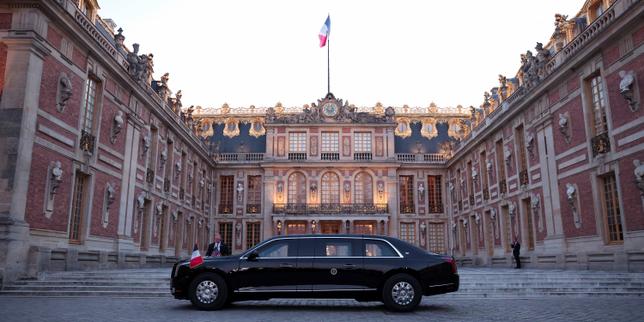
Emmanuel Macron is attempting to anchor a volatile American president-elect to the defense of Europe by turning diplomatic hospitality into a high-stakes geopolitical leverage point. The French President’s decision to host Donald Trump at the Palace of Versailles under the shadow of the ongoing war in Ukraine is not merely a display of European soft power. It is a calculated, desperate bid to prevent Washington from cutting a unilateral deal with Moscow that could dismantle the postwar security architecture of the continent. By framing the conflict not as a localized border dispute but as a direct challenge to Western economic stability, Paris hopes to appeal to Trump’s transactional view of global politics.
The strategy is fraught with immense risk. While Macron aims to position himself as the primary interlocutor between a fractured Europe and a disruptive White House, the foundational assumptions of this diplomatic offensive may already be obsolete.
The Mirage of Personal Diplomacy
Chasing the illusion of personal chemistry with Donald Trump is a path European leaders have walked before. During Trump’s first term, Macron attempted a similar strategy of high-profile engagement, famously inviting the American president to the Bastille Day military parade in 2017. That charm offensive yielded few concrete policy shifts, as Washington proceeded to withdraw from the Iran nuclear deal and impose tariffs on European steel.
The current geopolitical environment leaves far less room for symbolic gestures. Ukraine is facing severe pressure along the Donbas front, and European defense manufacturing is struggling to match Russia’s wartime economic mobilization. In this context, hosting a summit at Versailles carries uncomfortable historical echoes of top-down European partition plans rather than a display of unified Western resolve.
Paris believes that Trump can be persuaded through economic arguments. The French diplomatic corps is preparing briefs that highlight how a Russian victory would destabilize the Eurozone, trigger massive refugee flows, and ultimately harm American commercial interests in Europe. This approach assumes that the incoming administration views global trade and stability through a traditional lens. The reality is that the America First doctrine views European strategic dependence not as a problem to solve, but as leverage to use in trade negotiations.
The European Discord Behind the Façade
Macron’s diplomatic maneuvering exposes deep fractures within the European Union itself. Paris often speaks for Europe without securing the consensus of its continental partners.
- The German Paralysis: Germany’s political leadership remains deeply divided over the scale and nature of military aid to Kyiv. Berlin’s cautious approach directly undermines Macron’s attempts to project an image of a powerful, autonomous Europe capable of managing its own security.
- The Frontline States: Poland and the Baltic nations view Western European diplomatic overtures toward Trump with deep suspicion. For Warsaw and Tallinn, any negotiation that bypasses Ukraine or suggests territorial concessions is an existential threat. They prefer direct bilateral arrangements with Washington over a centralized European response led by France.
- The Orbán Factor: Budapest provides a alternative channel for the incoming US administration. Hungarian Prime Minister Viktor Orbán has established a direct line to Mar-a-Lago, promoting a message of rapid peace at any cost that directly contradicts Macron's insistence on a just settlement for Ukraine.
This lack of internal cohesion ensures that when Trump looks across the Atlantic, he does not see a single, formidable bloc. He sees a collection of middle powers with competing agendas, making it significantly easier for Washington to execute a divide-and-conquer strategy that prioritizes American economic concessions over long-term European security guarantees.
The Real Cost of Strategic Autonomy
For years, Macron has championed the concept of European strategic autonomy—the idea that the continent must develop the military and technological capability to defend itself independent of American power. The Versailles summit inadvertently highlights how little progress has been made toward that goal.
If Europe were truly autonomous, the identity of the occupant of the White House would not dictate the survival of a sovereign state on the European continent. The uncomfortable truth is that European security remains fundamentally dependent on American logistics, intelligence, and nuclear deterrence.
European Ammunition Production vs. Ukraine Demand (Estimated Annual Tons)
[██████████░░░░░░░░░░] European Maximum Output Capacity
[████████████████████] Ukrainian Minimum Operational Requirement
The gap between European rhetoric and material reality is vast. While France possesses a capable military, it lacks the industrial capacity to sustain a high-intensity conventional war without US supply chains. The French defense industry operates on a peacetime footing, optimized for export and boutique interventions rather than the mass production of artillery shells and air defense missiles required in Ukraine.
The Transactional Trap
The danger of engaging Trump on transactional terms is that he may take the deal that offers the most immediate, tangible return for the United States. If the French president frames the Ukraine conflict as a business proposition, Washington can easily reframe the parameters.
A potential American counter-proposal could demand that Europe take over 100% of the financial and military burden of supporting Kyiv in exchange for the US remaining inside NATO. Alternatively, Washington could demand sweeping concessions on agricultural imports and digital taxation, threatening to abandon Ukraine if Europe does not comply. By entering a transactional arena, France risks trading away European economic sovereignty to protect a security umbrella that is already fraying.
Moscow is watching the Versailles summit with a clear understanding of these dynamics. Russian strategy relies on the assumption that Western democratic coalitions are inherently unstable and incapable of sustaining long-term commitments. A visible split between Washington and its European allies over the terms of a ceasefire would be viewed by the Kremlin as a validation of its strategy of attrition.
The coming months will demonstrate whether high-stakes hospitality can alter the trajectory of American foreign policy. If the Versailles gambit fails, it will reveal that Europe’s architectural grandeur cannot mask its geopolitical vulnerability. The continent may soon find itself dealing with a superpower that no longer views the transatlantic alliance as an asset, but as a liability to be liquidated.


