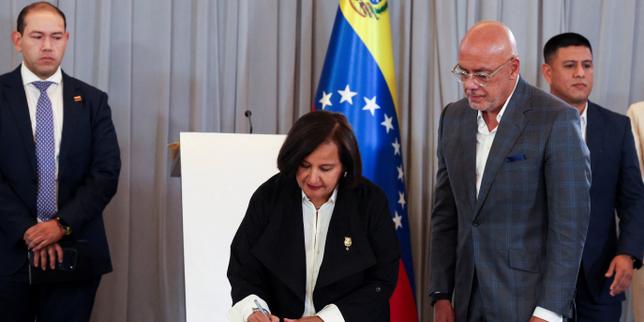
Everybody loves a good redemption story. The media lapdogs eat it up every single time Caracas and its fractured opposition manage to sit in the same room without throwing chairs. When headlines broadcast that the government and anti-regime factions have reached tentative agreement points over overhauling the judiciary, the international commentariat immediately reaches for the champagne. They call it a breakthrough. They call it a thawing of the ice.
They are being naive, or worse, willfully dishonest. For a closer look into similar topics, we recommend: this related article.
I have watched diplomatic theater for two decades. I have seen career bureaucrats blow millions of dollars in donor funds on transitional justice workshops that meant less than the paper they were printed on. Let us strip away the diplomatic varnish and look at the mechanical reality of what is actually happening in Venezuela right now.
This is not a transition to democracy. This is a cartel renegotiating internal turf boundaries. For additional background on this development, in-depth reporting can also be found on BBC News.
The Lazy Consensus Of Dialogue
The standard narrative goes something like this: international pressure works, sanctions bite hard enough to force concessions, and the ruling apparatus is finally bending toward the rule of law because both sides recognize the country cannot function with a captured court system.
It is a comforting illusion. It assumes that authoritarian regimes view the law the same way liberal democracies do as an impartial referee.
They do not. In a patronage state, the judiciary is not an independent branch of government. It is an internal enforcement arm, a collection agency, and a dispute resolution mechanism for competing factions within the ruling coalition. When the government discusses judicial reform with factions of the opposition, they are not debating constitutional separation of powers. They are negotiating quotas. They are discussing who gets to appoint which magistrates to protect private asset portfolios when the music eventually stops.
To understand why this agreement is structurally hollow, you have to look past the rhetoric of constitutional renewal and examine the incentive structures driving the negotiators.
The Anatomy Of A Controlled Concession
Let us run a thought experiment. Imagine a corporate board of directors running a failing monopoly that controls every square inch of the supply chain. The company is broke, international regulators are threatening asset freezes, and disgruntled middle managers are threatening a strike. Does the board surrender control of the auditing department?
Of course not. They offer to expand the board by two seats. They let a vocal critic head up a toothless subcommittee on compliance. They create the appearance of reform while keeping the master keys to the vault firmly in their own pockets.
That is precisely what is happening with the Venezuelan judicial talks.
The regime does not need to yield actual sovereignty over the courts to extract immense value from these negotiations. By merely sitting at the table and agreeing to discuss terms, they achieve three massive strategic victories:
- Sanctions Relief: They create diplomatic cover for sympathetic foreign actors to argue that normalization is underway, justifying the loosening of economic restrictions.
- Opposition Fragmentation: Nothing destroys an anti-establishment coalition faster than participating in institutional processes that legitimize the very system they swore to overthrow. The moment opposition figures start arguing over judicial appointment criteria, they become stakeholders in the regime's survival.
- Buying Time: As long as talks are active, radical disruption is off the table. The clock runs out on street-level pressure.
Why Technical Fixes Fail In Captured Systems
Experts love to talk about institutional design. They write white papers detailing how to draft procedural codes, how to implement merit-based exams for judges, and how to structure tenure guarantees.
All of this assumes a baseline of institutional integrity that simply does not exist.
When you introduce merit-based judicial reforms into a state where power flows entirely through informal patronage networks, the system simply adapts. The patronage networks swallow the new rules whole. The new judges, selected through whatever convoluted bipartisan committee emerges from these talks, will quickly realize that their career longevity depends not on their adherence to procedural law, but on their loyalty to the power brokers who engineered their appointment.
We saw this playbook in other failed transitions across the globe. Institutional engineering without a complete collapse of the underlying power structure is like repainting a sinking ship. It looks sharp for the cameras, but the hull is still full of holes.
The Real Agenda
If the judicial reform talks are not about democracy, what are they actually about?
Asset security and exit strategies.
The political elite on both sides have accumulated staggering amounts of wealth and exposure. Realizing that total victory is impossible for either side, the rational move is risk mitigation. The government wants legal guarantees that its key players will not face asset seizure or international prosecution tomorrow. Certain factions within the opposition want legal pathways to reclaim expropriated property or secure commercial concessions in a post-crisis economy.
This agreement is a mutual insurance policy wrapped in the language of civic renewal.
Does this mean the negotiations are completely useless? Not if you are an insider looking to protect your balance sheet. But if you are waiting for these talks to deliver justice to the average Venezuelan citizen who cannot get a civil dispute heard without paying a bribe, you are looking at the wrong movie.
Stop treating political survival tactics as democratic awakenings. The judiciary will not reform itself because the people running the system benefit from its malfunction.
The house never plays to lose. Stop betting on the dealer.